Before a new hire's first day, collect their signed offer, bank details, RSA PIN and tax ID, and set up their payroll entry. On day one, sign the contract and confirm pension, group life and NSITF cover. Pay the first salary correctly and in full for the days worked. Most onboarding failures in a Nigerian small business are payroll failures: a wrong PIN, a missing contract, pension left until confirmation. This checklist is ordered by time so you can work down it.
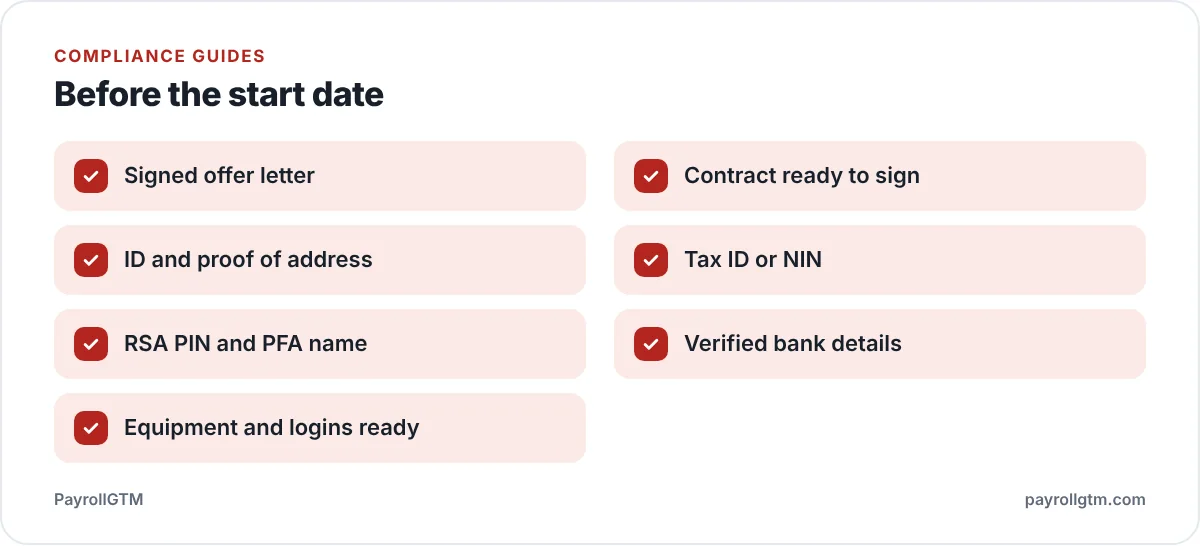
Before the start date
- Send the offer letter. State title, start date, gross pay and its parts (basic, housing, transport, others), probation, hours, reporting line and any conditions such as references. Ask for a signed copy. Our job offer letter template has wording you can copy.
- Prepare the contract. Use the clauses in employment contract essentials. The Labour Act expects written terms within 3 months of starting (s.7), but give them on day one.
- Collect documents. Identity, proof of address, passport photograph, certificates, references, next of kin and tax ID. Individuals can reportedly use their NIN as Tax ID under the unified system, so check the current NRS notice. If they have no tax ID yet, do not hold up the set-up, but close the gap quickly.
- Ask for the RSA PIN and PFA name. If they have none, they open an RSA with a PFA they choose. See how to open an RSA and get a PIN.
- Verify bank details. Account name, number and bank, checked against the person's ID.
- Confirm they are an employee. If the person controls their hours and works only for you, they are probably an employee, not a contractor.
- Prepare equipment, logins and a named manager.
On day one
- Sign the contract and acknowledgements. Contract, handbook receipt, confidentiality terms and a data protection notice.
- Enter the person into payroll. Record each pay component, start date, tax details and PIN. A second person checks the entry against the contract.
- Confirm statutory cover. Pension from the first month (not from confirmation), the employee on your group life policy, and the payroll counted for NSITF at 1% of payroll.
- Explain pay. Pay date, how the payslip reads and who to ask.
- Brief on safety. Exits, first aid and how to report an incident.
In the first week
- Write down objectives for the first 30 days.
- Book training on your tools and processes, and name a buddy.
- Test every login and piece of equipment, and fix gaps the same day.
- Hold a short end-of-week conversation: what is clear, what is not.
- Tell the person the payroll cut-off date so missing details arrive in time.
The first pay run
The first payslip tells a new hire how organised you are. Check that gross matches the contract, pension is on the right base, PAYE is right, and net matches the bank details.
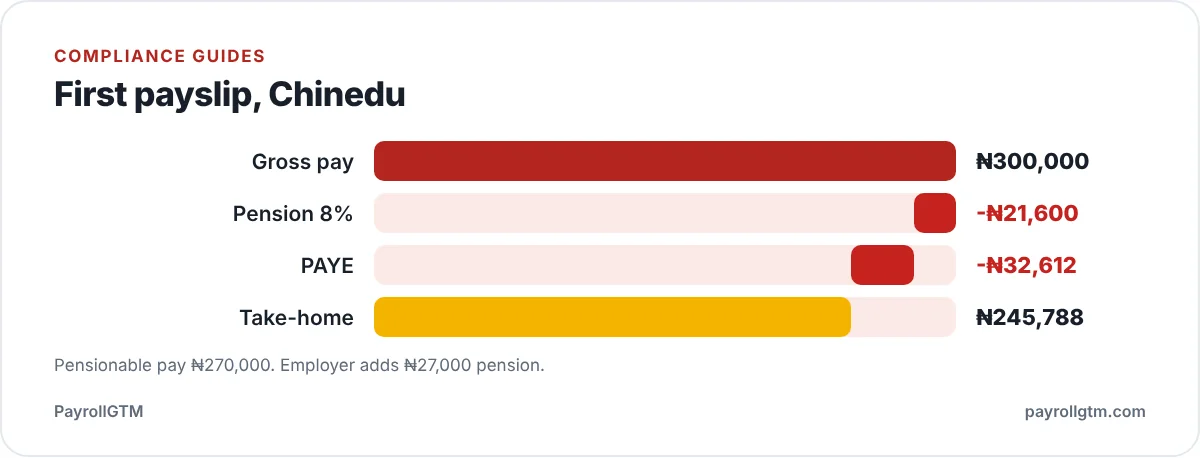
Chinedu is hired on ₦300,000 gross: basic ₦150,000, housing ₦75,000, transport ₦45,000, other ₦30,000. Pensionable pay is ₦270,000, so his 8% is ₦21,600 and his employer's 10% is ₦27,000. Annual chargeable income is (₦300,000 - ₦21,600) x 12 = ₦3,340,800. Tax is ₦0 on the first ₦800,000, 15% on the next ₦2,200,000 (₦330,000) and 18% on the remaining ₦340,800 (₦61,344). That is ₦391,344 a year, or ₦32,612 a month. Take-home is ₦245,788.
If someone joins part way through the month, state your proration method in the offer. Take Hauwa, who starts on the 11th of a 30-day month on ₦300,000: calendar-day proration pays 20 of 30 days, which is ₦200,000. Working-day proration gives a different figure. Either is fair if it is written down and applied to everyone. Pension is then calculated on the prorated pensionable pay. PAYE on a part month depends on how your state IRS wants the annual figure handled, so use the steps in how to prorate salary and confirm with your state IRS.
Afterwards, ask the employee if the payslip made sense and the bank credit matched. A first-month error damages trust more than a later one.
The first 90 days
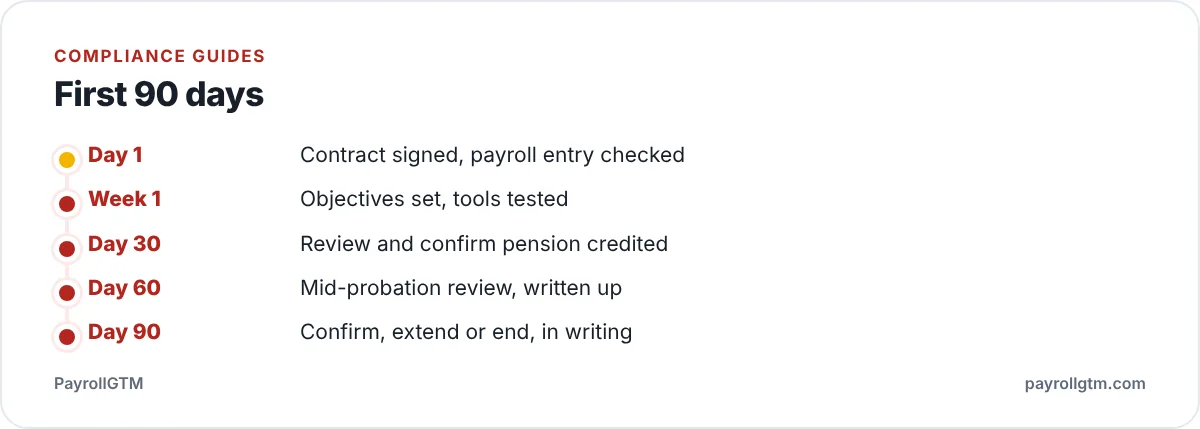
On day 30, review progress and confirm pension was remitted and credited. On day 60, hold a mid-probation review and write it up. On day 90, decide to confirm, extend or end, as the contract allows, and put it in writing. See probation periods in Nigeria. If you extend, state the reason and new end date, and check the contract permits it.
Common onboarding mistakes
- Starting someone without a contract. Pay and notice terms are then undefined.
- Waiting for confirmation before enrolling in pension. Probationers are employees, and the 3-employee rule counts them. Late remittance carries 2% a month (PRA s.11).
- A wrong PIN or account digit. It can leave contributions unallocated or salary in the wrong account for weeks.
- Keying pay components wrongly. Always have a second person check.
- No group life cover. It must be at least 3 times annual total emolument.
Seasonal, short-term and remote hires
Temporary staff are still employees if the relationship looks like employment. Run a short version of the checklist every time: contract, ID and bank details, PIN, safety briefing and a named supervisor. For remote hires, send equipment early, verify identity on video, use e-signature, and write down who pays for data and power. Keep one tracking sheet per hire with dates and initials, and file it in the personnel file for your annual payroll audit. If you are hiring for the first time, see hiring your first employees.
Common questions
Can a new hire start before the contract is signed?
Avoid it. If you must, get a signed offer letter first and issue the contract within days.
Do I deduct pension during probation?
Yes. Probationers are employees, so contributions start with the first salary.
How many documents should I keep?
Only what you need for employment and compliance, in line with the NDPA.