An employer may agree to pay the whole pension contribution so that nothing is deducted from the employee's salary. When that happens the legal minimum for the employer rises from 10% to 20% of the employee's monthly emoluments (at least basic, housing and transport), so the employee's retirement savings account still receives a total at least as large as under the standard 8% plus 10% split.
The effect on the payslip is easy to miss. With no pension deduction, taxable income goes up, so PAYE goes up too, but take-home pay still ends higher. Two worked cases below show the numbers, and a sample contract clause follows.
The rule in plain terms
The Pension Reform Act 2014 applies to employers with 3 or more employees. The standard minimum is 18% of monthly emoluments, with the employee paying 8% and the employer 10%. Where the employer bears the whole cost, the minimum employer contribution is 20%. The extra 2 points are the legal floor, not a company choice. An employer who says "we cover your pension" but remits only 10% is under-paying.
Whichever route you choose, contributions must reach the employee's RSA within 7 working days of paying salaries, as PenCom's guidelines expect, and a late remittance attracts a penalty of 2% of the unremitted amount for each month of delay (s.11). Our page on the remittance deadline and penalty explains how that runs in practice.
Case 1: Hauwa, ₦300,000 gross, ₦250,000 pensionable
Hauwa's pay is ₦150,000 basic, ₦60,000 housing, ₦40,000 transport and ₦50,000 in other allowances. Pensionable pay is therefore ₦250,000. We compare the standard split with the employer-pays-all arrangement.
- Employee pension: 8% of ₦250,000 = ₦20,000. Employer pension: 10% = ₦25,000. Total to the RSA: ₦45,000.
- Chargeable income: (₦300,000 minus ₦20,000) x 12 = ₦3,360,000.
- Tax: first ₦800,000 at 0%; next ₦2,200,000 at 15% = ₦330,000; remaining ₦360,000 at 18% = ₦64,800. Annual PAYE ₦394,800, monthly ₦32,900.
- Take-home: ₦300,000 minus ₦20,000 minus ₦32,900 = ₦247,100.
- Employer cost: ₦300,000 + ₦25,000 = ₦325,000.
- Employer pension: 20% of ₦250,000 = ₦50,000. Employee deduction: nil.
- Chargeable income: ₦300,000 x 12 = ₦3,600,000.
- Tax: ₦0 + ₦330,000 + 18% of ₦600,000 (₦108,000) = ₦438,000 a year, ₦36,500 a month.
- Take-home: ₦300,000 minus ₦36,500 = ₦263,500.
- Employer cost: ₦300,000 + ₦50,000 = ₦350,000.
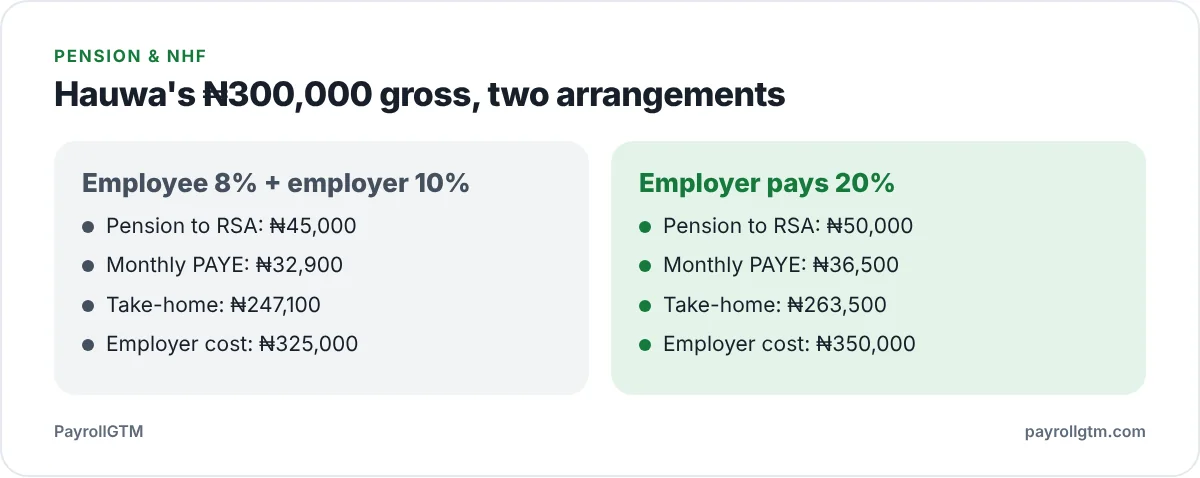
Hauwa's take-home is ₦16,400 higher, her RSA receives ₦5,000 more each month, and the employer spends ₦25,000 more. Her PAYE is ₦3,600 a month higher because she no longer has the ₦20,000 deduction. These figures come from the same method as in our PAYE calculation guide.
Case 2: Segun, ₦120,000, all pensionable
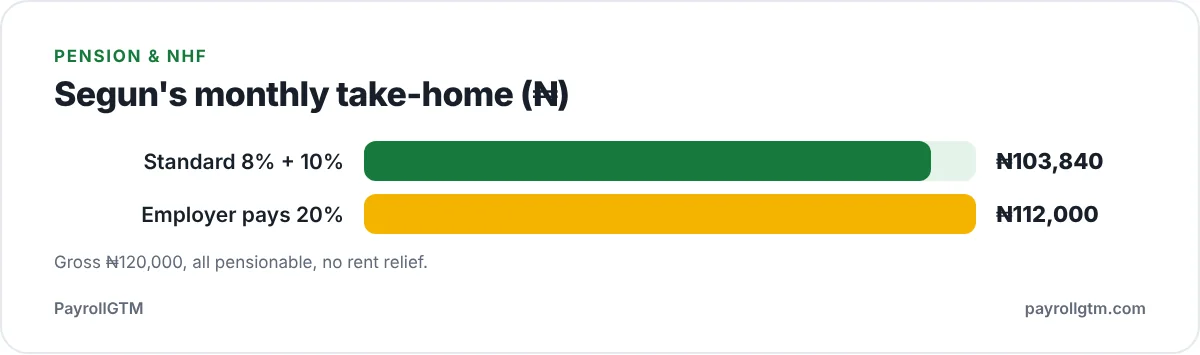
Segun works in a small retail business with a flat ₦120,000 salary, so the entire amount counts for pension.
- Standard split: pension ₦9,600 from Segun and ₦12,000 from the employer. Chargeable income ₦1,324,800, PAYE ₦6,560 a month, take-home ₦103,840. Employer cost ₦132,000.
- Employer pays 20%: pension ₦24,000 from the employer. Chargeable income ₦1,440,000, PAYE ₦8,000 a month, take-home ₦112,000. Employer cost ₦144,000.
Segun is ₦8,160 a month better off in hand, and the employer pays ₦12,000 more. At this salary the arrangement is cheap enough that some small employers use it as a recruitment tool, since the offer reads as "no deductions for pension".
Before you adopt it: a quick cost test
Multiply pensionable pay for every employee by 10% and by 12. That is the extra annual cost against the standard split. For ten people on ₦250,000 of pensionable pay each, it is ₦250,000 a month more in total, or ₦3,000,000 a year. Then add the employer pension you already pay. If that figure is uncomfortable, a middle route is to keep the standard 8% plus 10% and raise gross pay instead. You can price that against the same figure, and it keeps the contract simple, though the employee then pays PAYE on the increase.
When employers choose this route
- To compete for hires. A higher net figure on the offer helps when candidates compare net pay, as they usually do.
- To simplify a payroll. There is one contribution to compute and no employee deduction to explain.
- For specific groups. Some employers do it for senior staff or contract hires on fixed terms. For these categories see pension for contract and casual staff and the differences between casual, fixed-term and permanent staff.
It is not free. The employer carries a permanent extra cost of 10% of pensionable pay compared with the standard split, and moving back to 8% plus 10% later is a change to the employee's terms that needs agreement. Consider it only if the cost fits the budget over years and not months.
How to put it in the contract
State the arrangement in writing, in the offer letter or the contract itself, using words the employee can check against a payslip. A clause along these lines works:
The Company will pay the full pension contribution of 20% of your monthly basic salary, housing allowance and transport allowance into your Retirement Savings Account with your chosen Pension Fund Administrator, within 7 working days of paying salaries. No pension deduction will be made from your salary. If the law requires a different minimum in future, the Company will comply with it.
Pair the clause with the salary breakdown. The guide to salary structure explains how to set the three components, because they decide the pensionable base. Wrong or vague wording is a common cause of later disputes: staff assume 20% of total pay, while the employer remits 20% of basic only.
Questions employees ask about it
Can I still add my own money? Yes. A voluntary contribution on top is allowed and, when properly claimed with evidence, can reduce taxable income.
Does the 20% mean my net pay should have fallen? No. With nothing deducted for pension, your net pay should be higher than a colleague on the same gross who contributes 8%, although PAYE is a little higher. If your payslip still shows an 8% line, ask HR which arrangement applies.
Is the extra 2% mine if the employer changes? What has been paid into your RSA stays in your RSA. Going forward, the employer's obligation is set by the contract and the Act, so the written clause matters.
Mistakes to avoid
- Changing the arrangement mid-year without correcting PAYE. If you switch from the standard split to the employer-pays-all model in July, the earlier months were calculated with a deduction and the later ones without. Make sure each payslip is right for its month. The page on back pay and payroll corrections shows how to fix a month already paid.
- Forgetting to tell the payroll system. Many tools default to 8% deducted. Test one payslip before the run, as set out in the monthly payroll process.
- Treating it as a reason to cut basic pay. Reducing pay to cover the cost changes the employment contract and needs the employee's written agreement.
Our examples leave the employer's contribution out of the employee's gross pay and PAYE base. That is how payslips are normally built, but if you are putting a large figure on a senior package, confirm the treatment with your state IRS or a tax adviser. If an employee later moves, the balance goes with them, and changing PFA does not affect what the employer owes.