
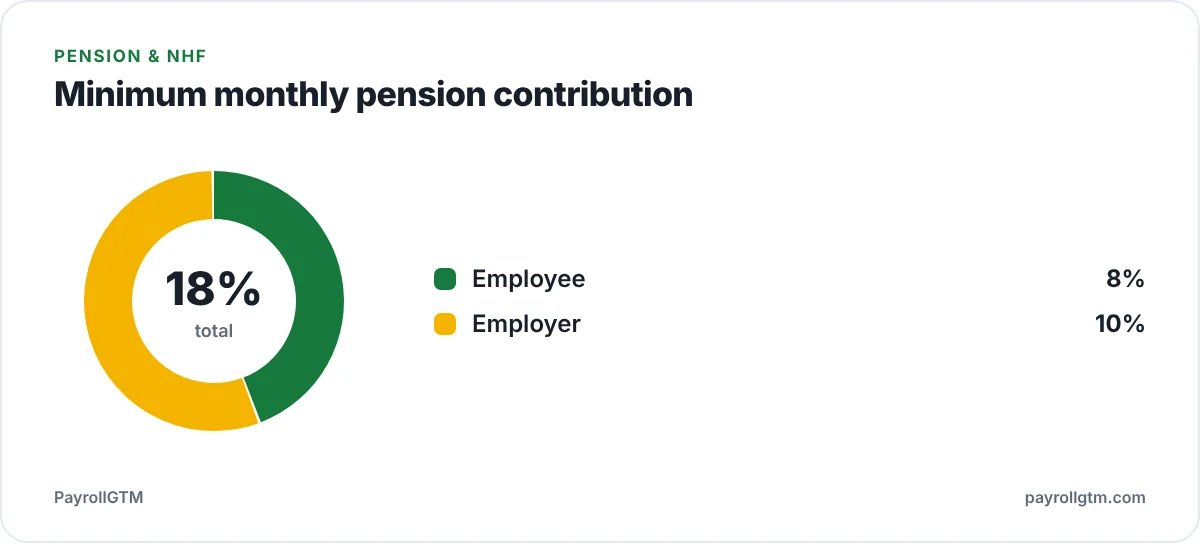
If your business has 3 or more employees, the Pension Reform Act 2014 applies to you. Not 15, whatever an older website told you. You must enrol every eligible employee with a pension fund administrator (PFA), pay in at least 18% of monthly emoluments (8% from the employee, 10% from you), and remit within 7 working days of paying salaries. Miss it and the penalty is 2% of the unremitted amount for each month of delay.
The list below follows the order a new SME owner actually meets these duties, from the first hire to the annual paperwork. Tick them off once, then repeat the monthly items forever.
1. Confirm that the Act applies to you
- Count your employees. At 3 or more, the contributory scheme is compulsory for you. Under 3, you are outside the Act's compulsory rule, though you can still offer pension voluntarily.
- Do not wait for the third hire to "settle in". Reaching three people triggers the duty. If you are close, plan the next payroll with pension in it.
- Edge cases (a director on salary, a part-time worker, a corps member) are where owners guess wrongly. Ask PenCom or a PFA before deciding someone does not count. Our guide to pension for contract and casual staff covers the commonest one.
2. Get every employee an RSA with a PFA
- Ask each person whether they already have a retirement savings account (RSA) and an RSA PIN. Many do from a previous job. They keep the same RSA and the same PFA.
- For first-time workers, they pick a PFA and complete the registration, and you collect the PIN when it is issued. The steps are in how to open an RSA and get a PIN.
- The choice of PFA belongs to the employee, not to you. Do not force the whole office into one PFA because it sent the friendliest account officer. If someone later wants to move, changing PFA is their right.
- Put "RSA PIN and PFA name" on your onboarding form so it is collected before the first salary, not chased in month three.
3. Set the right contribution rate and base
The statutory minimum is 18% of monthly emoluments, and emoluments for this purpose are at least basic salary plus housing allowance plus transport allowance. Anything else in the pay packet (a meal subsidy, a bonus) is outside the minimum base unless you choose to include it.
| Who pays | Minimum rate | Taken from salary? |
|---|---|---|
| Employee | 8% | Yes |
| Employer | 10% | No, paid on top |
| Employer pays everything | 20% (employee pays nothing) | No |
The 20% option is allowed, and some owners offer it as a perk. It has to be written into the contract; read what happens when the employer pays the full 20% before promising it.
A small Ibadan design studio has three staff. Pension is worked on basic + housing + transport only.
| Staff | Gross a month | Pensionable pay | Employee 8% | Employer 10% |
|---|---|---|---|---|
| Kemi (manager) | ₦250,000 | ₦210,000 | ₦16,800 | ₦21,000 |
| Obinna (designer) | ₦150,000 | ₦125,000 | ₦10,000 | ₦12,500 |
| Zainab (assistant) | ₦90,000 | ₦80,000 | ₦6,400 | ₦8,000 |
| Total | ₦415,000 | ₦33,200 | ₦41,500 |
The studio sends ₦74,700 to the PFAs each month. Employees' ₦33,200 is deducted from pay, so the studio's own cost is ₦41,500. Had the studio agreed to pay all of it, the minimum would be 20% of ₦415,000, which is ₦83,000. The same exercise with other salaries is in pension contribution examples by salary.
4. Deduct, then remit within 7 working days
- Deduct the employee's 8% in the payroll run and show it on the payslip.
- Pay the combined amount to each employee's PFA within 7 working days of paying salaries, per PenCom guidelines. If you pay salaries on the 28th, count seven working days from the 28th, skipping weekends and public holidays.
- Send one schedule per PFA: employee name, RSA PIN, pensionable pay, employee amount, employer amount.
- Keep the bank evidence together with the schedule.
The Act's penalty is 2% of the unremitted contribution for each month of delay. On the studio's ₦74,700, one month late is ₦1,494. It sounds small, until a business has quietly skipped six months and the sums stack up, a PenCom compliance certificate is refused, and a tender or contract needs it. The details are in the pension remittance deadline and penalty guide.
5. Buy group life cover and get the tax side right
Separate from pension, the Act requires you to hold group life cover for employees, for at least 3 times annual total emolument, with you paying the premium. For Kemi, whose annual gross is ₦3,000,000, that means cover of at least ₦9,000,000. Insurers usually quote a rate for the whole staff, so ask your broker how they define total emolument and keep the policy schedule. More in the group life insurance guide.
On tax, the employee's pension contribution is deductible before PAYE is worked out, and pension benefits under the Act are tax-exempt. In Kemi's payslip, the ₦16,800 comes off first, then tax is charged on what remains. That is also why a payroll that skips pension overstates PAYE. Use the payroll calculator to see the effect for any salary. Voluntary top-ups by an employee can also be deducted when properly claimed, but they are the employee's choice and not part of your compliance duty.
6. Keep these documents
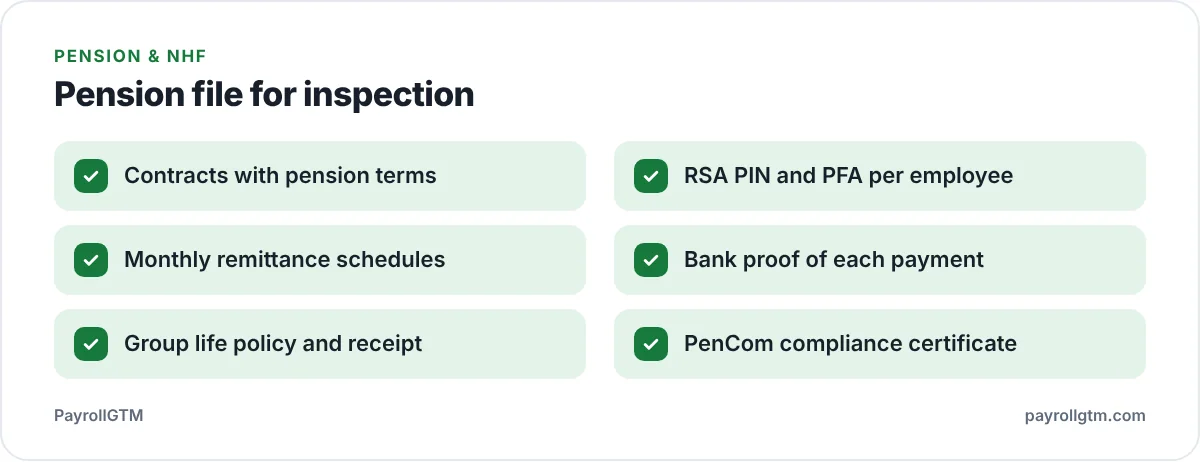
- Signed employment contracts that state the pension terms.
- Each employee's RSA PIN and PFA name.
- Monthly remittance schedules and proof of payment.
- The group life policy and latest premium receipt.
- Your PenCom compliance certificate, once you apply. See how to get it.
Having these in one folder is also what saves you when a compliance review or a client's vendor check lands unannounced. For the wider list of registrations a new business faces, use the registered-business basics guide.
7. Avoid the mistakes that cost SMEs money
Four patterns come up again and again in small offices.
- Pension on basic salary only. The owner reads "8%" and applies it to basic. If Obinna's basic is ₦70,000 but his pensionable pay should be ₦125,000, the 8% is ₦5,600 instead of ₦10,000, and the employer's 10% is short by ₦5,000 every month. Over a year that is a ₦60,000 gap for one person on the employer side alone, before the PFA or PenCom adds anything.
- Deducting but not remitting. Cash is tight in March, so the staff deductions sit in the business account. This is the worst version, because the money belongs to the employees.
- No RSA PIN, so no remittance. A PFA cannot credit a contribution to a person it cannot identify. Chase the PIN in week one, not month three.
- Treating group life as optional. It is a separate requirement, and a claim after a death is the worst time to learn the policy lapsed.
8. Run a monthly routine
- Run payroll and fix the pensionable pay column for any starter, leaver or salary change.
- Export the PFA schedules and check the totals against the payroll journal.
- Pay the PFAs and save the proof of payment with the schedule.
- Note the seventh working day on your calendar when salaries are paid, not when you remember.
- Once a quarter, check that each PFA has acknowledged your contributions on the employees' RSAs.
If you outgrow the spreadsheet, the same steps sit inside any decent payroll package; see the first-year payroll compliance guide for how they fit with PAYE and the other levies.
The rules above are the statutory minimums. How PenCom treats a specific borderline case, or what a given PFA needs from you for a bulk upload, is something only they can confirm. Start at pencom.gov.ng or phone your PFA's corporate desk.