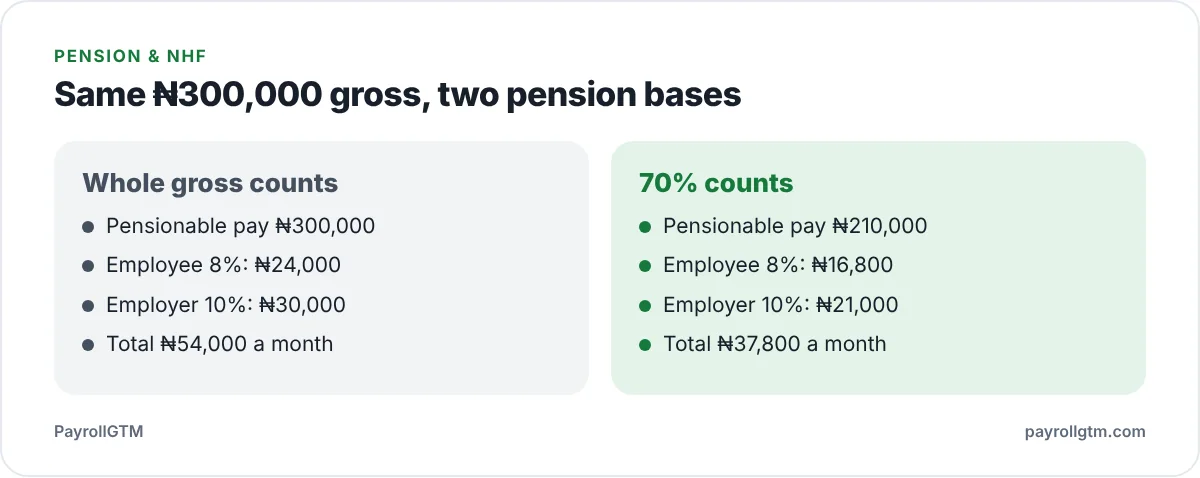
On a monthly gross of ₦300,000 where the whole amount counts as pensionable pay, the employee pays ₦24,000 (8%), the employer pays ₦30,000 (10%), and ₦54,000 goes into the employee's retirement savings account every month. If only 70% of the gross is basic, housing and transport, the same salary produces ₦37,800 a month instead.
That gap is the whole reason this page has two tables. Which one matches your payslip depends on how your pay is split, and the split decides what lands in your RSA. For the formula and its legal background, see how pension contributions are calculated. This page is for looking up a figure.
Table 1: the whole gross is pensionable
Use this one if your employer calculates pension on your total monthly pay, which is common where the salary is a single consolidated figure. The minimum is 8% from the employee and 10% from the employer.
| Monthly gross | Employee 8% | Employer 10% | Total 18% | Total for 12 months |
|---|---|---|---|---|
| ₦100,000 | ₦8,000 | ₦10,000 | ₦18,000 | ₦216,000 |
| ₦150,000 | ₦12,000 | ₦15,000 | ₦27,000 | ₦324,000 |
| ₦200,000 | ₦16,000 | ₦20,000 | ₦36,000 | ₦432,000 |
| ₦250,000 | ₦20,000 | ₦25,000 | ₦45,000 | ₦540,000 |
| ₦300,000 | ₦24,000 | ₦30,000 | ₦54,000 | ₦648,000 |
| ₦400,000 | ₦32,000 | ₦40,000 | ₦72,000 | ₦864,000 |
| ₦500,000 | ₦40,000 | ₦50,000 | ₦90,000 | ₦1,080,000 |
| ₦600,000 | ₦48,000 | ₦60,000 | ₦108,000 | ₦1,296,000 |
| ₦800,000 | ₦64,000 | ₦80,000 | ₦144,000 | ₦1,728,000 |
| ₦1,000,000 | ₦80,000 | ₦100,000 | ₦180,000 | ₦2,160,000 |
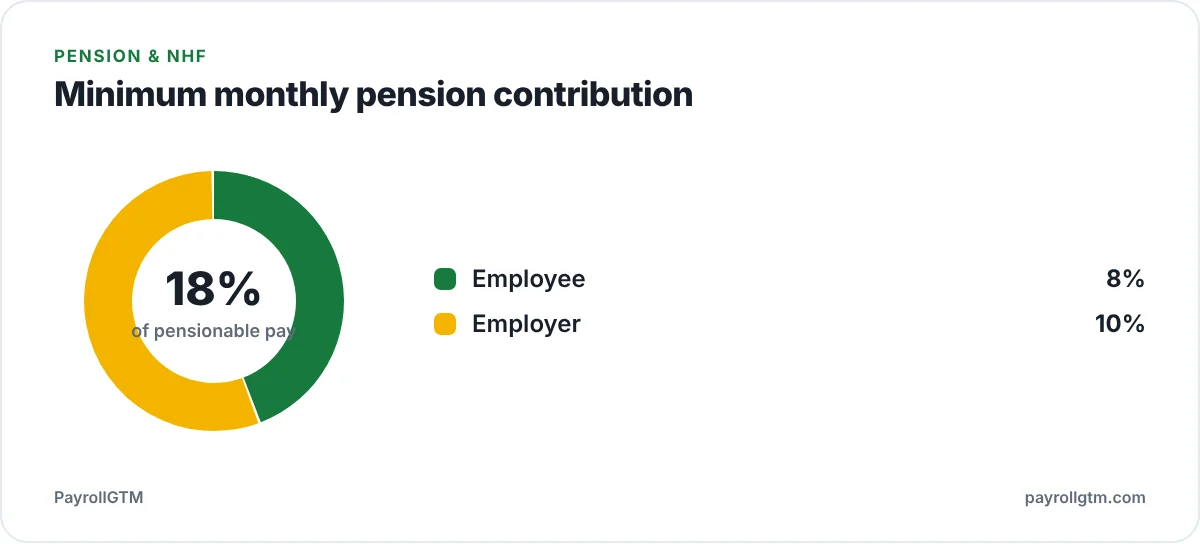
Table 2: only 70% of the gross is basic, housing and transport
Many payrolls add "utility", "meal", "wardrobe" or "responsibility" allowances on top of the three core components. The legal minimum base is basic plus housing plus transport, so those extras can sit outside it. Here we assume 70% of gross is pensionable. Your own ratio will differ, so replace the percentage with your payslip figures.
| Monthly gross | Pensionable pay (70%) | Employee 8% | Employer 10% | Total 18% | Total for 12 months |
|---|---|---|---|---|---|
| ₦100,000 | ₦70,000 | ₦5,600 | ₦7,000 | ₦12,600 | ₦151,200 |
| ₦150,000 | ₦105,000 | ₦8,400 | ₦10,500 | ₦18,900 | ₦226,800 |
| ₦200,000 | ₦140,000 | ₦11,200 | ₦14,000 | ₦25,200 | ₦302,400 |
| ₦250,000 | ₦175,000 | ₦14,000 | ₦17,500 | ₦31,500 | ₦378,000 |
| ₦300,000 | ₦210,000 | ₦16,800 | ₦21,000 | ₦37,800 | ₦453,600 |
| ₦400,000 | ₦280,000 | ₦22,400 | ₦28,000 | ₦50,400 | ₦604,800 |
| ₦500,000 | ₦350,000 | ₦28,000 | ₦35,000 | ₦63,000 | ₦756,000 |
| ₦600,000 | ₦420,000 | ₦33,600 | ₦42,000 | ₦75,600 | ₦907,200 |
| ₦800,000 | ₦560,000 | ₦44,800 | ₦56,000 | ₦100,800 | ₦1,209,600 |
| ₦1,000,000 | ₦700,000 | ₦56,000 | ₦70,000 | ₦126,000 | ₦1,512,000 |
Put the two tables side by side for ₦300,000 and the difference is ₦16,200 a month, or ₦194,400 a year, in the employee's retirement savings. An employee who spends 30 years on a pay package built like Table 2 collects noticeably less than a colleague on the same gross built like Table 1. The rights employees have under the Pension Reform Act include checking that the base is at least the legal minimum.
Which table is your payslip?
- Find the three lines on your payslip: basic, housing, transport.
- Add them. If the total is your whole gross, use Table 1. If it is smaller, use Table 2 logic with your own total in place of 70%.
- Multiply that total by 8% and compare it with the "pension" deduction on the payslip.
- Multiply the same total by 10% to get what your employer should add.
An employer may choose to base pension on a wider pay figure than the minimum. That is allowed and some contracts do it. What an employer cannot do is use a base lower than basic, housing and transport. Our guide to how to structure basic, housing and transport explains why the split is also a tax decision.
Reading your RSA statement against the tables
Your pension fund administrator (PFA) sends statements for your retirement savings account, and the layout differs from one PFA to another, so we will not describe a standard format. What you can do with any statement is check three things for each month.
- The amount credited. It should equal 18% of your pensionable pay, which is the "Total 18%" column above.
- The date of the credit. The employer is expected to remit within 7 working days of paying salaries. A credit that arrives months late is a breach even if the amount is right.
- The month the credit relates to. Several months paid together in one lump is a warning sign that remittances are being delayed.
The rule of thumb: if the credit is not 18% of a base you can identify, ask which base is being used. Do not accept "that is what the system calculates" as an answer. If you do not yet have an account, the steps for opening an RSA and getting a PIN come first.
What a pay rise does to the pension line
Pension moves with pay, so the tables double as a quick way to see the effect of a raise. If Bola's basic salary goes up by ₦50,000 a month and housing and transport stay the same, her pensionable pay rises by ₦50,000. Her own 8% rises by ₦4,000, the employer's 10% rises by ₦5,000, and her RSA gains ₦9,000 more a month, or ₦108,000 a year. She sees only the ₦4,000 on her payslip. The ₦5,000 is the employer's cost and never shows as pay.
The same logic works against an employee when an employer moves a raise into an allowance outside the pension base. Take-home pay looks better this month, but the RSA grows more slowly. Neither choice is wrong, and each should be made knowingly.
The employee's 8% is also deducted before PAYE is calculated, so it lowers taxable income. On ₦300,000 a month the ₦24,000 in Table 1 means ₦288,000 a year is removed from the tax base.
Why your balance is not just the totals added up
The "total for 12 months" column is money paid in. Your RSA balance will usually differ because the PFA invests the fund and credits returns, which can be positive or negative from year to year, and because the fund may also carry fees. So a balance below the sum of the credits is not automatically a missing contribution, and a balance above it is not a gift. When you test for missing money, compare contributions month by month, not the headline balance. Ask your PFA for the contribution history if the statement only gives a running total.
Things that change the numbers
- Employer pays everything. Where the employee contributes nothing, the employer's minimum becomes 20% of pensionable pay. That case is covered in when the employer pays the full 20%.
- Fewer than 3 employees. The Act applies to employers with 3 or more employees. A very small business may be outside it, though many join voluntarily.
- Contract and casual staff. Short engagements still count where the person is an employee, as explained in pension for contract and casual staff.
- Voluntary top-ups. An employee can contribute more than 8%, and an approved voluntary contribution can reduce taxable income when properly claimed.
- Changing PFA. Your balance moves with you. See how to change your PFA.
If you run the payroll, the tables also show the employer cost of the 10%: for ₦400,000 on Table 1 that is ₦40,000 a month on top of salary. An employer checking readiness for a compliance certificate should read how the PenCom compliance certificate works and the pension compliance guide for small businesses.