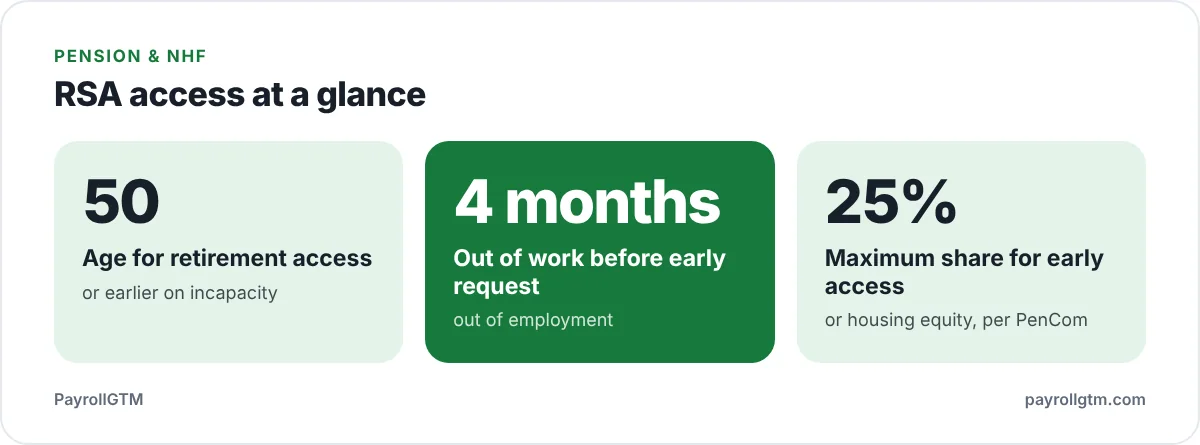
You can start drawing your pension from age 50 once you have retired from employment, or earlier if you retire on medical grounds. The money comes from your retirement savings account (RSA) and is paid in one of three ways: programmed withdrawal, an annuity, or a lump sum taken from whatever exceeds the amount needed to fund your income. Pension benefits under the Pension Reform Act (PRA) are tax-exempt. Exact thresholds and paperwork are set by the National Pension Commission (PenCom) and can change, so get the current position from your pension fund administrator (PFA) before deciding.
Where the money comes from
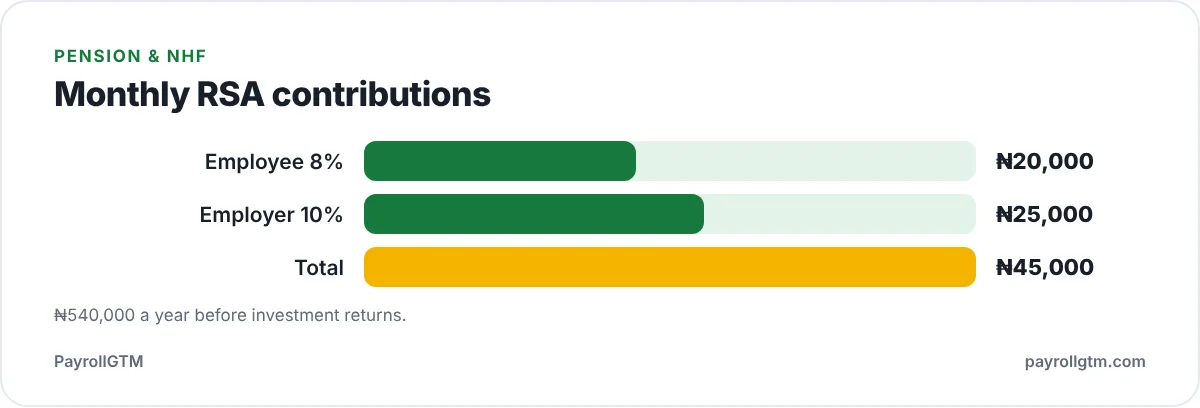
Under the Contributory Pension Scheme, the benefit is whatever sits in your RSA: your 8% contribution, your employer's 10%, any voluntary contributions, and the investment returns. This is different from the old formula tied to final salary and years of service. Contributions are what you get back, so missing months hurt. On a pensionable pay of ₦250,000 a month, the minimum contribution is ₦20,000 from the employee plus ₦25,000 from the employer, so ₦45,000 a month and ₦540,000 a year before returns. Our pension contribution examples by salary show other pay levels.
When can you access your RSA?
The general rule is retirement from employment from age 50, or earlier on incapacity (with documents). Someone who stops work at 45 cannot simply cash out at retirement, which is why the early-access rules below exist. PenCom guidelines also let you use part of the balance for a home. See the 25% rules for housing and unemployment for details.
The three ways to be paid
Programmed withdrawal
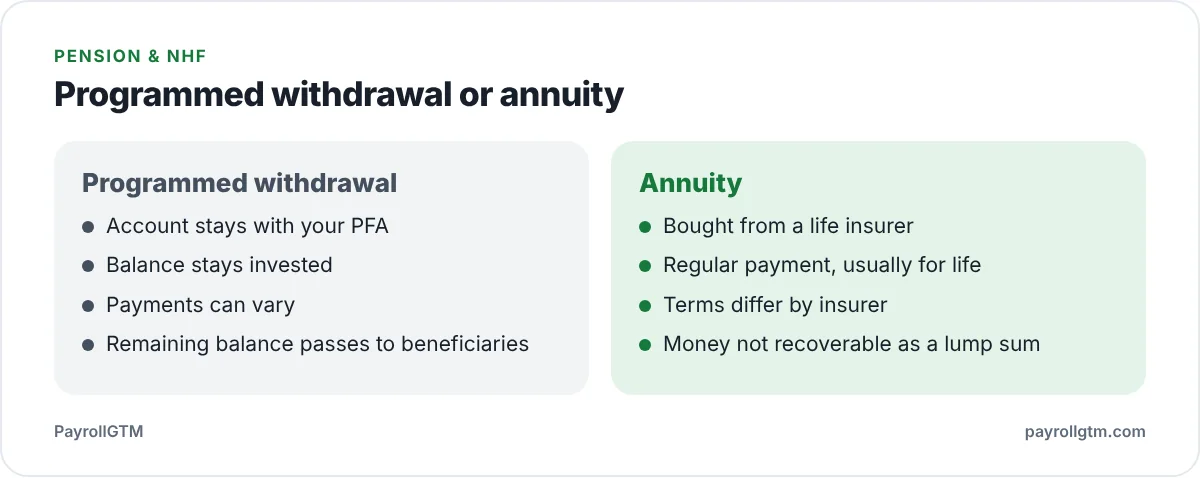
You keep the account with your PFA and receive monthly or quarterly payments. The amount is worked out from your balance and an estimate of the years you have left. The rest stays invested, so the balance can grow, but payments can change as the balance and the assumptions change. You still own what remains, and it passes to your beneficiaries.
Annuity
You use part of the balance to buy a regular payment from a licensed life insurance company, usually for life. The advantage is certainty: it keeps coming however long you live. The trade-off is flexibility, since the money used is generally not recoverable as a lump sum. Terms differ between insurers, so ask for written quotes from at least two.
Lump sum
You may be able to take a lump sum, but only from the amount above what PenCom's rules say is needed to fund your income through programmed withdrawal or an annuity. A small balance may leave little or nothing available as a lump sum.
Suppose a retiree has ₦12,000,000 in the RSA and the PFA's calculation says ₦8,000,000 is needed to fund the minimum income. The retiree might be able to take the remaining ₦4,000,000 as a lump sum. The real requirement depends on PenCom's rules, your age and the assumptions in force at the time, so ask your PFA for a written illustration.
What if you lose your job before 50?
A contributor who has been out of work for 4 months may request up to 25% of the RSA balance. The rest stays invested until retirement. Expect to give your PFA a termination letter or a declaration, and confirm the current procedure with them. The provision is deliberately limited, because the purpose of the account is retirement income. See also what happens to your pension when you leave a job.
Check the account while you are still working
Most retirement problems start years earlier, with a gap nobody noticed. Ask your PFA for a statement at least once a year and look for three things: a credit for every month you worked, your name and RSA PIN spelt correctly, and an employer contribution that matches 10% of your pensionable pay. If a month is missing, tell your employer in writing first. Employers must remit within 7 working days of paying salaries, and a late payment attracts a penalty of 2% of the unremitted amount for each month of delay (PRA s.11). The PenCom compliance certificate is one way an employer shows its remittances are up to date.
Also check who you have named as beneficiaries. A nomination made at your first job and never updated can leave a former partner on the form while your current family is not. Your PFA can tell you how to change it.
Tax on pension benefits
Benefits paid under the Pension Reform Act are tax-exempt, and your own 8% contribution is deductible when you pay PAYE. Voluntary top-ups can also reduce taxable income when properly claimed. This is one reason to start early: the money is not taxed on the way in or the way out. Whether a particular payment counts as a pension benefit (rather than, say, a gratuity from your employer) depends on its source, so ask your state IRS or a tax adviser where it is not clear.
What happens when a contributor dies
The RSA balance goes to the beneficiaries under the Act and your nominations. Where the employer holds group life insurance, which must cover at least 3 times annual total emolument, the insurer pays an additional sum. That is why employees should keep nominations up to date and employers should keep the policy in force. See the group life rule.
How employers can help staff nearing retirement
- Start early. Two or three years before, invite the employee to review the RSA statement with their PFA.
- Check the record. Confirm every month of contribution was remitted and credited. Fixing gaps is easier now than at exit.
- Prepare documents. A retirement letter, a service record and confirmation of final pay.
- Explain what is separate. Accrued leave, any gratuity the contract promises and final salary are not paid from the RSA. See how final settlement is calculated.
- Do not give investment advice. Send the employee to the PFA and, if needed, an independent adviser.
Questions to settle before choosing
The choice is hard to reverse. Ask how long the money must last (a healthy 60-year-old may need income for 30 years), what other income exists, who depends on you, and how inflation will affect a fixed payment over 20 years. Then ask your PFA and at least two insurers for written illustrations, so you compare real figures. If you want to raise the balance before you retire, voluntary contributions are one route. For a plain account of how RSAs and PFAs work, read RSAs and PFAs explained.