Yes, you can change your pension fund administrator (PFA) in Nigeria. Your RSA balance moves from the old PFA to the new one and your RSA PIN stays the same, because the PIN belongs to you, not to the PFA. The request is made through the PFA you are moving to, and PenCom sets how often a transfer is allowed, so the first thing to ask any PFA is when the current transfer window is.
The questions below are the ones employees actually bring to HR before they switch. Where the exact rule is set by PenCom and may change, we say so and tell you who to ask, rather than quote a date we cannot verify.
Why do people change PFA?
The usual reasons, in the order we hear them in offices, are these.
- Service. Statements that never arrive, a helpline nobody answers, an app that cannot show the last remittance. When an employee is trying to confirm that an employer has paid, poor service is a real cost.
- Returns. Funds are invested by the PFA and the returns differ between PFAs and between fund types. Past performance is not a promise, so treat a one-year league table with caution.
- Fees. PFAs charge for managing the fund. Ask the fee in writing before and after you move, and what it is charged on.
- Convenience. A branch near your office, or a colleague group that has moved together.
- Exit from a PFA that has had trouble. If your PFA is in the news for the wrong reasons, call PenCom as well as the new PFA.
Moving because a friend said so is a poor reason. Moving because your PFA cannot tell you what you hold is a good one.
What moves, and what stays the same?
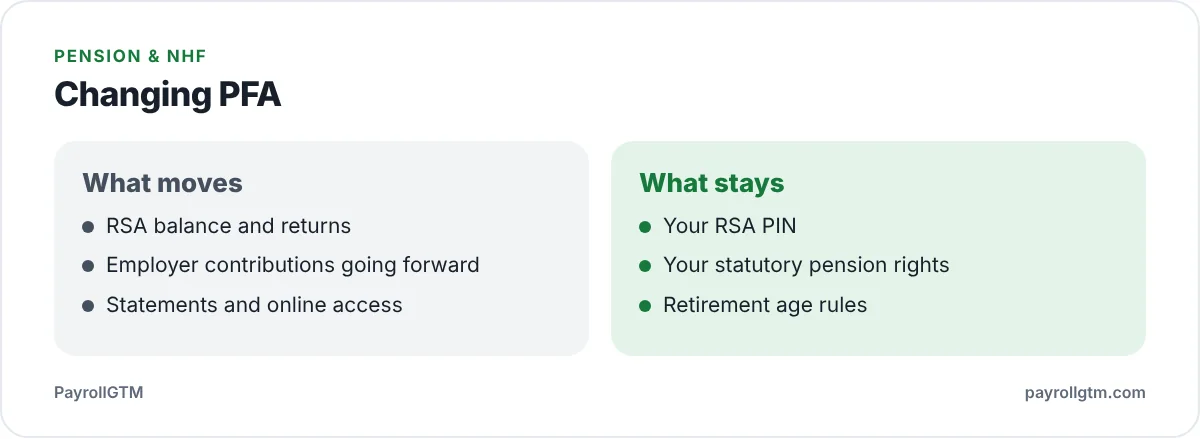
Your whole RSA balance is meant to move: the contributions made so far, with the returns they have earned. Your RSA PIN, which employers quote on every remittance, stays. Your employer's contributions after the switch go to the new PFA once HR has updated the details.
| Item | After a transfer |
|---|---|
| RSA balance | Moves to the new PFA |
| RSA PIN | Stays the same |
| Employer's future contributions | Go to the new PFA once HR is told |
| Your retirement age and rights | Unchanged; they come from the law, not the PFA |
| Fund type chosen | Ask the new PFA to confirm which fund you are placed in |
The statutory rights you hold as an employee, including your right to choose a PFA, are covered in employee rights under the Pension Reform Act.
How does the transfer work?
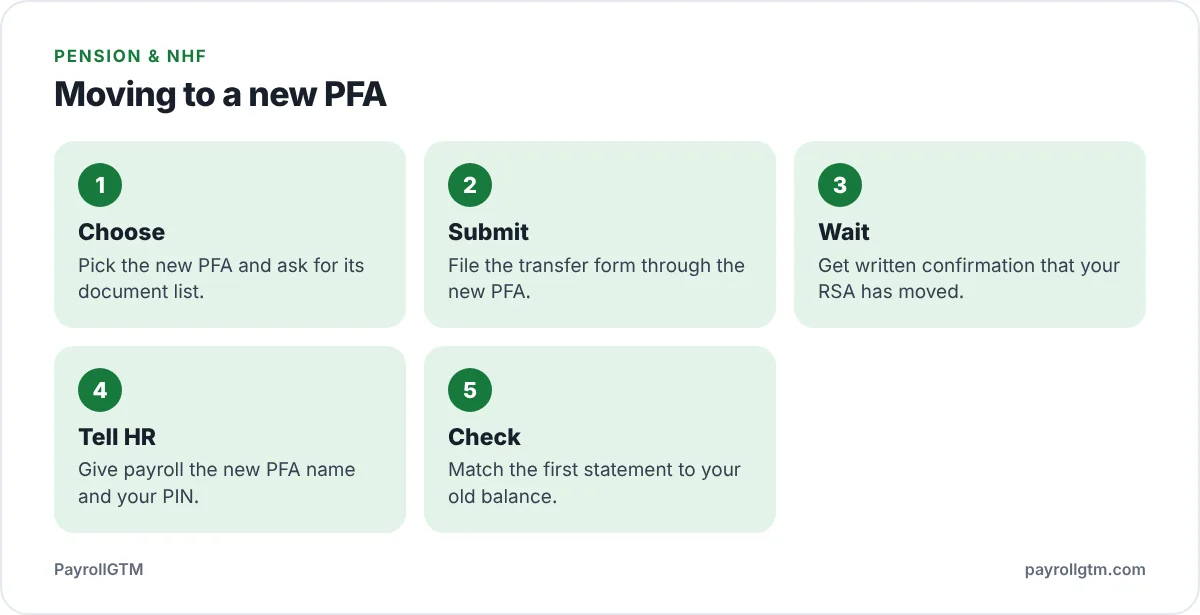
In principle the steps are these, with the new PFA doing most of the work:
- Choose the new PFA and ask what documents it wants. Expect a valid ID, your RSA PIN, and a transfer or change-of-PFA form.
- Submit the form through the new PFA, not the old one. You do not usually need to write to your old PFA first, though some will contact you to ask you to stay.
- Wait for confirmation. The balance is moved between PFAs and the new PFA should confirm in writing when your RSA is with them.
- Tell your employer. HR needs the new PFA name and your RSA PIN to send future contributions to the right place.
- Check your first statement. The balance should match what the old PFA showed at the transfer date, plus later contributions.
The exact forms, the length of the process and any approval step are set by PenCom and the PFA. Ask the new PFA for its written procedure and a target timeline. If you do not yet have an RSA, start at how to open an RSA and get a PIN instead.
How often can I switch?
Not whenever you like. PenCom limits how frequently an RSA holder can move between PFAs, and it has changed the rules over time. We have not confirmed the current limit or the window in which requests are accepted, so we will not quote one. Ask your PFA two direct questions: "What is the current limit on transfers?" and "When did I last move, and when can I move again?" If the answers conflict, PenCom is the authority and publishes its own guidance at pencom.gov.ng.
What should I check before I switch?
- Is the current balance on your latest statement correct, with every month of employer remittance showing? A switch will not fix missing contributions. Chase those first; see what happens to your pension when you leave a job for the same checks.
- Do you plan to use the 25% for a house or a first withdrawal soon? Do not change PFA mid-application. See using 25% of your RSA for housing. Ask both PFAs whether a pending application is affected.
- What are the new PFA's fees, and how do they compare in writing?
- Which fund type will you be placed in, given your age?
- Does the new PFA have a working portal and a branch or contact you can reach?
The point of a checklist is that most switches are made on impulse and regretted when nothing improves. Write the answers down and compare, and if the old PFA has only one fault, ask them to fix it before you move.
What does my employer need to do?
For staff who change PFA, payroll updates one record: the PFA name and RSA PIN used for the monthly remittance. Contributions are due within 7 working days of paying salaries, so a delay in updating the record is a delay in remitting. Sending to the old PFA is the most common error after a switch, and a late or misdirected remittance can attract the 2% a month penalty for lateness described in pension remittance deadlines and penalties.
Kemi tells HR in March that she has moved to a new PFA. The new PFA only confirms in May. HR sends March and April contributions to the old PFA as before. Kemi's balance now sits in two places, and both PFAs have to reconcile before her statements make sense. The fix is for HR to keep a short log: the date the employee asked, the date the new PFA confirmed in writing, and the first month the new PFA was paid.
Employers also keep an eye on the PenCom compliance certificate, since remittance records under the right PFA support it. For the wider duties of the business, see pension compliance for Nigerian SMEs, and for how the monthly amounts are worked out, how to calculate pension contributions.
What if the transfer is delayed or refused?
Ask for the reason in writing from the new PFA. Common causes are mismatched names or dates of birth between your ID and the RSA record, an outstanding query on the account, or a request outside the permitted window. Fix the record, resubmit when allowed, and keep every acknowledgement. If a PFA does not respond within a reasonable time, you can complain to PenCom. This article is general information, not advice on a particular case, so keep your own evidence and ask PenCom or the PFA for what applies to you.
Most people who are unhappy with their PFA are really unhappy with a missing contribution or a poor statement. Check your own contributions first, then decide whether a move is needed. The basics of how RSAs and PFAs work are in RSA and PFA explained for employees.