A Nigerian employee on ₦150,000 a month takes home ₦127,300 in 2026, and one on ₦600,000 takes home ₦470,140. The table below gives the take-home pay for ten common salaries, after the 8% employee pension and PAYE under the Nigeria Tax Act 2025, which took effect on 1 January 2026.
These are the figures for the simplest case: the whole monthly gross is pensionable, there is no rent relief, no NHF and no other deduction. Your own payslip will differ if your pay is split into basic, housing, transport and other allowances. The sections after the table show how much, and in which direction.
Take-home pay from ₦100,000 to ₦1,000,000 a month
Each row below was run through the same calculation: pension at 8% of gross, then PAYE on the rest using the 2026 bands, then divided by 12.
| Monthly gross | Pension (8%) | PAYE | Take-home | PAYE as % of gross |
|---|---|---|---|---|
| ₦100,000 | ₦8,000 | ₦3,800 | ₦88,200 | 3.8% |
| ₦150,000 | ₦12,000 | ₦10,700 | ₦127,300 | 7.1% |
| ₦200,000 | ₦16,000 | ₦17,600 | ₦166,400 | 8.8% |
| ₦250,000 | ₦20,000 | ₦24,500 | ₦205,500 | 9.8% |
| ₦300,000 | ₦24,000 | ₦32,180 | ₦243,820 | 10.7% |
| ₦400,000 | ₦32,000 | ₦48,740 | ₦319,260 | 12.2% |
| ₦500,000 | ₦40,000 | ₦65,300 | ₦394,700 | 13.1% |
| ₦600,000 | ₦48,000 | ₦81,860 | ₦470,140 | 13.6% |
| ₦800,000 | ₦64,000 | ₦114,980 | ₦621,020 | 14.4% |
| ₦1,000,000 | ₦80,000 | ₦148,100 | ₦771,900 | 14.8% |
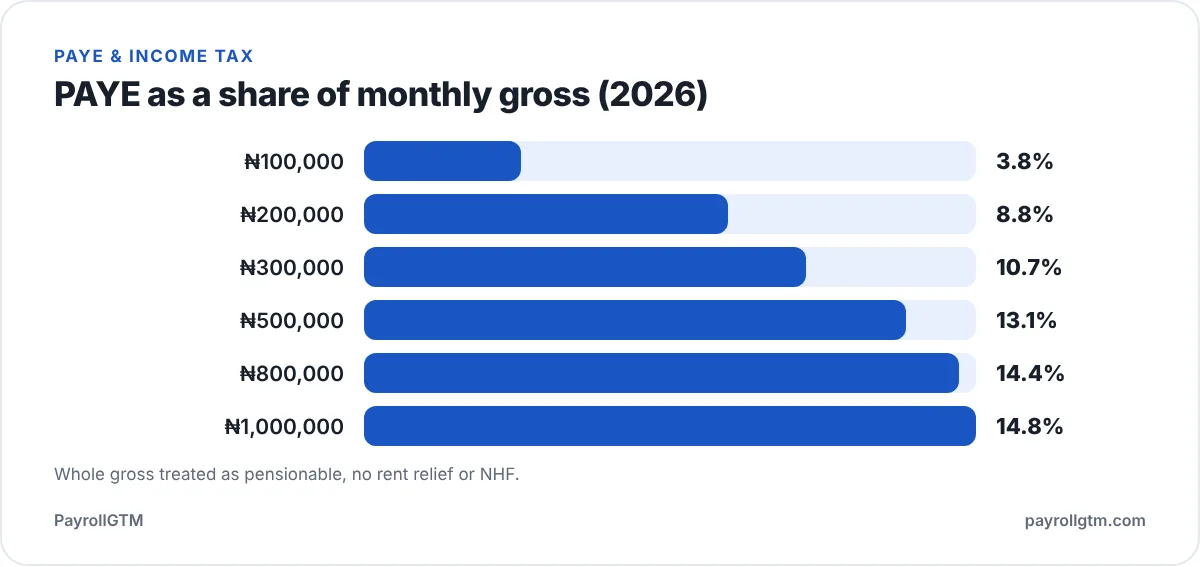
Two things stand out. The first ₦800,000 of chargeable income a year is taxed at 0%, so the lowest earners pay very little. And the share of gross that goes to PAYE climbs slowly: someone on ₦1,000,000 a month pays about 14.8% in PAYE, not the 25% top rate, because that rate only bites on chargeable income above ₦50 million a year.
The employer also pays 10% pension on top (₦15,000 on a ₦150,000 salary), but that never touches your take-home. It is an employer cost. If you want to see that side, the employer cost calculator adds it up.
How the ₦150,000 figure is worked out
- Annual gross: ₦150,000 x 12 = ₦1,800,000.
- Employee pension: 8% of ₦150,000 = ₦12,000 a month, or ₦144,000 a year.
- Chargeable income: ₦1,800,000 minus ₦144,000 = ₦1,656,000.
- First ₦800,000 at 0% = ₦0. The remaining ₦856,000 at 15% = ₦128,400.
- Monthly PAYE: ₦128,400 divided by 12 = ₦10,700.
- Take-home: ₦150,000 minus ₦12,000 minus ₦10,700 = ₦127,300.
Notice what is missing. Nothing like the old Consolidated Relief Allowance appears, because the CRA no longer exists. Under the old rules a ₦150,000 earner got a large relief before any band applied. Now the zero-rated first ₦800,000 does that job, and the only other reliefs are the ones you can evidence.
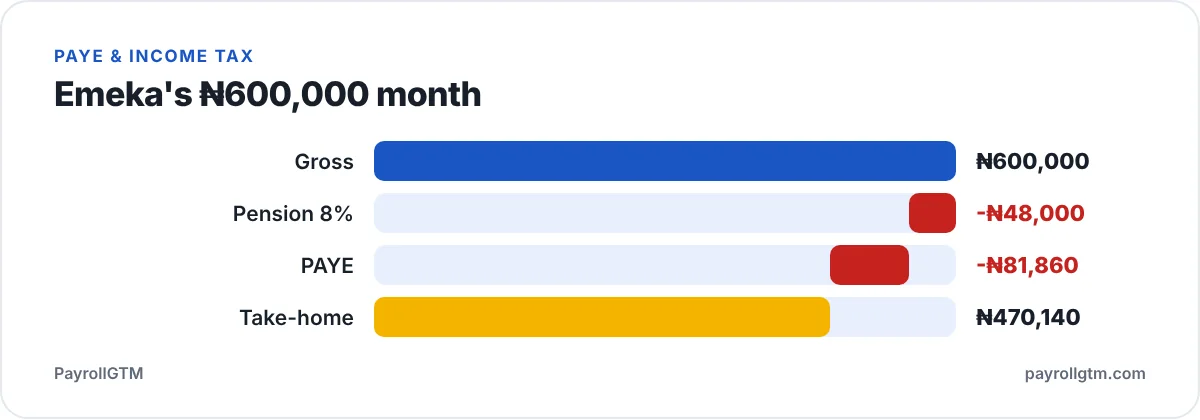
How the ₦600,000 figure is worked out
- Annual gross: ₦600,000 x 12 = ₦7,200,000.
- Employee pension: 8% of ₦600,000 = ₦48,000 a month, or ₦576,000 a year.
- Chargeable income: ₦7,200,000 minus ₦576,000 = ₦6,624,000.
- First ₦800,000 at 0% = ₦0.
- Next ₦2,200,000 at 15% = ₦330,000.
- Remaining ₦3,624,000 at 18% = ₦652,320.
- Annual PAYE: ₦330,000 + ₦652,320 = ₦982,320. Monthly: ₦81,860.
- Take-home: ₦600,000 minus ₦48,000 minus ₦81,860 = ₦470,140.
Why your payslip may not match the table
The table assumes everything you earn counts for pension. In most Nigerian payrolls it does not. The pension minimum is based on basic salary, housing and transport only. If the other part of your pay is a "utility", "meal" or "responsibility" allowance, the pension line is smaller and the taxable pay is larger.
Take Emeka again, but split his ₦600,000 as ₦360,000 basic, ₦120,000 housing, ₦60,000 transport and ₦60,000 other allowances. Pensionable pay is ₦540,000, so pension is ₦43,200 instead of ₦48,000. PAYE rises to ₦82,724 and take-home becomes ₦474,076. He keeps ₦3,936 more each month in hand, but his RSA gets less, and so does the employer's 10% contribution. That is a trade-off, not a free gain. The guide to salary structure explains how the split should be set.
What a pay rise is really worth
The table also answers the question every employee asks at appraisal time: if I am offered ₦100,000 more, how much reaches my account? Compare ₦300,000 with ₦400,000. Take-home moves from ₦243,820 to ₦319,260, a gain of ₦75,440. Both salaries sit in the 18% band, so each extra ₦100,000 of gross loses ₦8,000 to pension and then 18% of the remaining ₦92,000 to PAYE, which leaves ₦75,440. The same gain appears between ₦500,000 and ₦600,000.
Lower down the scale the position is kinder. From ₦150,000 to ₦200,000 the extra ₦50,000 of gross becomes ₦39,100 in hand, because that slice is taxed at 15%. So a rise is never wiped out by tax, but a raise negotiated "to take home ₦X" needs the net-to-gross working, not a flat percentage.
What can raise your take-home
- Rent relief. You can claim 20% of the rent you actually pay in a year, up to ₦500,000, with a tenancy agreement and receipts. If Emeka pays ₦1,800,000 a year in rent, the relief is ₦360,000 and his PAYE falls from ₦81,860 to ₦76,460 a month. Take-home rises to ₦475,540. The steps are in how to claim rent relief, and the background is in how rent relief replaced the CRA.
- Other evidenced deductions. Health insurance contributions, life insurance premiums, interest on a loan for your own home and voluntary pension top-ups can reduce chargeable income when claimed with proof. The list of deductions that reduce PAYE says what each needs. We have not put caps on them because none are confirmed in the sources we rely on.
What can lower it
- NHF, if you opt in. The 2.5% National Housing Fund deduction is on basic salary and is now voluntary for private sector staff. On a ₦360,000 basic it is ₦9,000 a month. It does reduce chargeable income, so PAYE falls a little (to ₦81,104 in Emeka's split case), but net pay still drops to ₦466,696. Check whether NHF still applies to you before agreeing to it.
- A second job. Each employer may apply the free ₦800,000 band separately, so combined PAYE can be too low and you owe the balance later. See PAYE for a second job.
- Bonuses and 13th-month pay. They are added to the year's income and taxed at your top marginal rate in that year. The bonus tax guide shows how a ₦500,000 bonus lands.
Low earners and the minimum wage
Employees on ₦70,000 a month or less are exempt from PAYE. In practice the zero-rated first ₦800,000 a year already covers most of that group. The ₦100,000 row above shows PAYE of ₦3,800, which is the small tax that starts once pay moves above that level. See whether the minimum wage is taxable for the edge cases.
Check your own number
Put your gross, basic, housing and transport into the payroll calculator, then compare the result with your payslip line by line. If PAYE on the payslip is higher than the calculator shows and you pay rent, the first thing to ask HR is whether your rent relief has been applied. If it is lower, ask what has been deducted from your chargeable income, since that needs evidence on file. For the full method behind every figure here, read how to calculate PAYE in Nigeria in 2026.
Your state IRS (LIRS in Lagos, FCT-IRS in Abuja and so on) has the final say on how PAYE is applied to your payroll, so use these figures as a guide and confirm with it when a number looks wrong.