Kemi does the books for a nine-person logistics firm in Lagos. In October, Chinedu from dispatch asks for his RSA statement before applying for a loan, and it shows nothing after June. The firm had deducted his 8% every month and never sent it. Pension must reach the PFA within 7 working days of paying salaries, and every month of delay adds a 2% penalty on the unremitted amount.
For Kemi's firm the bill came to ₦926,640: ₦891,000 of contributions for July to September plus ₦35,640 in penalty. This article shows where those numbers come from, how the 7-day clock is counted, and what to do if you are already late.
How the 7 working days are counted
The Pension Reform Act 2014 sets the contribution rates, and PenCom's guidelines set the remittance window at 7 working days after the employer pays salaries. The clock starts on the day salaries are paid, not on the last day of the month and not when payroll is approved. Weekends and public holidays do not count as working days.
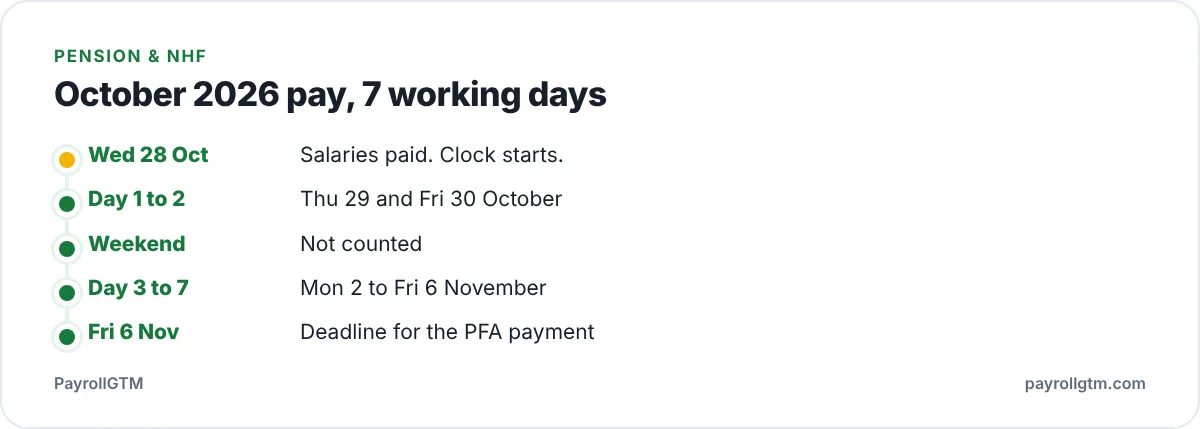
Example: if October salaries are paid on Wednesday 28 October 2026, day 1 is Thursday 29 October, day 2 is Friday 30 October, and days 3 to 7 are Monday 2 to Friday 6 November. The money must be with the PFA by Friday 6 November, assuming no public holiday falls in between. Pay salaries on the 25th and the deadline moves with you, which is why your payroll cut-off dates and your pension date should sit on the same calendar.
What was owed: the arithmetic behind ₦297,000 a month
Kemi's nine staff have pensionable pay (basic + housing + transport) of ₦1,650,000 a month in total. The minimum contribution is 18%: 8% from the employee and 10% from the employer.
- Employee 8%: ₦1,650,000 x 8% = ₦132,000 (deducted from salaries).
- Employer 10%: ₦1,650,000 x 10% = ₦165,000 (the firm's own cost).
- Total to remit: ₦297,000 a month.
If the employer carries the whole cost with no deduction from staff, the minimum employer share is 20% instead; see when the employer pays the full 20%. For the per-employee method, read how to calculate pension contributions.
The 2% a month penalty, worked out
Under section 11 of the Act, an employer who does not remit on time owes the contribution plus a penalty of 2% of the unremitted amount for each month of delay. The penalty is not a replacement for the contribution; the contribution is still owed, and the penalty is added.
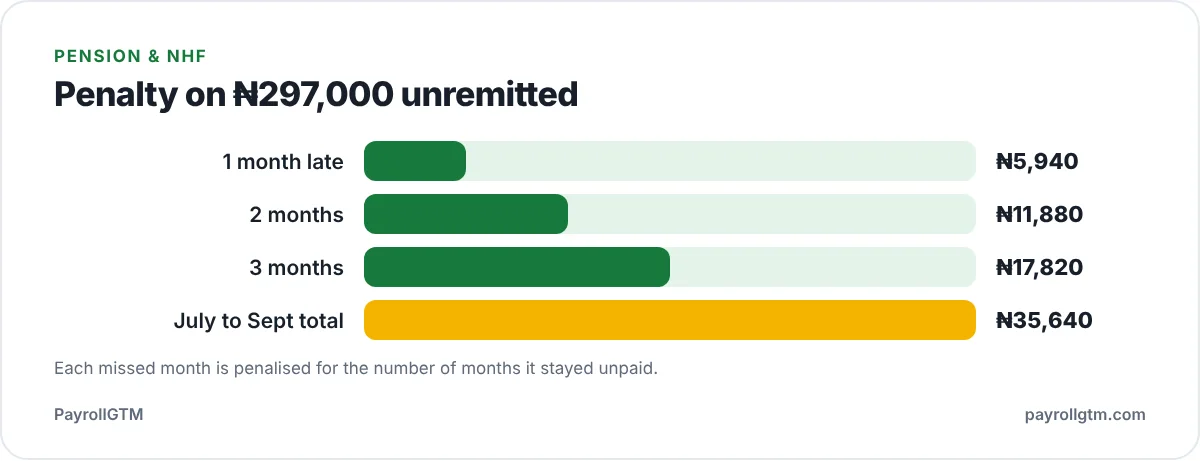
Say Kemi's firm missed July, August and September and paid everything on 30 October. To keep the sums clear we treat the delays as three, two and one full months. Whether a part-month counts as a full month is a point to confirm with PenCom or your PFA before you pay, because it changes the bill.
| Month missed | Contribution | Months late | Penalty (2% x months) |
|---|---|---|---|
| July | ₦297,000 | 3 | ₦17,820 |
| August | ₦297,000 | 2 | ₦11,880 |
| September | ₦297,000 | 1 | ₦5,940 |
| Total | ₦891,000 | ₦35,640 |
The penalty looks small, and that is the trap. For a firm with 9 staff, ₦35,640 is not what hurts. What hurts is ₦891,000 appearing in one month, a loan application that failed because the statement was blank, and a compliance certificate that depends on a clean remittance record. The PenCom compliance certificate is the document clients and tender panels tend to ask for.
How the money actually moves
An employer does not simply "send pension" in one transfer. Each employee has chosen, or been assigned, a PFA, and the employer files a contribution schedule listing every employee by name and RSA PIN with the amount for each. Payment goes to the account the PFA gives you, normally with a pension fund custodian, and the PFA matches it to the schedule and credits each RSA. Ask each PFA for its current account and schedule format rather than copying last year's.
Three things go wrong most often:
- Missing PIN. A new hire without an RSA PIN cannot be credited. The money sits unmatched, and the employee sees nothing. See how to open an RSA and get a PIN and get this at onboarding.
- One lump transfer for several PFAs. Staff in three PFAs need three payments and three schedules.
- Employee share only. The firm sends the 8% it deducted and forgets its own 10%. The employee's statement then looks short every month.
What employees see, and what they can do
An employee finds out from their PFA statement, from an online portal or app, or when a withdrawal or loan check fails. If an employee spots a gap, the order is: ask HR in writing with the statement attached, then ask the PFA to confirm what it has received, then complain to PenCom. The employee's side of that route is in pension rights under the Pension Reform Act.
PenCom is the regulator and has powers to chase employers for arrears. We do not have a published schedule of how it enforces on small firms in 2026, so do not assume a quiet month means nobody is checking.
A routine that stops it happening again
Late pension is rarely a decision. It is a cash-flow squeeze or a task nobody owns. Kemi's firm paid salaries from a single account and treated the pension transfer as "next week's job", then month-end tax and supplier payments crowded it out three months running. The fix was dull and worked.
- Open the pension line in the payroll sheet before salaries are approved, so the cash need is known on pay day: ₦297,000 on top of net pay.
- Put the deadline in the payroll calendar the same day you set the pay date. Our payroll compliance calendar shows where pension sits next to PAYE and NSITF.
- Have a second person check that the amount paid equals the schedule total.
- Keep the PFA acknowledgement with the payroll file for each month.
- For new hires, collect the RSA PIN or start the RSA before the first payday.
Leavers are the other blind spot. When someone resigns mid-month, their final salary still carries pension, and it still has the same 7-working-day clock. The employee's RSA stays with them and moves to the next employer, so a missed final month is a gap in a record they will keep for life, and they are the person most likely to notice it.
If you are already late: what to do this week
- List every month with a gap and the employees affected. Match your payroll registers to the PFA statements.
- Compute the contribution for each month, then the 2% per month of delay, using the whole-month method above, and ask your PFA or PenCom to confirm the figure.
- Pay the principal first. The contributions belong to the employees. Whether PenCom will agree a plan for the penalty is something to ask it directly, not to assume.
- Send the corrected schedules and keep the payment evidence in the file.
- Put the next deadline in the payroll calendar, with a named person who signs it off.
If your staff had pension deducted and nothing remitted, tell them before they find out. Back-dated corrections to payslips and RSA records are handled the same way as other adjustments: see back pay and salary corrections. Late PAYE carries its own penalties and a different deadline, covered in penalties for late PAYE and other payroll defaults, and the full set of steps a payroll run needs is in how to run payroll step by step.