For a small Nigerian business the benefits worth paying for are the ones staff would otherwise buy themselves and that cost you less than they are worth to the employee: a group health plan, a lunch or meal arrangement, transport help, flexible hours, extra leave days, training and a modest performance bonus. A salary advance policy costs almost nothing and solves a real monthly problem.
This page ranks the options by what they cost you against what an employee gets, shows the tax angle in one place, and finishes with a sample budget for a ten-person team. We do not quote prices for HMO plans or meals, because they vary by provider, city and plan level. Get quotes before you commit.
How to compare benefits
Use two questions for every benefit. First, what is the cost to the business, in cash and in management time? Second, what would it cost the employee to buy the same thing from after-tax income? A benefit that costs you ₦1 and saves the employee ₦1.50 of net pay is a good deal. A benefit that costs you ₦1 and is worth ₦0.30 to the employee, such as a branded gift bag, is not.
Note too that statutory items are not benefits. Pension contributions, NSITF and group life insurance are legal obligations, so do not count them against your benefits budget or advertise them as perks. The legal floor is set out in employer obligations under the Labour Act.
The options, ranked by value for the money
| Benefit | Cost to the employer | What staff get | Watch out for |
|---|---|---|---|
| Group HMO or health plan | A premium per person, quoted by the HMO | Cover for clinic visits, drugs and some admissions | Plan limits, waiting periods and which hospitals are on the list |
| Flexible start and finish times | No cash cost | Fewer hours lost in traffic | Needs a clear attendance policy so it does not become abuse |
| Leave days above the statutory minimum | Cover for absent staff | Time off the employee values | Must be written in the policy |
| Meals or lunch allowance | Daily cost per head, or a kitchen set-up | Saves daily spending | May be taxable if paid as cash |
| Transport support | Monthly allowance or staff shuttle | Cuts commuting cost | A cash allowance is part of pay for PAYE |
| Training and certification | Course fees and time | Skills that raise earning power | Bonding agreements need legal advice |
| Salary advance policy | Interest-free cash flow cost | Cover for emergencies without borrowing | Repayment deductions need written consent |
| Performance bonus pool | Variable and linked to results | Cash reward | Added to taxable pay for the year |
Health plan first
If you can afford only one cash benefit, make it health cover. Staff can easily lose a month's pay to one hospital bill, and absence from illness costs you output. The National Health Insurance Authority Act 2022 intends health insurance to be mandatory for residents, and many employers satisfy that through an HMO group plan. The detail of how plans and the NHIA fit together is in health insurance for employees in Nigeria. We do not state contribution percentages here because we have no confirmed figure.
Before you sign with an HMO, ask for the list of hospitals near your staff, the annual limit per person, what is excluded and how long claims take to be approved. A cheap plan whose hospitals are on the other side of Lagos will not be used.
Benefits that cost time, not cash
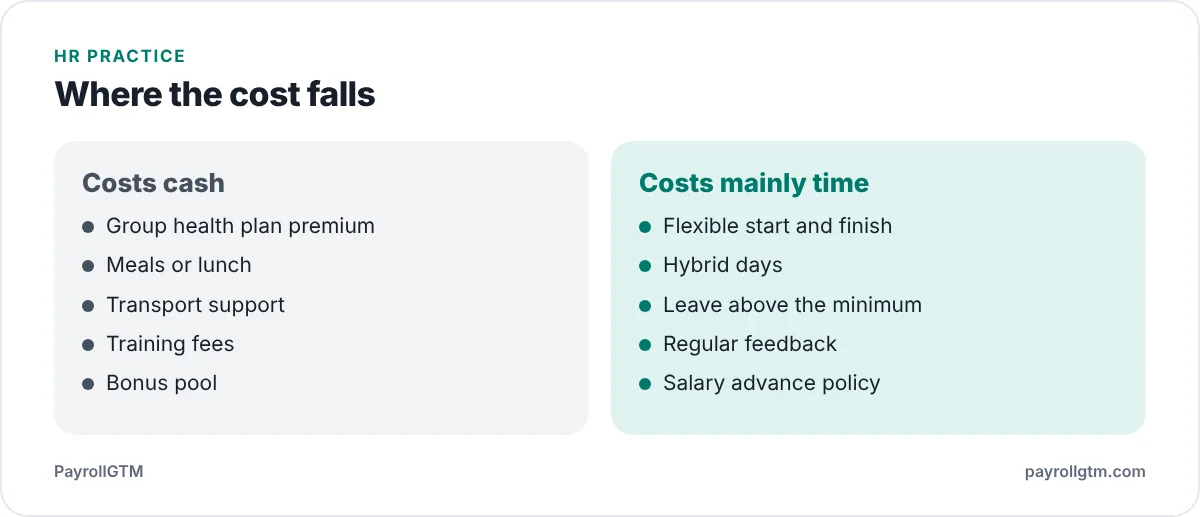
- Flexible hours. Allow staff to start between, say, 7:30 and 9:30 and finish after the same number of hours. Write it into the attendance and lateness policy so everybody knows the core hours.
- Remote or hybrid days. Where the work allows it, one remote day a week saves commuting costs and fuel. Set rules for equipment, data and availability in a remote and hybrid work policy.
- Extra leave. The Labour Act sets a minimum of 6 working days of paid annual leave after 12 months, and many employers give 15 to 21 days or more by contract. A few days beyond what competitors offer is cheap, but it must be written down. Use the leave policy template for the wording.
- Recognition and feedback. A regular, honest review does more for retention than most gifts. See performance appraisal for small businesses.
The tax angle in one paragraph
Cash allowances such as a transport or meal allowance paid in the salary are part of employment income, added to the PAYE base for the year. Some benefits provided in kind, such as housing, a company car or school fees, can also be taxable. The rules differ by item, so read how benefits in kind are taxed and confirm with your state IRS before you announce anything. Health insurance premiums and some pension contributions can reduce an employee's taxable income when properly evidenced, but we have no confirmed cap to quote. An employer should not promise a net benefit before checking.
A sample budget for a ten-person team
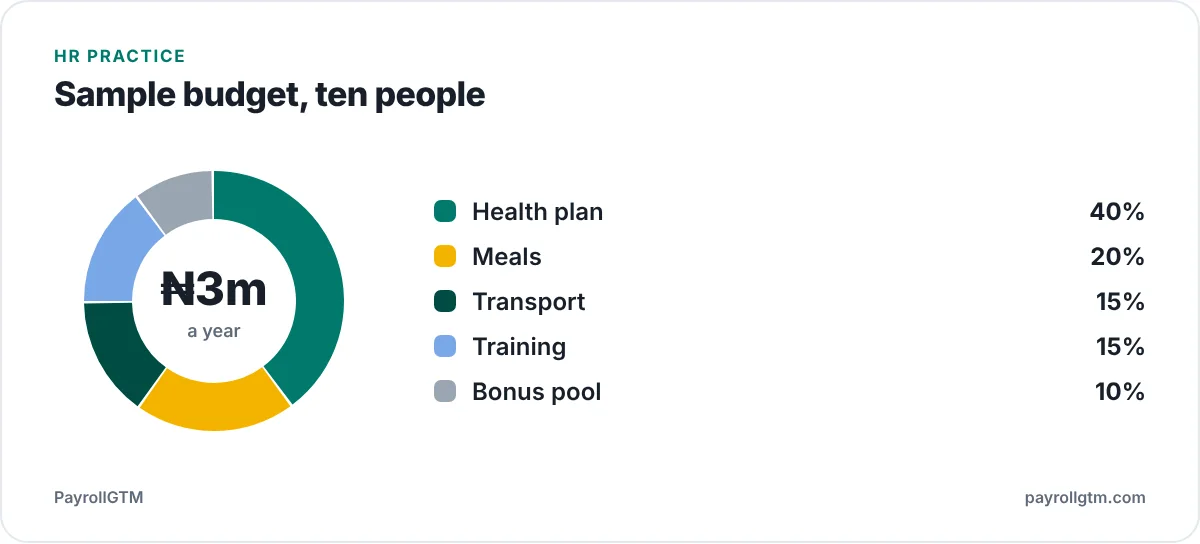
This is an illustration, not a price list. Assume the owner of a ten-person agency sets aside ₦3,000,000 a year for benefits, which is ₦300,000 per employee or ₦25,000 per person a month. The split below is one reasonable allocation, and the amounts for each line would need to be confirmed against real quotes.
| Line | Share of budget | Annual amount | Per person a month |
|---|---|---|---|
| Group health plan | 40% | ₦1,200,000 | ₦10,000 |
| Lunch or meal arrangement | 20% | ₦600,000 | ₦5,000 |
| Transport support | 15% | ₦450,000 | ₦3,750 |
| Training fund | 15% | ₦450,000 | ₦3,750 |
| Performance bonus pool | 10% | ₦300,000 | ₦2,500 |
| Total | 100% | ₦3,000,000 | ₦25,000 |
Flexible hours, extra leave and a salary advance policy do not need a line, because they cost management attention more than cash. If the owner can only afford half this amount, keep the health plan and drop transport and the bonus pool first, then add the next benefit as revenue grows. Staff will tolerate a smaller package that is reliable better than a bigger one that is cut in a bad month.
Why a cash allowance is a poor way to give a benefit
Take Ngozi, who earns ₦300,000 a month. Her employer wants to help with lunch and adds a ₦30,000 meal allowance to her pay. We treat the whole of the new gross as pensionable here, to keep the sum simple, though in practice that depends on how your salary structure defines pensionable pay.
Pension is not lost, since it goes into her RSA, but she cannot spend it this month. A benefit the employer buys directly, such as a staff lunch arrangement or an HMO plan, avoids this leakage, subject to how the benefit is taxed (see the tax paragraph above). Ask your state IRS or a tax adviser before choosing between the two routes. Run your own figures through the payroll calculator before you announce an allowance.
Salary advances without trouble
A written policy keeps this benefit safe. State the maximum (for example, one month's net pay), how it is requested, who approves it, the repayment period and that the employee consents in writing to repayment by deduction from salary. Deductions from wages are restricted, so check lawful deductions from wages first. Keep a register so nobody has two open advances.
How to choose and announce
- Ask staff to rank the options. The answer is often a surprise.
- Get written quotes for the top two paid items.
- Pilot for six months and set a review date.
- Put the benefits in the employee handbook with eligibility rules, so benefits cannot be argued about later.
A benefit you withdraw is remembered longer than one you never gave, so start with what the business can sustain through a poor year.