The most enforceable attendance rule is a clear start time, a short and honest grace or flexible window, a record that employees can see, and a staged response to repeated lateness that begins with a conversation and ends, if needed, with the formal disciplinary steps. Blanket penalties such as "late three times, lose a day's pay" are the part that goes wrong, because pay deductions are tightly controlled and a rule that nobody believes in will not hold.
Start with the real problem, not the rule
In Lagos, a person who lives in Ikorodu and works in Victoria Island can lose an hour to one accident on the bridge. In Abuja the commute is shorter but the bus queues are not. If your policy pretends traffic does not exist, staff will either leave at 4am or lie about why they arrived at 9:20. Before you write a clause, find out how often lateness happens, who is late and why. If it is one person on 12 days out of 20, you have a conduct matter. If it is fifteen people on the same wet Monday, you have a start-time matter.
Choose a start-time model
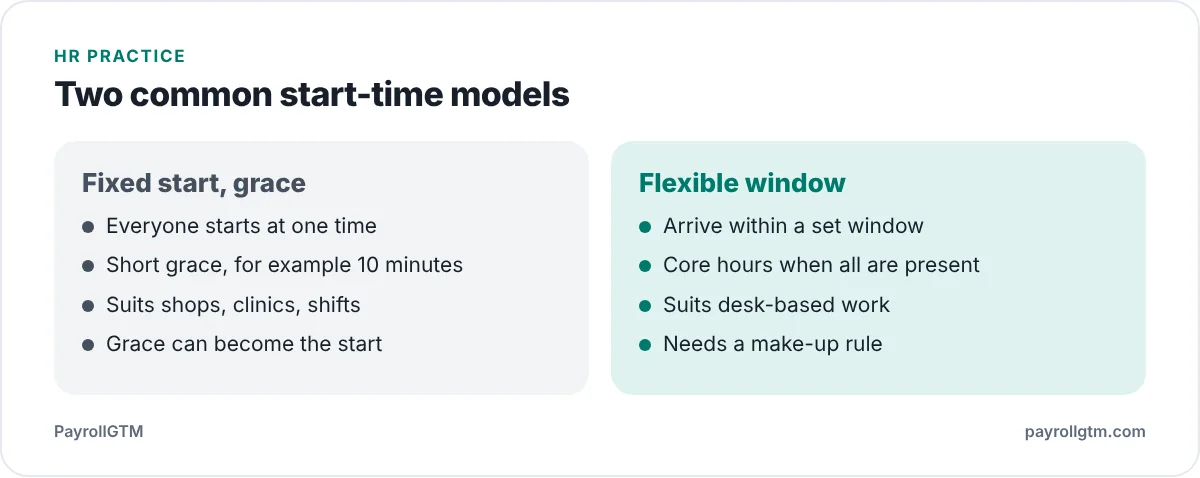
Three models work for small employers. The right one depends on the work.
| Model | How it works | Best for | Watch out for |
|---|---|---|---|
| Fixed start, short grace | Everyone starts at 8:00, arrival up to 8:10 not recorded as late | Shops, clinics, reception, shifts | Grace becomes the real start time |
| Flexible window with core hours | Arrive between 7:30 and 9:30, work 8 hours, be present 10:00 to 15:00 | Offices, agencies, finance teams | Needs trust and a rule on making up hours |
| Output-based | Hours matter less than agreed deliverables | Remote or sales roles | Hard to apply to anyone with fixed customer hours |
For a customer-facing team, fixed starts are fair because someone must be there. For an office doing desk work, a flexible window is a cheap benefit and does more for morale than a small gift. If you are drafting the wider policy, see remote and hybrid work policy and low-cost employee benefits, where flexible hours often feature.
How to record attendance
A paper sign-in sheet is acceptable in a small office provided it is filled in at the time, not at the end of the week. A system with swipe cards or a web check-in is better because it creates a record that cannot be edited later. Biometrics such as fingerprints are the most sensitive option. Under the Nigeria Data Protection Act 2023, biometric data is personal data that needs a lawful basis, a stated purpose and secure storage, and staff should be told what is collected and why. Check the employee data protection rules before installing a fingerprint reader, and consider whether a card or PIN would do the job with less risk.
Whatever you use, let employees see their own record. If someone disagrees with a late mark, there should be a quick way to correct it. Do not let attendance records live only on the HR manager's phone.
Why a pay deduction for lateness is risky
Nigerian law restricts what an employer may take from wages. A deduction normally needs a basis in the contract or a written agreement, and a deduction applied as a penalty is the kind most likely to be challenged. For the controls on lawful deductions see wage payment and lawful deductions. We cannot give you a ruling for your case; ask a labour lawyer before you write a deduction into a policy.
A "late equals half a day" rule would take ₦3,000, eight times the value of the time. A "late three times equals one day" rule takes ₦6,000 for three late arrivals worth ₦1,125 in total, more than five times their value.
A rule like that will be seen as a penalty and not as a fair adjustment. Employees notice the arithmetic.
Safer options: ask the employee to make up the time on the same or next day, record it against a flexible-time balance, or move to the staged process below. If your contract does allow deduction for time not worked and the employee has agreed in writing, keep it proportionate to the time actually missed.
One more point on fairness: apply the rule to the person who is always at the desk at 7:45 and then leaves at 4:00 as well. Attendance is about being present for the agreed hours, and an employer who only polices arrival, never departure, will see staff drift in early, do little, and still be marked "on time". Look at the whole day.
Stages for repeated lateness
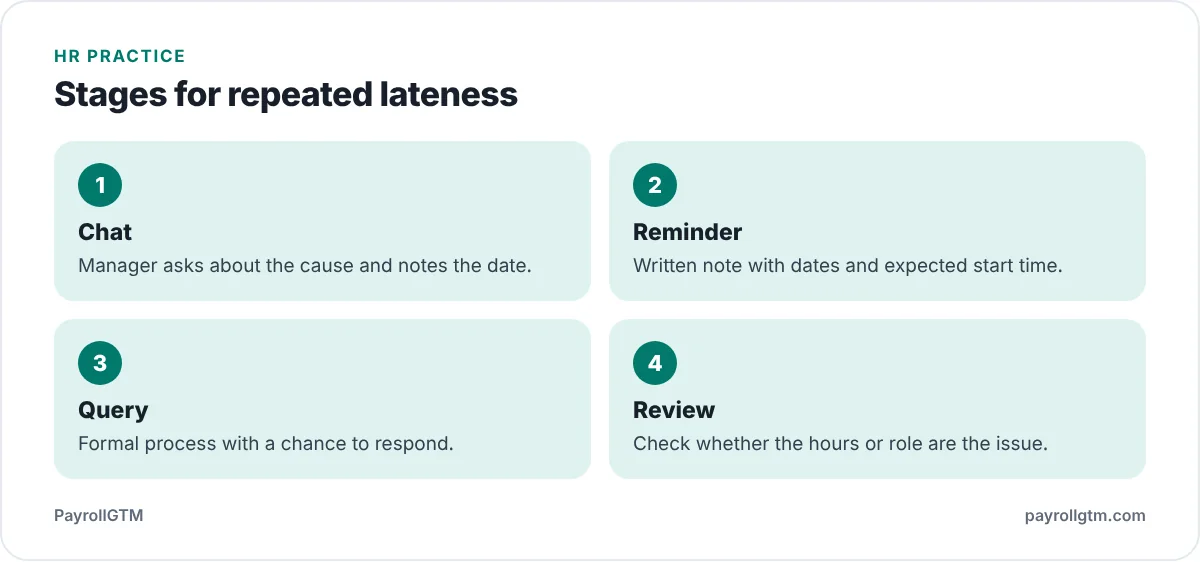
- Informal chat. After the pattern appears (say, 3 lates in a month), the manager talks to the employee, asks about causes and notes the date. Many cases end here, because the cause is a childcare change or a new route.
- Written reminder. If it continues, send a short email or letter stating the dates, the expected start time and what support is possible (a changed start time, a move to a different shift).
- Query or formal warning. If lateness persists after the reminder, move to the formal steps: a query, a chance to respond and a decision. The templates are in query letter and warning letter templates and the process, including fair hearing, in the disciplinary procedure guide.
- Review. Consider whether the role or the hours are the real issue before the next step.
Define "repeated" in the policy so every manager uses the same trigger. Otherwise one manager acts at three lates and another at ten.
Excused absences and lateness
Some lateness is not misconduct: a road closure, a medical emergency, a family death, a documented transport strike. The policy should say who accepts the explanation and how quickly the employee has to give it (the same day by message is reasonable). It should also keep sick leave and annual leave out of the lateness count. Those entitlements sit in your leave policy.
Sample policy clause
Working hours and punctuality. Normal working hours are [8:00 to 17:00], Monday to Friday. Arrival up to [10] minutes after the start time is not recorded as late. Employees must record their arrival through [the sign-in system]. If an employee expects to be late, they must tell their manager as early as possible and, where possible, before the start time. Lateness caused by events outside the employee's control will be considered on its facts. Repeated lateness, meaning [three or more late arrivals in a calendar month], will be addressed first through a conversation, then a written reminder and then, if it continues, the company's disciplinary procedure. The company does not make deductions from salary for lateness unless the employee's contract provides for it and the law allows it.
How to roll it out
Publish the policy, hold a short staff briefing and give a start date a month away. Apply it from that date to everyone, including managers; a policy that exempts the boss is dead on arrival. Review it after three months with the data: if lateness is concentrated on Mondays or in one team, adjust the start time rather than the punishment. Put the final version in your employee handbook and have each person sign for it. Attendance also feeds into annual performance appraisal, so keep the records consistent. The wider rules of conduct are in the workplace code of conduct.