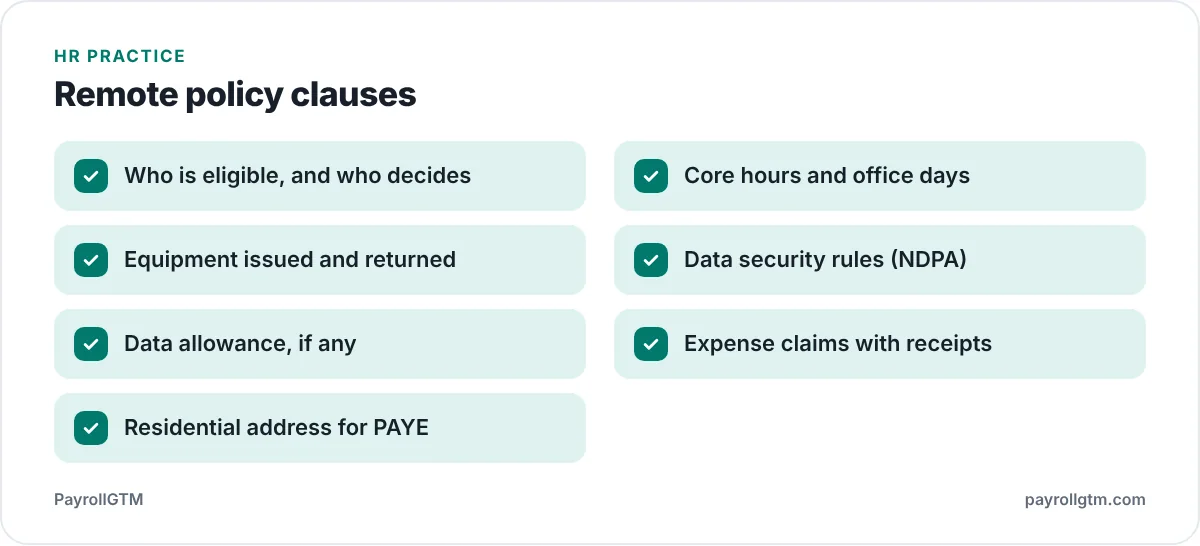
A remote or hybrid work policy should settle seven things in writing: who is eligible, which days and hours the person works, who provides and owns the equipment, how company data is protected, whether you pay a data or internet allowance, how expense claims work, and where the employee lives for tax. Nigeria has no single statute for home working, so the policy and the employment contract do the job. Below is a plain skeleton you can copy and adapt, with the reasoning behind each clause.
Decide eligibility before anything else
Not every role can be done from home, and a policy that pretends otherwise makes the rest unworkable. Start with the job, not the person: does it need a physical presence (stores, production, front desk, cash handling), or can the output be measured remotely? Then add conditions such as completed probation, a stable power and internet set-up, and a manager's approval that can be withdrawn.
Apply the same test to everyone in a role. If one accountant works from home three days a week and another is refused without a reason, you have a fairness problem that will surface in an appraisal or a grievance. The contract should say that remote work is an arrangement, not a permanent term, unless you really mean it to be. See what an employment contract should contain for where to place that wording.
Hours, availability and attendance
Say what you expect, not "reasonable hours". For example: core hours of 9am to 4pm Lagos time, reachable on Teams or WhatsApp during them, and in the office on Tuesdays and Thursdays. Say how time is recorded for staff who are paid by the hour or who are eligible for overtime. The legal position on hours and overtime for private employees mostly comes from the contract, see working hours, overtime and rest days. Lateness and attendance rules still apply on remote days, and your attendance and lateness policy should be cross-referred, not rewritten.
Power cuts and network failure are normal in Nigerian cities, so write down the fallback. A sensible clause: tell your manager within 30 minutes, use a power bank or mobile data if you can, and if you cannot work, either come into the office or take unpaid or approved leave, as the manager decides.
Equipment, data security and the NDPA
Decide who supplies what. Typical split: the company provides a laptop (and perhaps a phone or MiFi) that stays company property, while the employee provides the desk, chair and power. Record what was issued and get a signature. On leaving, the same list is your return checklist.
Employees' work at home often means customer and staff data on personal networks. The Nigeria Data Protection Act 2023 covers how personal data is handled, and the regulator is the Nigeria Data Protection Commission (ndpc.gov.ng). Your policy should at least require:
- Work on company devices or approved accounts only, not personal email or WhatsApp groups for files containing customer or payroll data.
- A screen lock, a strong password and no sharing of devices with family members.
- No printing of sensitive documents at home, or shredding if it is unavoidable.
- Immediate reporting of a lost laptop or phone, so you can wipe it and assess whether a breach has occurred.
The detail on handling staff records is in our NDPA payroll guide. If you track remote staff with monitoring software, say so in the policy, because secret monitoring of personal data is exactly what the NDPA principles of transparency are about.
Data allowance and expense claims
There is no law that makes an employer pay for an employee's home internet, so do not describe it as an obligation. Many employers still pay a monthly data or internet allowance because it is cheaper than losing people. If you do, say whether it is a fixed amount or a claim against receipts, and say that it can be varied.
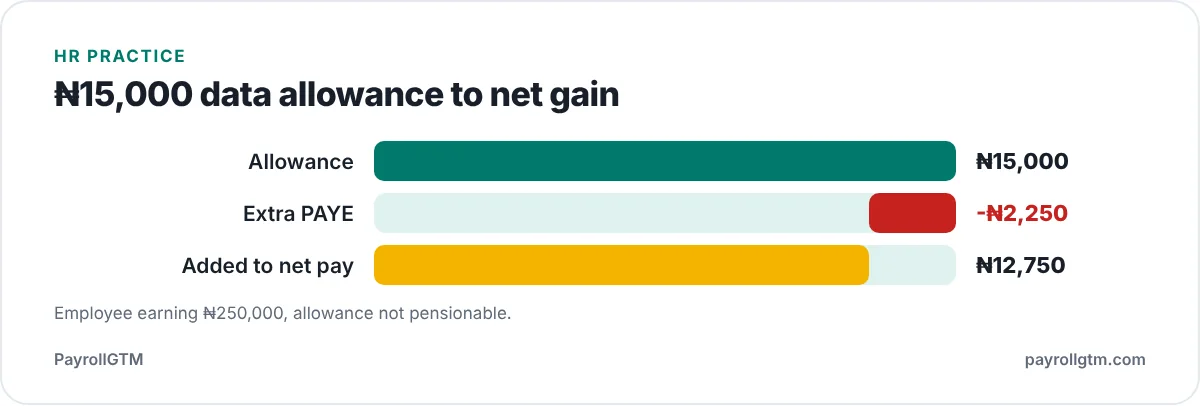
A fixed cash allowance is, in general, part of pay and part of the PAYE base, though how a state IRS treats a genuine reimbursement of a business expense can differ, so ask yours. Here is what a fixed ₦15,000 monthly allowance, treated as taxable and not pensionable, does for a Lagos employee earning ₦250,000 (basic ₦150,000, housing ₦60,000, transport ₦40,000):
Without the allowance: PAYE ₦24,500 a month, net ₦205,500.
With the ₦15,000 allowance: gross ₦265,000, PAYE ₦26,750, net ₦218,250.
The employee keeps ₦12,750 of the ₦15,000, because PAYE rises by ₦2,250. The employer pays ₦15,000 plus NSITF of ₦150 (1% of payroll), so ₦15,150. Pension does not change because the allowance is outside basic, housing and transport.
Look at our low-cost benefits guide if you are weighing a data allowance against other perks. For expense claims, require a receipt, a business reason and submission within a stated number of days.
Tax residence, pension and where PAYE goes
PAYE for an employee is generally collected by the state IRS of the state where the employee lives, not necessarily where the company is registered. A Lagos company with a developer working from Abuja is dealing with the FCT-IRS for that person's tax, and an employee who relocates in the year changes where the tax goes. Make the policy require staff to tell HR their residential address and any move within 30 days, and ask for a utility bill or tenancy agreement for the file. The rules and the exceptions are in where PAYE goes: state IRS or NRS. Pension, NSITF and the group life requirement apply the same way regardless of where in Nigeria the person sits.
Staff who want to work from another country need a separate decision. Their tax residence, immigration status and the employer's own exposure abroad can change, and we do not set out rules for that here. Require written approval and take tax advice before saying yes.
Sample policy skeleton
Adapt the bracketed parts. Short is better than complete: if nobody reads it, nobody follows it.
Remote and Hybrid Work Policy, [Company name]
1. Purpose. This policy sets out when and how employees may work away from the office. It forms part of the employee handbook and does not change the terms of any contract of employment.
2. Eligibility. Remote work is available for roles listed by HR as suitable, to employees who have completed probation and whose manager has approved in writing. Approval may be withdrawn on [notice] for business reasons.
3. Hours. Employees work [number] hours a week, with core hours of [time] to [time], and attend the office on [days]. Employees must be reachable on [channel] during core hours.
4. Equipment. The company issues the items on the equipment form, which remain its property. Employees provide a workspace, power and a working internet connection. Faults are reported to [name] on the day.
5. Data security. Employees use company devices and approved accounts, lock screens, do not share devices, and report a loss or suspected breach to [name] immediately, in line with our data protection policy.
6. Allowance and expenses. The company pays a data allowance of [amount] a month while remote work is approved. Other expenses must be pre-approved and claimed with receipts within [number] days.
7. Place of work and tax. Employees must give HR their residential address and notify any change within [number] days. Working from outside Nigeria needs prior written approval.
8. Performance. Remote employees are measured against the same objectives and appraisal as office staff.
9. Health and safety. Employees must report any work-related injury, including at home, to HR within [number] days.
10. Review. The policy is reviewed every [12] months.
Clause 9 matters more than it looks. The Employees' Compensation Act can apply to work-related injury, and where the line falls for a home worker is a question to put to NSITF or a lawyer. Keep the policy consistent with your employee handbook, and once it is signed off, run it for a trial period and review the output of remote staff through your appraisal process rather than by counting hours online.