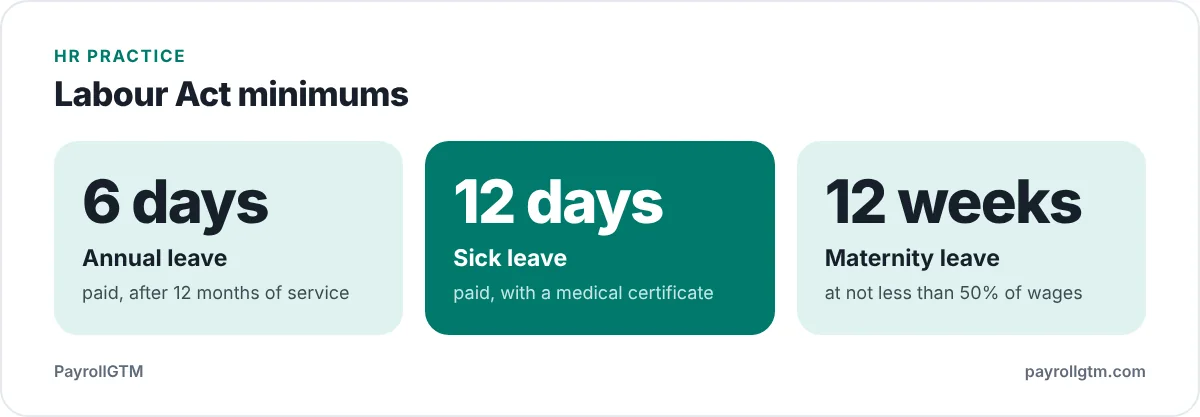
A good leave policy states how many days each type of leave gives, who approves it, how far ahead to ask, what happens to unused days and what records payroll keeps. The legal floor is low: at least 6 working days of paid annual leave after 12 months of continuous service, up to 12 working days of paid sick leave a year on a medical certificate, and 12 weeks of maternity leave at not less than 50% of wages. Most employers go beyond those minimums, and the clauses below use 15 working days of annual leave as an example. Change the numbers to suit your business, but never go below the statutory figures.
What the law sets, and what you decide
| Type | Statutory minimum (Labour Act) | What your policy decides |
|---|---|---|
| Annual leave | At least 6 working days with pay after 12 months of continuous service (s.18) | Actual days (many give 15 to 21 or more), when it starts accruing, carry-over, whether weekends and holidays count |
| Sick leave | Up to 12 working days a year with pay, on a certificate from a registered medical practitioner (s.16) | When a certificate is needed, how to report, whether longer illness gets more |
| Maternity leave | 12 weeks, usually 6 before and 6 after birth, at not less than 50% of wages (s.54); reduced working time for nursing | Whether you pay full pay (many do), notice to give, return-to-work arrangements |
| Paternity leave | No federal statutory entitlement for private-sector staff | Whether to give a few days as a benefit |
| Compassionate leave | None in the Act | Days, who counts as family, whether paid |
Maternity rules may be better under some state laws or employer contracts, so check your state. The background is in annual, sick and maternity leave in Nigeria and, for the maternity detail, the maternity leave guide. Say in the policy that it covers managers too, since whether the Labour Act reaches senior staff is a separate question.
How to use this template
Copy the clauses into your handbook or a stand-alone policy. Replace bracketed text and delete anything you will not honour. Do not promise what payroll cannot deliver: if you offer full-pay maternity leave, put the cost in your budget. Have a Nigerian employment lawyer check the final text, because the policy becomes a contractual document once staff are told it applies.
Clause 1: Purpose and scope
1. Scope. This policy applies to all permanent employees of [Company name]. Staff on fixed-term contracts receive leave on a pro-rata basis in line with their contract. Where this policy and an individual contract conflict, the contract applies if it is more favourable to the employee. Nothing in this policy gives less than the minimum required by law.
Clause 2: Annual leave
2.1 Entitlement. Each employee is entitled to [15] working days of paid annual leave for each completed year of service. Weekends and public holidays that fall within a leave period are not counted as leave days.
2.2 Accrual and probation. Leave accrues at [1.25] days for each completed month. Leave may be taken after [6] months of service, subject to approval, and the first full entitlement is due after 12 months of continuous service.
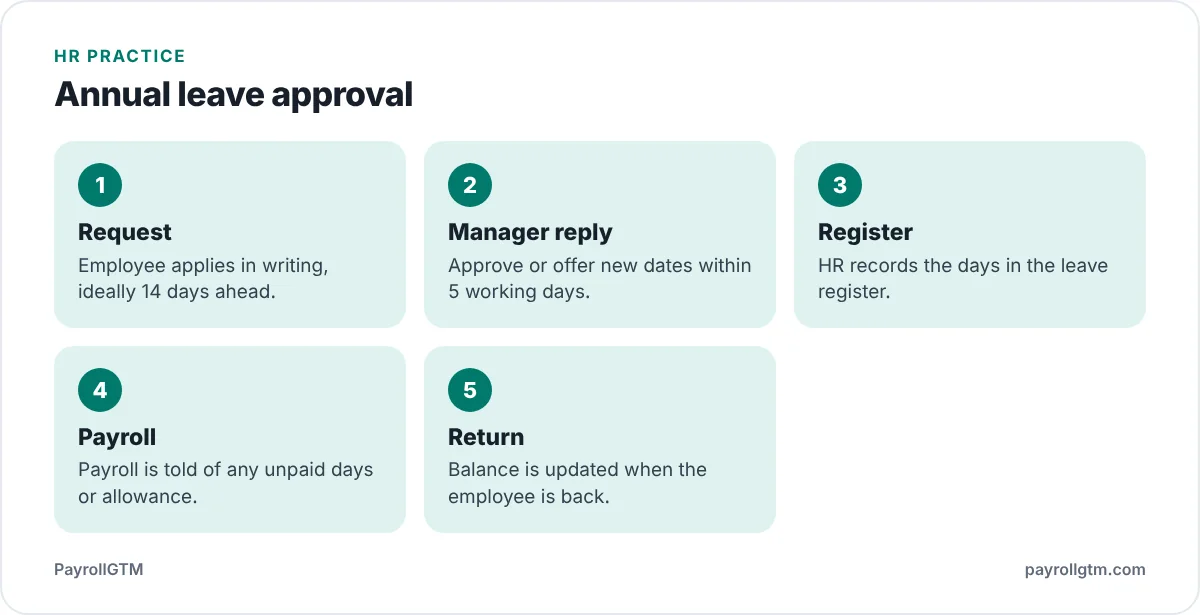
2.3 Approval. Employees must apply in writing to their line manager at least [14] days before the proposed start date. The manager replies within [5] working days. Approval may be refused or moved for business reasons, but not unreasonably, and a different date is offered.
2.4 Carry-over. Up to [5] unused days may be carried into the next year and must be taken by [31 March]. Unused leave beyond this is [forfeited / paid at basic salary] at the company's discretion unless the contract says otherwise.
2.5 Leave allowance. Where the contract provides for a leave allowance, it is paid [with the salary for the month in which leave begins].
Two points need a decision before you publish. First, forfeit or pay: forfeiting unused leave is allowed only where the contract and policy say so, and it can annoy staff, so many employers cap carry-over and pay out the rest. Second, leave allowance is part of employment income and goes into the PAYE base for the year (see PAYE on bonuses, 13th-month pay and leave allowance), so do not tell staff it is paid tax-free.
Clause 3: Sick leave
3.1 Reporting. An employee who cannot attend work because of illness must inform their line manager on the first day, before [9:00 am], by phone or message.
3.2 Certificate. Absence of [2] or more consecutive working days must be supported by a certificate from a registered medical practitioner, submitted on return or earlier where possible.
3.3 Pay. Employees receive full pay for certified sick leave up to [12] working days in a year. Absence beyond that is handled under [clause X] and the contract, and the company will discuss support with the employee.
Whether a certificate is required for a single day is a policy choice. The statutory language refers to a certificate, so be consistent and do not demand certificates only from staff you dislike. Frequent short absences are a lateness and attendance question, handled in the attendance and lateness policy, not here.
Clause 4: Maternity and nursing leave
4.1 Entitlement. A female employee is entitled to [12] weeks of maternity leave, normally [6] weeks before and [6] weeks after the expected delivery date, with [full / 50%] of her wages paid by the company, subject to law.
4.2 Notice. The employee should give written notice, with a medical certificate of the expected delivery date, at least [4] weeks before leave begins, except where the birth is early.
4.3 Nursing. On return, a nursing mother may have reduced working time during working hours for [6] months, as agreed with her manager.
4.4 Paternity leave. A male employee may take [3] working days of paid leave around the birth of his child, on notice to his manager.
The statute sets the 12 weeks and the 50% minimum, and you can pay more. Clause 4.4 is a company benefit, not a legal entitlement. If you have a very small team, put the cost of a full-pay maternity period in your budget before you promise it.
Clause 5: Compassionate and other leave
5.1 Compassionate leave. An employee may take up to [5] working days of paid leave on the death of a spouse, child, parent or sibling, and [2] days for other close relatives, on notice to their manager. The company may ask for reasonable confirmation.
5.2 Unpaid leave. Unpaid leave of up to [30] days may be approved for study or personal reasons, at the manager's discretion, with HR approval, and must be agreed in writing before it starts.
5.3 Public holidays. Public holidays declared by the government are days off, not counted against annual leave.
For how public holidays interact with pay, see public holidays in Nigeria: pay and work rights. Do not list holiday dates in the policy, since some depend on moon sighting and extra days may be declared.
Clause 6: Records, payroll and exits
6.1 Records. HR keeps a leave register for every employee showing days earned, taken and remaining. Payroll uses it for unpaid leave deductions and final pay.
6.2 Unpaid absence. Absence without approval is unpaid and may lead to disciplinary action.
6.3 Leaving the company. On exit, accrued unused leave is [paid at basic salary / not paid] in line with the employee's contract.
Pro-rating pay for unpaid days is covered in how to prorate salary for part of a month. If you pay for unused leave on exit, say which pay it is calculated on, and see how final settlement works in the resignation acceptance and exit templates.
Rolling it out
- Share the policy in writing and ask for acknowledgement of receipt.
- Put a short line in each offer letter referring to it.
- Review it each year, and when staff numbers or the law change.
- Apply it the same way to everyone. Selective approval invites grievances, which you then handle with the query and warning letter templates and good records.