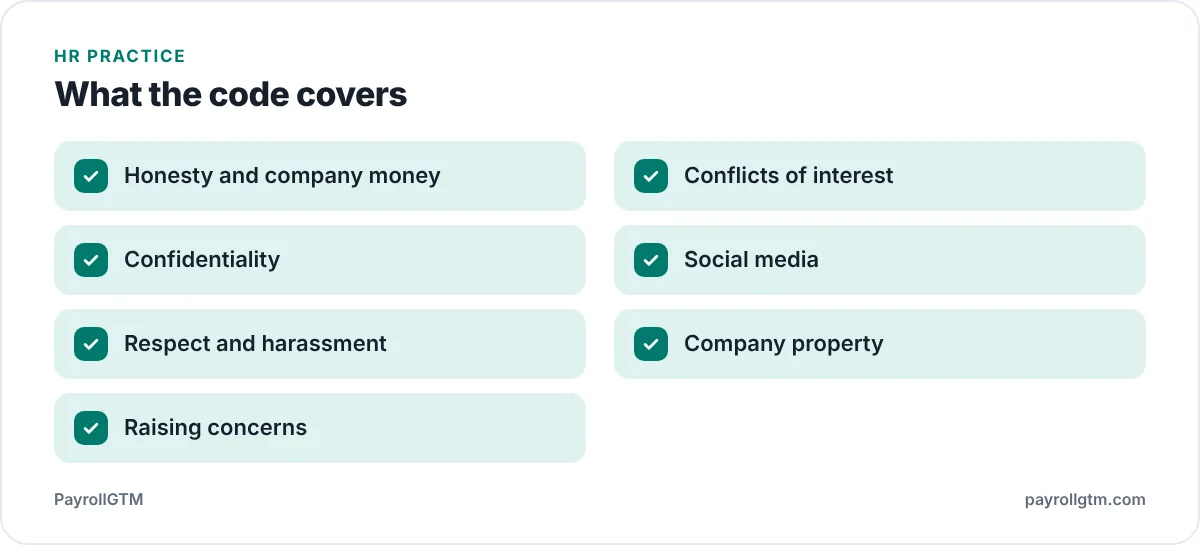
A good code of conduct for a small Nigerian business fits on one page, uses plain sentences, and tells staff what you expect on honesty, conflicts of interest, confidentiality, social media, respect, company property and raising concerns. Below are sample clauses for each, written to be copied and adjusted, followed by how to roll the code out so it can be relied on later.
- Seven short clauses you can paste into your own document
- What to leave out so the code stays readable
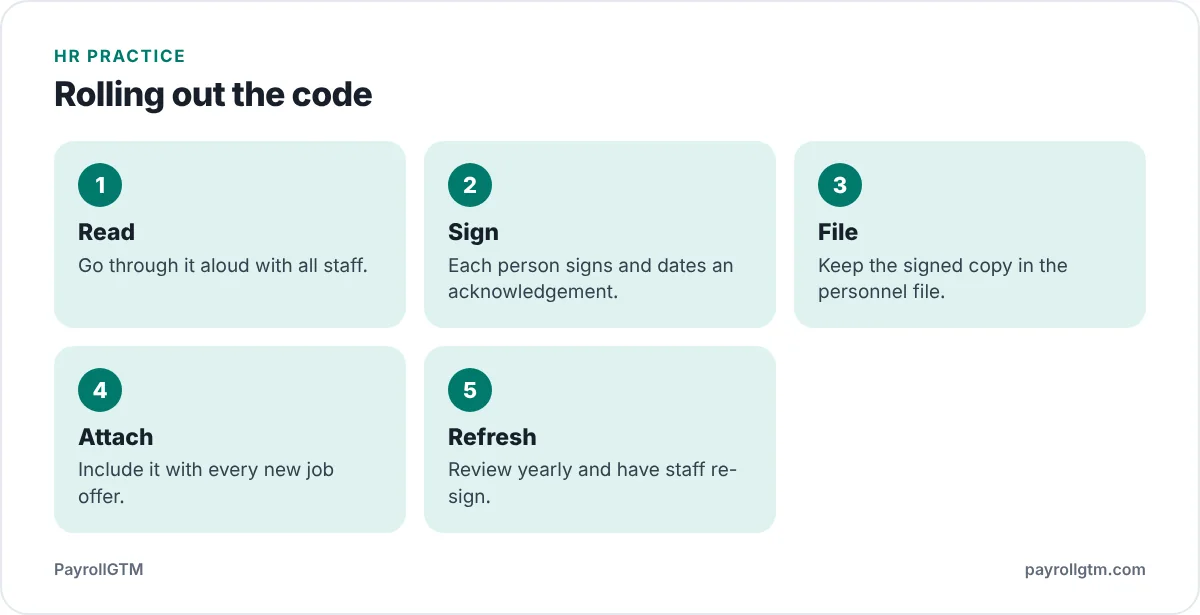
- How to introduce it: read, sign, file, refresh
- How it connects to queries and warnings
What a code of conduct is, and is not
A code of conduct states the behaviour you expect from everyone. It is not the employment contract, not the full staff handbook and not a list of every punishable act. The contract fixes pay and notice, the employee handbook covers procedures such as leave and expenses, and the code sets standards of behaviour. If your code runs past two pages, people stop reading it, and a rule nobody has read is hard to enforce.
The clauses below are drafting examples, not legal advice. If you have a lawyer, have them look at the version you will actually use, especially the clauses on confidentiality and consequences.
Sample clauses you can adapt
Write them in the first person plural for the company and the second person for staff. Replace the square brackets.
1. Honesty and company money
You must be honest in all dealings for [Company name]. You must not take, borrow or misuse company money, stock, data or time. You must record sales, expenses and stock movements accurately, and you must not accept payments, gifts or favours from a customer or supplier in return for treating them better.
2. Conflicts of interest
Tell your manager in writing before you take on any business, job or role that competes with [Company name], supplies it, or could influence a decision you make for it. This includes a business owned by a family member. Disclosing a conflict is not misconduct. Hiding one may be.
3. Confidentiality
You must not share information about our customers, prices, staff pay, systems or plans with anyone outside [Company name] unless your job requires it or a manager has approved it. This continues after you leave. Personal data about staff and customers must be handled as set out in our privacy notice.
That last sentence is there because the Nigeria Data Protection Act 2023 applies to the personal data you hold on staff and customers. See employee data protection and payroll. Longer restrictions on working for a competitor after leaving belong in the employment contract, not the code.
4. Social media and public statements
Do not post customer information, internal documents, photographs taken inside restricted areas or statements that appear to speak for [Company name] unless you are authorised to. Your own views are yours, but you must not use social media to insult, threaten or harass a colleague, customer or supplier.
5. Respect and harassment
We treat each other with respect. Bullying, threats, discrimination and unwelcome sexual comments or contact are not acceptable, whether in person, by message or on a work group chat. A manager who receives a complaint must pass it to [named person, e.g. the MD or HR lead] within [2] working days.
6. Company property and systems
Use company equipment, vehicles, accounts and software for company work. Reasonable personal use of the phone or internet is allowed if it does not interfere with your job or cost the company money. You are responsible for equipment issued to you and must report loss or damage promptly.
7. Raising concerns
If you believe something at [Company name] is dishonest, unsafe or unfair, tell [named person] or [alternative person if the first is involved]. We will look into it fairly. You will not be punished for raising a genuine concern in good faith.
The last clause matters more than it looks. Staff who fear being punished for reporting fraud tend to stay silent until the loss is large. If payroll fraud is your worry, the checks in preventing payroll fraud and ghost workers work alongside this clause.
What to leave out
- Anything you will not enforce. A rule that everyone breaks, such as "no personal phone calls", teaches staff that the document is decoration.
- Time and attendance detail. Put start times and lateness in a separate rule, as in the attendance and lateness policy, and leave rules in a leave policy.
- Fixed penalties that conflict with the law. Do not write that misconduct means a deduction from pay or automatic dismissal without checking the rules on lawful deductions and fair process. State the principle, "breach may lead to disciplinary action up to dismissal", and keep the detail for your procedure.
- Religious, political or lifestyle rules unrelated to the job. Keep it to conduct that affects work.
Adjusting the code to your kind of business
The seven clauses are a base. A few additions are worth considering for particular workplaces, each in a single sentence.
- Shops and restaurants: cash handling, till reconciliation and who may give discounts. Name the person, not just the rule.
- Drivers and dispatch riders: use of the vehicle outside work hours, reporting accidents and traffic offences the same day, and who pays for fines caused by the driver. Decide the last point with a lawyer, as deductions from pay have their own rules (wage payment and lawful deductions).
- Remote staff: working hours you can be reached, keeping company data off shared personal devices, and where work may be done. The remote and hybrid work policy goes further.
- Staff with access to payroll or bank accounts: a rule that no one approves a payment to themselves or to a relative.
Use the same acknowledgement for everyone:
I, [name], confirm that I have received a copy of the [Company name] Code of Conduct dated [date], that it has been explained to me, and that I understand that serious breaches may lead to disciplinary action. Signed: ____ Date: ____
How to roll it out so it counts
- Read it with staff. Sit everyone down for 20 minutes, read it aloud, and let people ask questions. In a small team this is a conversation, not a lecture.
- Get a signature. A one-line acknowledgement is enough: "I have received, read and understood the Code of Conduct and agree to follow it." Date it.
- File it. Keep the signed copy in the personnel file. A signed code is your evidence that the person knew the standard.
- Add it to hiring. Attach it to the job offer letter so new staff accept it before day one.
- Refresh it. Review it once a year, or when the business changes, and have staff re-sign the updated version.
When someone breaks the code
The code says what the standard is. The response to a breach follows a process: tell the person what they are accused of, let them answer, decide, and record it. The sequence of a query, a warning and, in serious cases, suspension and dismissal is set out in the guide to disciplinary procedure and fair hearing, with wording for each letter in the query and warning letter templates. Whether a particular act justifies dismissal depends on the facts, the contract and the Labour Act position for that employee, so take advice before a serious case.
A code also sits well beside things that keep good staff, such as a clear appraisal (performance appraisal for small businesses). Expectations written down on both sides are easier to hold to.