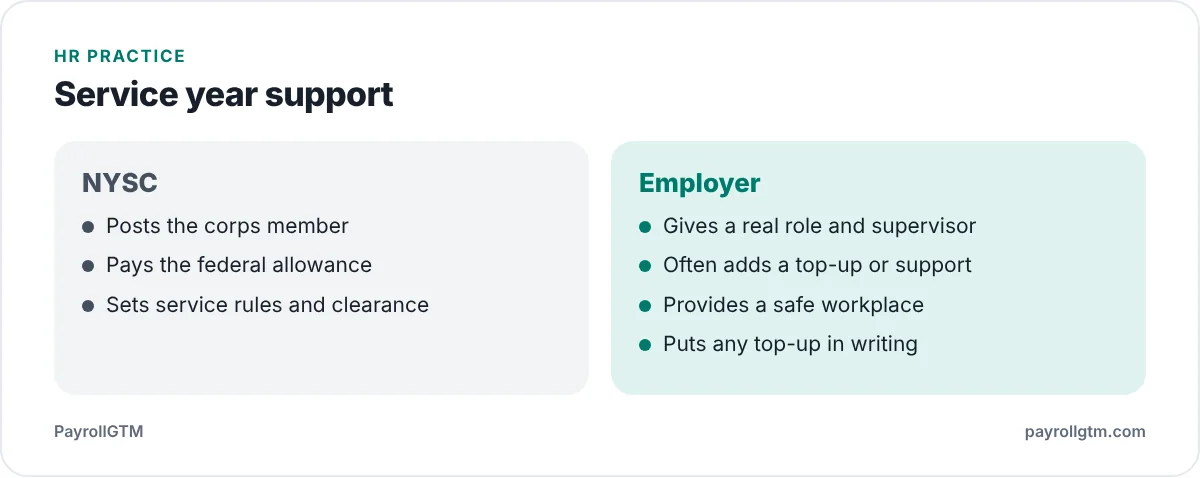
A corps member serving with your business is on national service under the National Youth Service Corps (NYSC), not on your payroll as an ordinary employee. NYSC posts them to you, NYSC pays the federal allowance, and you are expected to provide a real placement, a safe workplace and, in practice, support such as a top-up allowance or accommodation help. The rules on how employers apply for corps members, and the allowance amount, are set by NYSC and change, so we give principles here and send you to the NYSC website and your state NYSC office for the current process.
Can a small business get a corps member?
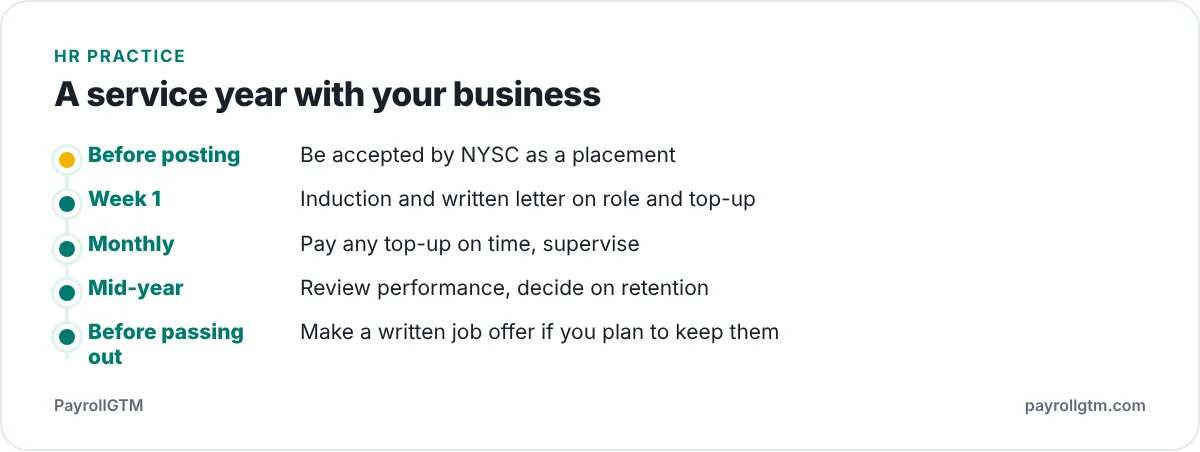
Generally, an organisation that wants corps members has to be accepted by NYSC as a place of primary assignment, through the NYSC process in its state. Acceptance usually depends on the organisation being a registered business with a real role for a graduate, a suitable and safe workplace, and the ability to supervise. We cannot state the exact checklist or timelines. Ask the NYSC state secretariat in your state what documents it wants, which probably include your CAC registration. Our registration checklist covers the documents you should have anyway.
Corps members are posted by NYSC, and you may not always get the person or the skills you wanted. Do not advertise a post as "guaranteed corps member" before NYSC has confirmed it.
Who pays the corps member?
The federal allowance is paid by NYSC. The amount is set by the government and has changed over time; check NYSC for the current figure rather than relying on a number in an article. Many employers add something: a monthly top-up, transport or lunch, or housing support, because the federal allowance often does not cover rent in a big city such as Lagos or Abuja.
There is no standard top-up. If you give one, write it in a short letter so that both sides know what it is, how often it is paid and that it can be reviewed. A verbal promise is the commonest cause of a bitter ending to a service year. Whatever you promise, you should pay on time, since a corps member has less room to wait for your cash flow than an employee has.
A practical test before you commit: add up the top-up, transport and any lunch for twelve months and ask whether the business can carry it in its slowest quarter. If the answer is no, offer a smaller package and keep to it.
Is a corps member my employee?
During the service year, a corps member is not a regular employee in the usual sense, because the relationship is set by the national service scheme. That does not mean you can ignore the person. Treat them as a member of the team: induction, a named supervisor, reasonable hours, safe working conditions and respect. Duties and workload should match the posting, and complaints you cannot resolve go through NYSC's channels in your state.
The tax and pension position of employer top-ups is a point where we cannot give you a confirmed rule. A payment from you to a corps member may count as income from the work, and a state IRS may expect it to be recorded. Ask your state IRS how it treats an employer allowance to a corps member and keep the letter and the payment records. The same applies to any housing you provide; benefits in kind tax explains the general principle that housing and similar benefits can be taxable income.
What should I give a corps member at the start?
Do the same basics you would for a new hire, scaled to a year. Give a one-page letter with the role, hours, supervisor, any top-up and its payment date, and the end date. Show the workplace safety rules and where to go if they feel unsafe. Introduce them to staff. Agree how leave and absence will work, and tell the corps member that NYSC rules, not your handbook alone, govern matters such as clearance and passing-out. The new hire onboarding checklist is a good base to adapt.
Keep personal data tidy: collect the details you need, store them securely and delete what you do not need, consistent with the Nigeria Data Protection Act. The guide on references and background checks explains the limits.
Can a corps member be asked to work extra hours or at a different place?
Only within the posting and reasonable limits. A corps member cannot be treated as free labour for jobs unrelated to the role, and a change of location or duties normally runs through NYSC, not through you. Writing hours into the letter helps. If the work is physical or in a risky place, be careful about safety; the principles in the workplace injury guide are worth following even where the legal status is different. Put the daily start and finish times and any weekend duty in the posting letter, so nobody has to guess later. If a shop or office opens late on Saturdays, say whether the corps member is expected and what time off they get in return.
What if the corps member is not performing, or misbehaves?
You cannot dismiss a corps member as you would an employee, because the posting belongs to NYSC. Handle problems early and in writing: a private conversation, a short note of what was said and what must change, and a date to review. If there is no improvement, or the matter is serious (absence without leave, theft, harassment), report it to NYSC through the channel your state office gives you and keep your records. Do not stop the top-up or send the person home on your own without checking what NYSC expects, because that can lead to a complaint against you. The fair-process habits in query, suspension and fair hearing are a good guide even though the formal route differs.
The opposite case matters too. If a corps member reports harassment or an unsafe task, take it seriously the same day and tell NYSC. A host who ignores such a complaint risks losing the right to receive corps members.
What happens when service ends?
If you want to keep the person, make the offer well before the passing-out date so they can plan. From the day they begin as your employee, the ordinary employment rules apply: a written offer and contract, PAYE, pension if you have 3 or more employees, group life cover, and the notice and leave floors. A short probation can be agreed in writing. The job offer letter template and probation period rules cover the details. Convert any top-up into a proper salary structure so that pension is calculated on at least basic, housing and transport.
If you do not plan to retain, say so honestly and give a short reference or completion letter. Corps members who finish well speak well of you, which helps next year's hiring. A first-time hirer will find hiring your first employees useful for the interview and offer steps, and low-cost benefits lists cheap ways to support a young person on a small budget, such as transport help or lunch.
Common mistakes
- Promising a top-up verbally, then paying it late or not at all.
- Using the corps member to cover a vacancy that should be a paid job.
- Skipping safety induction because "it is only a year".
- Assuming the person will stay, then losing them because no offer was made.
- Ignoring NYSC's own rules about posting and conduct.