Under the National Health Insurance Authority Act 2022, health insurance is meant to become mandatory for residents of Nigeria, but in practice most private employers still decide it by choice, usually by buying a group plan from a health maintenance organisation (HMO). If you employ people, the safest position is to cover them, put it in the contract, and choose the plan by network and claims behaviour rather than by the cheapest quote. We do not give premium figures here because they vary by plan, location, age and the benefits chosen. Get written quotes from at least three HMOs.
The legal position on enforcement is still developing. Check what applies to your business and state with the National Health Insurance Authority or your state's health insurance agency before treating this as optional.
Your four main options
| Option | How it works | Fits | Watch for |
|---|---|---|---|
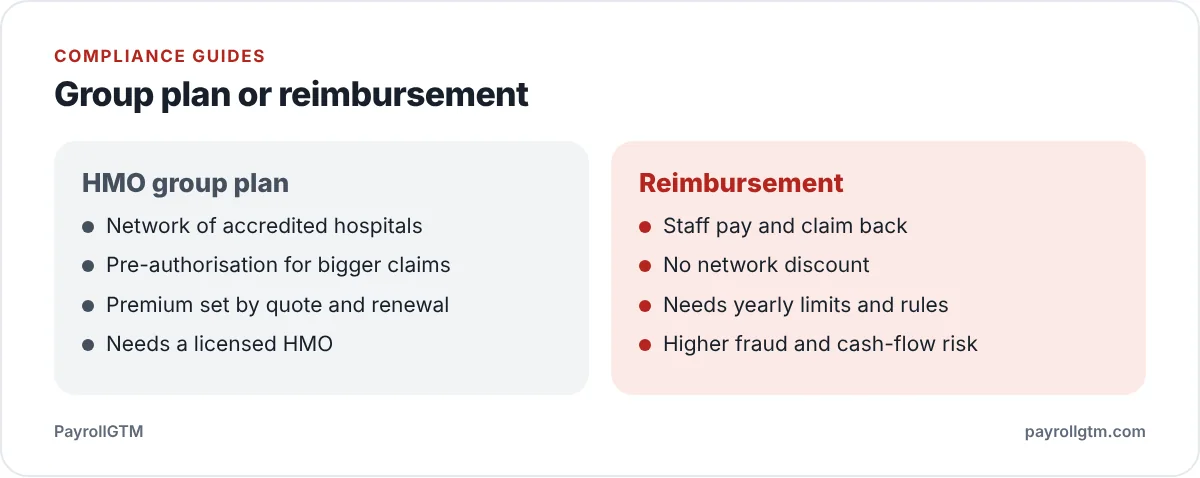
| HMO group plan | Employer pays a premium to an HMO for all staff, who use a network of hospitals | Most SMEs and larger firms | Network size in your city, claim delays, exclusions |
| Scheme linked to the national or a state health insurance programme | Contributions go through the public scheme, with care at accredited providers | Employers who want to follow the public framework | Registration steps and benefit package differ; ask the authority |
| Employer-funded reimbursement | Staff pay at a clinic and the employer refunds, often with a yearly limit | Very small teams, remote staff | Cash-flow for staff, fraud risk, no network discount |
| Nothing, or an allowance only | No plan, perhaps a medical allowance in pay | Rarely a good idea | Exposure if the law is enforced; unhappy staff after an emergency |
Many employers combine a group plan with a small top-up allowance for dependants. That is normal, provided the contract says who is covered.
How to choose an HMO
A cheap premium is worthless if your staff cannot get seen. Ask each HMO for answers in writing on these points:
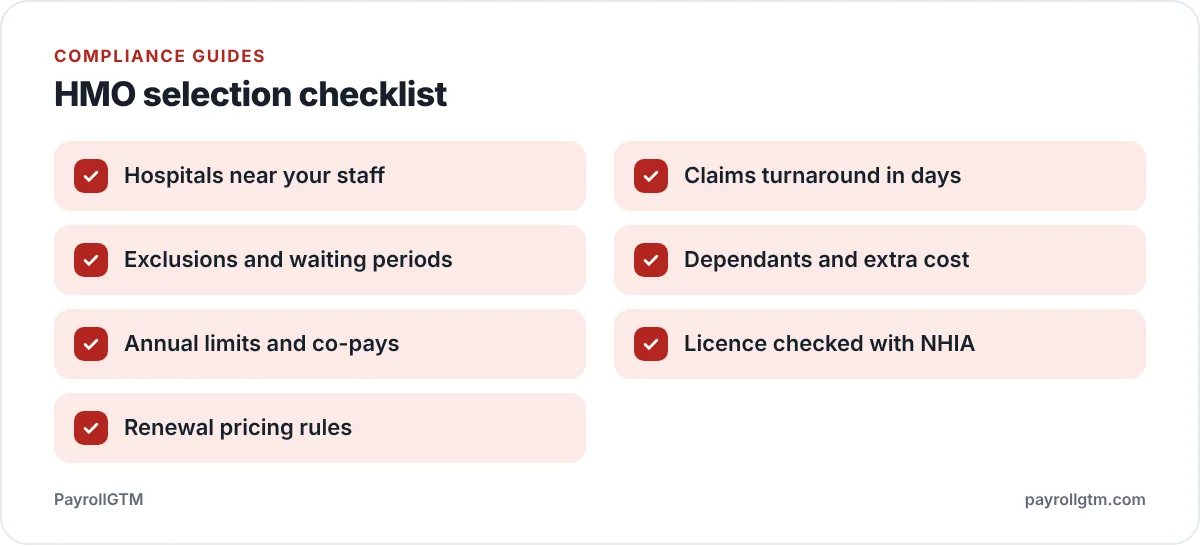
- Providers where your people live and work. A plan with excellent hospitals in Victoria Island is no use to a team in Ikorodu or Kubwa. Ask for the provider list for each location and phone two or three to confirm they actually accept the plan.
- Claims and authorisation turnaround. Ask how long a pre-authorisation for a procedure takes and what happens at night or at weekends. Ask current clients, not the sales team.
- Exclusions and waiting periods. Pre-existing conditions, maternity, dental, optical, chronic medication and surgery limits are where most disputes happen.
- Dependants. Who counts, at what extra cost, and whether the plan covers a spouse and children as standard.
- Annual limits and co-payments. What the employee pays at the clinic and what cap exists per person.
- Renewal terms. A low first-year price can be followed by a large increase after claims. Ask how renewal pricing is set.
- Regulation. Confirm the HMO is licensed by the health insurance regulator. The NHIA is the place to check.
Sit with a few staff and ask what they would use the plan for. A young team with mostly outpatient visits needs a different plan from a team with many parents and children.
What it does to payroll and tax
If the employer pays the premium, it is a benefit and a business cost. Whether any part of a benefit is taxable in the employee's hands is a question for your state IRS, and the general approach to company-provided benefits is in benefits in kind tax in Nigeria; do not assume without checking. If the employee contributes through payroll, NHIS or NHIA contributions are one of the deductions that can reduce taxable income when properly claimed and evidenced. We are not stating a cap, because none is confirmed in our sources.
The mechanics of who claims what are in the deductions that reduce PAYE. If you change payroll treatment from 2026, add it to your January 2026 employer checklist.
What to put in the contract and handbook
- Whether the company provides health insurance, from what date (day one or after probation), and who is covered (employee only, spouse, children up to a stated number).
- Who pays: the employer in full, or a split, and how any staff share is deducted.
- That the plan may change or be replaced at renewal and that the employer will tell staff in advance.
- What happens on exit: cover normally ends with employment, usually at the end of the month or the policy period; say which.
- That staff must give accurate information on enrolment, and that misuse (lending the card to relatives) is a disciplinary matter.
If you do not yet have a handbook, the clauses belong in the employee handbook. Do not promise full coverage in the offer letter and then buy a limited plan, because the offer letter is what a court or an angry employee will read.
How it fits with other employer obligations
Health insurance sits next to, not in place of, the other statutory items. The Pension Reform Act requires group life cover from the employer (group life insurance for Nigerian employers). NSITF covers work injuries through the 1% payroll levy (NSITF registration and contributions). The ITF levy is separate again (ITF compliance). An HMO plan does not discharge any of these, and an HMO will not treat a workplace injury claim as you would under the Employees' Compensation Act. Keep premium invoices, member lists and renewal letters with your other compliance records, because they are the first things an auditor or a new accountant will ask for; how to prepare for a payroll tax audit lists the documents.
Small teams, probation and part-time staff
An HMO often sets a minimum group size or a minimum number of enrolled members, so a five-person business may be quoted differently from a fifty-person one. Ask about it before you plan the budget. Decide in advance whether new joiners are covered from day one or after probation, and say so in the offer letter; the low-cost benefits for small businesses guide has other ways to look after staff when the budget is tight. Casual and part-time workers are a grey area. Cover for them depends on the plan's rules and on how you classify them, so ask the HMO and put the answer in writing. Do not leave anyone assuming they are covered when they are not.
A mistake that is easy to make
A start-up in Abuja buys the cheapest group plan in December and tells staff they are covered. In February an employee needs a scan, finds the nearest accredited hospital is a long drive away, and is told the scan needs approval that takes days. She pays cash at a private facility and sends the receipt to HR, who has no policy on reimbursement. The result is a grievance, a lost week, and trust gone. Choosing for network and turnaround and writing the claims route down in advance would have cost nothing. Look back at your plan once a year and ask staff what happened when they used it.