Pick a pay day you can meet every month without stress, and a cut-off date at least five working days earlier, after which changes wait for the next run. For most Nigerian employers that means paying on the 25th to the 28th or on the last working day, with a cut-off around the 18th to the 20th. The calendar also has to leave room for two statutory deadlines that run from the pay date: PAYE by the 10th of the following month, and pension remittance within 7 working days of paying salaries.
Choosing the pay day: 25th, 28th or last working day
There is no legal pay day for private employers. The contract or handbook sets it, and the Labour Act obligations are about paying what is owed, not about the date. Choose by cash-flow and workload, not habit.
| Pay day | Good for | Trouble |
|---|---|---|
| 25th | Staff with rent, school fees and loans due at month-end; gives payroll time before the 28th rush | Cut-off must be early (around the 15th); late starters and leavers need pro-rating or estimates |
| 28th | Close to month-end, with a cut-off around the 20th | Collides with banks' busy days; falls on weekends, so you need a rule for those |
| Last working day | Pay for the full month worked; no estimates | Payroll has almost no time; any error means late salaries; also the day most banks are slowest |
If your business collects revenue late in the month, a pay day after the last working day, such as the 3rd, can be safer than overdrafts, but staff dislike it. Whatever you choose, never move the date without notice, because late pay is the quickest way to lose trust.
Which pay day suits which business
- A 12-person shop in Aba with cash coming in daily. Pay on the 28th with a cut-off on the 20th. Takings are steady, so the fixed date is easy to meet, and the owner can do payroll himself in the days between.
- A consulting firm in Lagos that invoices clients monthly and is paid 30 days later. Pay on the last working day or even the 1st, because cash only arrives after month-end. Staff are told in the offer letter, and the cut-off is the 22nd.
- A school in Kaduna with fees paid termly. Salaries come from a bank balance built up from term fees, so choose a fixed date such as the 25th and protect it, since teachers plan rent and fees around it.
The point is that there is no best date, only one that you will always meet. Check the answer against your bank's payment cut-off times too, as described in paying salaries by bank transfer.
How the cut-off works
The cut-off is the last day on which changes (new joiners, leavers, overtime, allowances, loan deductions, unpaid leave) are accepted for the current run. After it, the payroll officer freezes the data, calculates, and sends the draft for approval. Late changes go into the next month as adjustments; the process is described in back pay, arrears and salary corrections.
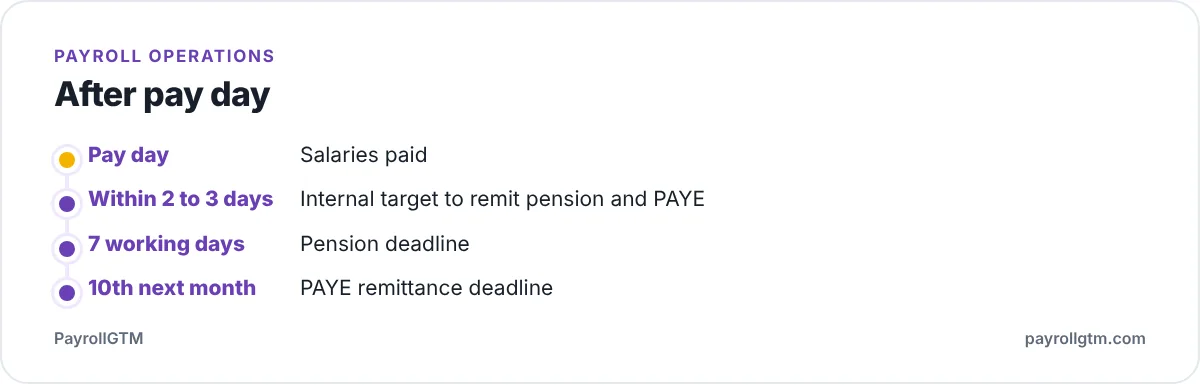
A realistic sequence for pay on the 28th:
- 20th, cut-off. HR and department heads send all changes in writing by close of business.
- 21st to 22nd, calculation. Payroll processes gross pay, pension, PAYE and other deductions. If you run it on a spreadsheet, see the payroll spreadsheet template.
- 23rd, review. A second person checks the variance against last month. This is where ghost workers and keying errors show up; how to prevent payroll fraud lists the checks.
- 25th, approval. The person who authorises payment signs the schedule.
- 26th, bank file. Upload the bulk payment, leaving a day for rejections (wrong account numbers, daily limits).
- 28th, pay day. Salaries land. If the 28th is a weekend or public holiday, pay on the last working day before it. Say so in the handbook.
What happens after pay day
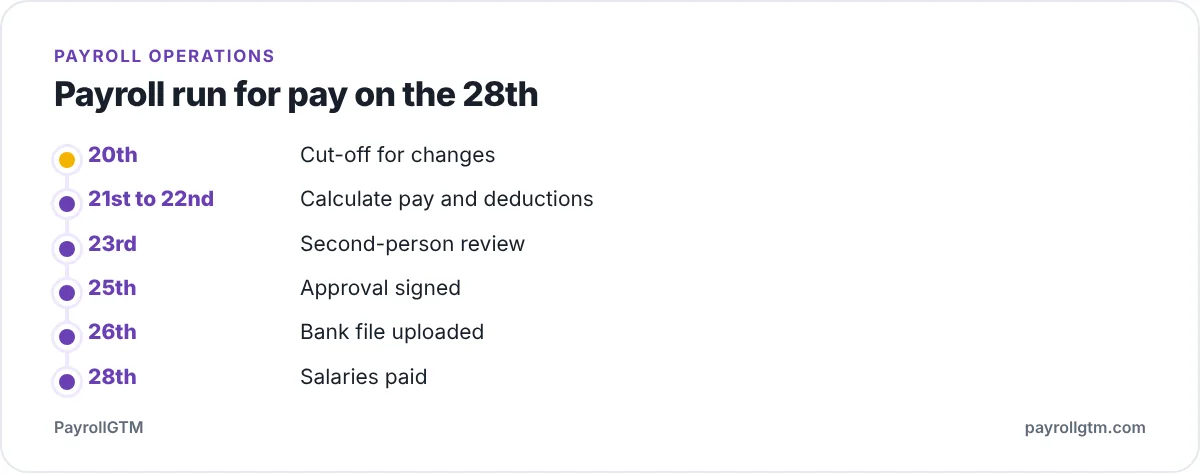
The pay date starts two clocks. PAYE deducted in a month is remitted by the 10th of the following month (state practice, confirm with your state IRS; see PAYE remittance deadlines and how to pay). Pension must be remitted within 7 working days of paying salaries, and a late payment attracts 2% of the unremitted contribution for each month of delay (the pension remittance deadline and penalty).
With pay on the 28th, seven working days later usually falls somewhere between the 6th and the 10th of the next month, depending on weekends and public holidays. Count working days properly, because a long weekend can move it. If the pay day is the 25th, the pension deadline lands earlier in the following month, usually in the first week, and the PAYE date stays the 10th. Payroll must therefore plan the remittance run as a separate task, not as something to do "after the month-end rush". A good rule is to pay PAYE and pension in the same working week as the salaries, within 2 or 3 days of pay day, so nothing waits for the deadline.
Sample calendar for pay on the 28th
This table shows a pay month with a 20th cut-off and the PAYE due date it leads to. Where the 28th is a weekend or holiday, pay on the preceding working day. We do not list public holidays because some depend on moon sighting and the Minister can declare others.
| Month worked | Cut-off | Pay day | PAYE due (state practice) |
|---|---|---|---|
| January | 20 January | 28 January | 10 February |
| February | 20 February | 28 February | 10 March |
| March | 20 March | 28 March | 10 April |
| April | 20 April | 28 April | 10 May |
| May | 20 May | 28 May | 10 June |
| June | 20 June | 28 June | 10 July |
| July | 20 July | 28 July | 10 August |
| August | 20 August | 28 August | 10 September |
| September | 20 September | 28 September | 10 October |
| October | 20 October | 28 October | 10 November |
| November | 20 November | 28 November | 10 December |
| December | 20 December | 28 December | 10 January |
Add a separate line for pension: 7 working days from each pay day. The December cycle needs extra care: staff want pay early before the festive break, banks are busy, and year-end tasks pile up, including the Form H1 annual return due on 31 January. Many employers bring December's cut-off forward by a few days and announce it in November.
Weekly and bi-weekly pay for casual staff
Casual and daily-rated workers are often paid weekly or fortnightly, and the same logic applies on a smaller scale: a cut-off a day or two before pay day, a short review, then payment. The wage is due as agreed, so do not let a casual worker's pay slide while salaried staff are paid on time. The law and classification questions around casual staff are in casual, fixed-term and permanent employees. PAYE and pension still follow the amounts paid, so keep the weekly records in a form you can total by month.
Tell people the calendar
Publish the dates for the year in January. Put them in the handbook or a notice, with the rule for weekends and holidays, the cut-off for claims and a name for queries. Staff who know that overtime sheets close on the 20th stop sending them on the 26th. A short wording works: "Salaries are paid on the 28th of each month, or the last working day before if the 28th is not a working day. Changes must reach payroll by the 20th for the same month." For a longer process see how to run payroll in Nigeria step by step, and the monthly payroll reconciliation checklist for what to check afterwards.