A working Nigerian payroll sheet needs about a dozen columns: the pay components, pensionable pay, 8% employee pension, rent relief, chargeable income, PAYE, net pay and the employer's costs. The only formula that scares people is PAYE, and it is one line once you split the tax bands into nested MIN and MAX terms. We give every formula below, tested against our PAYE calculator for four salaries. If you would rather start from a finished file, download the payroll template workbook.
The columns, in order
Row 1 holds headings and row 2 is the first employee. Every figure is monthly except the rent and chargeable income columns, which are annual.
| Col | Heading | Formula or input (row 2) |
|---|---|---|
| A | Employee | Name or staff number (input) |
| B | Basic | Input |
| C | Housing | Input |
| D | Transport | Input |
| E | Other allowances | Input |
| F | Gross pay | =SUM(B2:E2) |
| G | Pensionable pay | =B2+C2+D2 |
| H | Employee pension 8% | =G2*8% |
| I | Employer pension 10% | =G2*10% |
| J | NHF opt-in (Y or N) | Input |
| K | NHF 2.5% of basic | =IF(J2="Y",B2*2.5%,0) |
| L | Annual rent paid | Input (0 if none) |
| M | Rent relief | =MIN(L2*20%,500000) |
| N | Chargeable income (year) | =MAX(0,(F2-H2-K2)*12-M2) |
| O | PAYE (year) | The band formula below |
| P | PAYE (month) | =O2/12 |
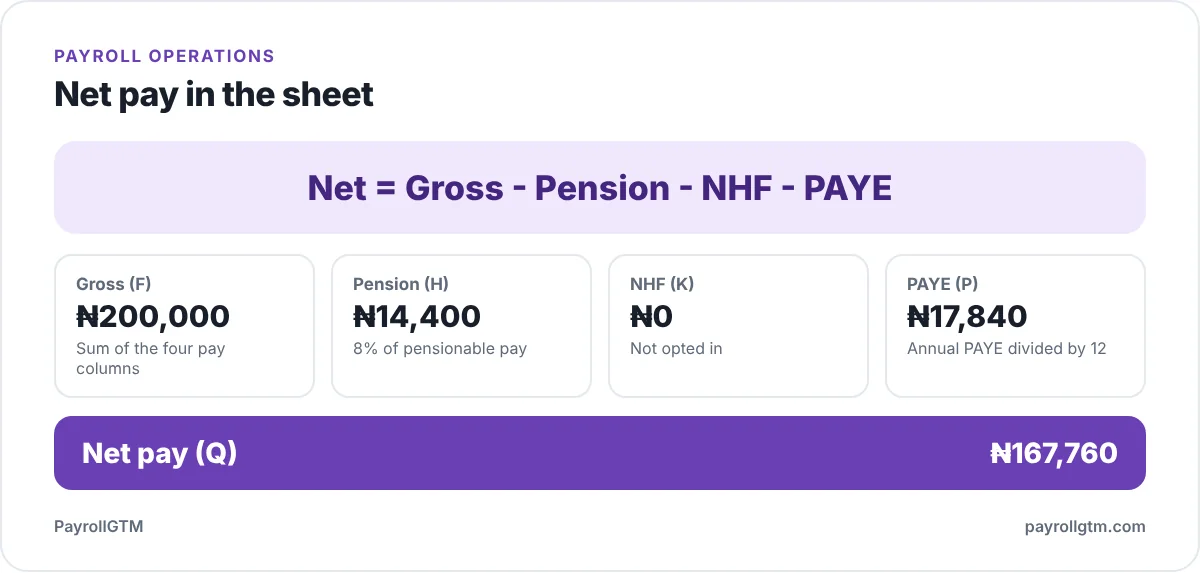
| Q | Net pay | =F2-H2-K2-P2 |
| R | NSITF 1% (employer) | =F2*1% |
Pensionable pay is basic, housing and transport, which is the statutory minimum base. If your contract defines pensionable pay more widely, change column G, not the 8%. NHF is a voluntary 2.5% for private-sector staff, so it sits behind an opt-in flag, not a default deduction. The reasoning is in our NHF guide.
The PAYE formula that works in Excel
The bands start at ₦800,000 at 0%, then 15% to ₦3m, 18% to ₦12m, 21% to ₦25m, 23% to ₦50m and 25% above. Each term below takes only the slice of income that falls inside one band. Paste this into O2:
=MAX(0,MIN(N2,3000000)-800000)*15%+MAX(0,MIN(N2,12000000)-3000000)*18%+MAX(0,MIN(N2,25000000)-12000000)*21%+MAX(0,MIN(N2,50000000)-25000000)*23%+MAX(0,N2-50000000)*25%
Read one term to see how it works: MAX(0,MIN(N2,12000000)-3000000)*18% caps income at ₦12m, subtracts the ₦3m already taxed in lower bands, floors the result at zero so a small income gives nothing, and multiplies the slice by 18%. The 0% band needs no term because tax only starts above ₦800,000, which is what the first term's "minus 800000" does. This is our own construction, not an official formula, and it follows the bands as set out in the Nigeria Tax Act 2025.
Checked against four salaries
We ran four employees through the formulas above and through the PAYE calculator. They agreed to the naira. Compare your own sheet with these before you trust it.
| Employee | Gross | Pension 8% | Rent paid (year) | Chargeable (year) | PAYE (month) | Net pay |
|---|---|---|---|---|---|---|
| Chinedu (basic 120,000, housing 40,000, transport 20,000, other 20,000) | ₦200,000 | ₦14,400 | ₦0 | ₦2,227,200 | ₦17,840 | ₦167,760 |
| Aisha (200,000 / 80,000 / 40,000 / 30,000) | ₦350,000 | ₦25,600 | ₦1,200,000 | ₦3,652,800 | ₦37,292 | ₦287,108 |
| Segun (450,000 / 150,000 / 80,000 / 70,000) | ₦750,000 | ₦54,400 | ₦0 | ₦8,347,200 | ₦107,708 | ₦587,892 |
| Zainab (700,000 / 300,000 / 150,000 / 350,000) | ₦1,500,000 | ₦92,000 | ₦3,000,000 | ₦16,396,000 | ₦239,430 | ₦1,168,570 |
Aisha's rent relief is 20% of ₦1,200,000 = ₦240,000. Zainab's is 20% of ₦3,000,000 = ₦600,000, which the formula caps at ₦500,000. Her chargeable income is (₦1,500,000 - ₦92,000) × 12 - ₦500,000 = ₦16,396,000. Employees with no rent evidence on file get ₦0 in column L, see how rent relief is claimed.
Adding the employer's side
Staff see columns A to Q. You also need the cost to the business, which is gross pay plus the employer's 10% pension plus NSITF at 1% of the monthly payroll. For Segun that is ₦750,000 + ₦68,000 + ₦7,500 = ₦825,500 a month, and the group life premium and any ITF liability come on top (ITF applies at 1% of annual payroll to employers with 5 or more staff or turnover of ₦50 million or more). Add a column S: =F2+I2+R2 and total it. The employer cost calculator gives a cross-check.
Using a Settings sheet instead of typed rates
Create a sheet called Settings with the rates in labelled cells: B1 employee pension rate (8%), B2 employer pension rate (10%), B3 rent relief rate (20%), B4 rent relief cap (500,000), B5 NSITF rate (1%). Then column H becomes =G2*Settings!$B$1 and column M becomes =MIN(L2*Settings!$B$3,Settings!$B$4). The band limits can sit in a small table too, with the PAYE formula pointing at those cells. Give the cells names (Formulas, then Define Name) and the formulas read like English. If the law changes in a later Finance Act, you change one cell and re-check the four test rows above.
Mistakes that break payroll sheets
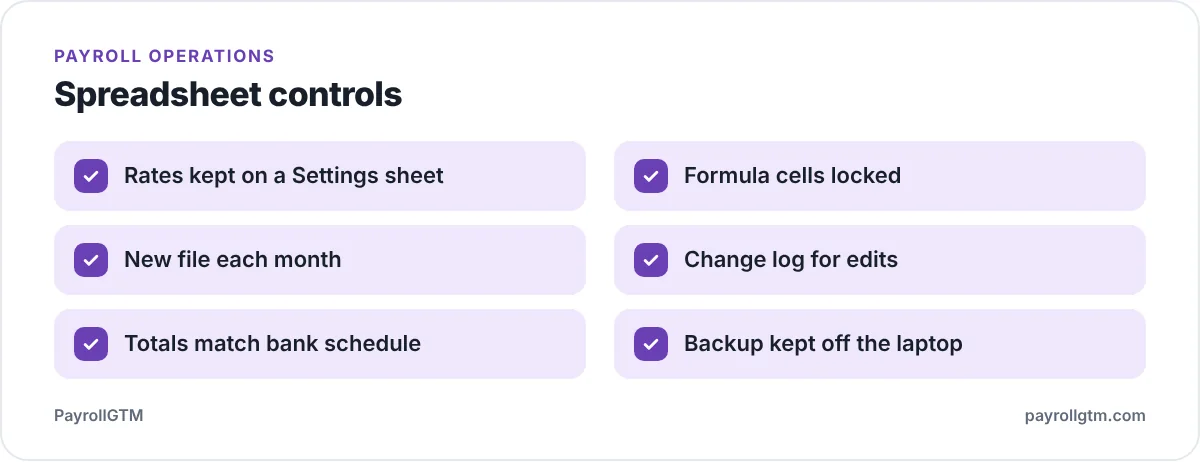
- Typing rates into every formula. We show 8% and the band limits inline for readability. In a real file, put them on a separate Settings sheet and refer to those cells, so a rate change is edited once.
- Copying values over formulas. One overwritten cell in the PAYE column is how a wrong amount survives for months. Colour input cells yellow and lock the rest.
- Using gross for pension. Column G exists so the base is visible. Our worked example in the pension examples shows what an under-based pension costs.
- Dropping a row in the sum range. Totals like =SUM(F2:F40) silently skip row 41. Use a table (Ctrl+T) so ranges expand.
- Rounding inconsistently. Decide whether PAYE is rounded to the nearest naira and apply that rule in column P with =ROUND(O2/12,0). Totals must equal the sum of the payslips staff actually receive.
- Forgetting part-month staff. New starters and leavers need prorated pay before the tax formula runs. See part-month salary calculation.
A monthly routine that fits the sheet
- Copy last month's file to a new name and clear the inputs that change (other allowances, overtime, deductions).
- Update joiners and leavers, with prorated pay for part months.
- Check that no formula cell has been overwritten: scan column O for numbers that look rounder than the rest.
- Run totals for pension, PAYE and net pay, and prepare the remittance schedules from them.
- Get a second person to approve before the bank file is uploaded.
What this sheet does not do
It treats every allowance as taxable pay, which is the simple default. It has no columns for staff loans, union dues, benefits in kind, bonuses or arrears, and it assumes a full month. Bonuses and back pay need the annual view of the tax, so handle them as described in our guide to arrears and salary corrections instead of forcing them into column E. Other deductions, such as voluntary pension or insurance premiums, can be added as an extra subtraction inside column N once the employee has given you the evidence. Ask your state IRS if you are unsure what evidence it expects.
Protect the file and keep versions
A payroll sheet is a control document, not a scratchpad. Lock the formula columns (Review, then Protect Sheet) and keep the password with someone who does not run the payroll. Save a new file each month named by period and version, for example payroll_2026-11_v2, and never overwrite last month's. When a figure changes after approval, record who changed it, why and when. That trail is also your answer to a ghost-worker question; read how to prevent payroll fraud and ghost workers for the controls around who can add a name.
Before you pay anyone
Compare the sheet total with the bank schedule, and check that pension, PAYE and net pay add back to gross. The steps are in the monthly payroll reconciliation checklist, and the overall sequence is in how to run payroll in Nigeria. Payslips should show each column staff would expect, see what a payslip should include. If you only need to check a figure, the payroll calculator will do one salary in seconds.
A spreadsheet works well up to a few dozen staff when one careful person owns it. When the manual checks start taking longer than the payroll, compare the options in payroll software against spreadsheets.