Kemi hands in her resignation at a Port Harcourt distribution company on a Friday, with a month's notice. By Monday she is asking the question most leavers ask: "What happens to my pension?" The short answer is that nothing is lost. Your retirement savings account (RSA) is yours, it stays with your pension fund administrator (PFA), and it carries on with your next employer under the same RSA PIN. What you do need to do in your last month is check that the contributions up to your exit date have been paid.
The RSA does not belong to the employer
Your employer never holds your pension. Each month the 8% from you and the 10% from the company go into the RSA you opened with your PFA. When you resign, are dismissed or are made redundant, the account stays where it is, with the same PIN and the same PFA. Nothing needs to be "closed" or "cashed out" at the exit. If you want the background on how the account, the PFA and the funds fit together, read RSA and PFA explained for Nigerian employees.
If you never had a PIN, a new job is the moment to fix that. How to open an RSA and get your PIN covers it. If you do have one, do not open a second account at the next employer, however much their HR form seems to want a fresh start.
What the employer still owes you in the final month
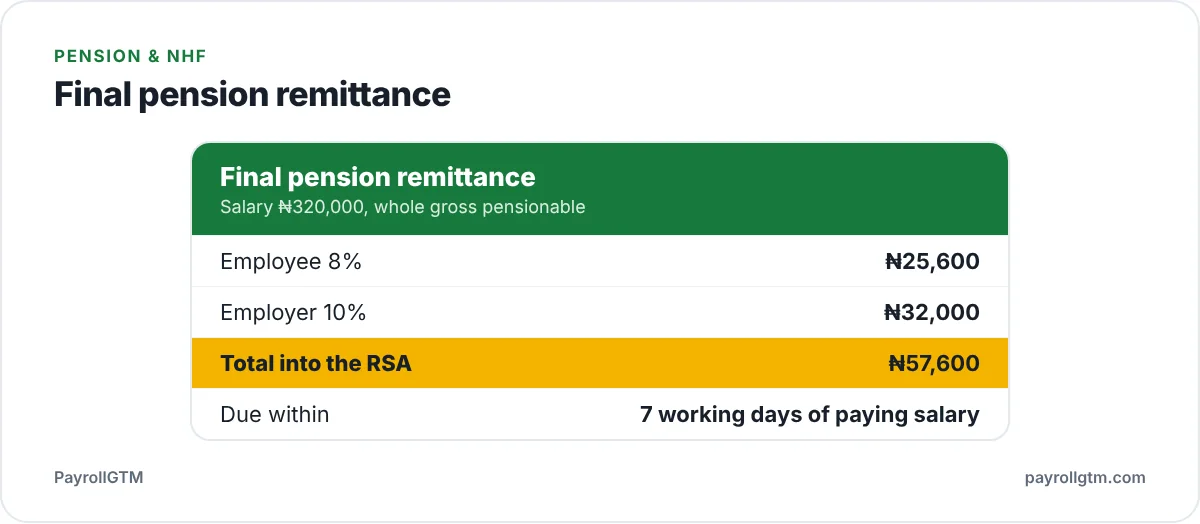
Pension is calculated on the pay you actually received, so the last salary (full or pro-rated) attracts its own 8% and 10%. The employer's duty to remit within 7 working days of paying salaries applies to that final payment too. This is where leavers get caught, because the final payslip is often prepared by hand, late, and outside the normal payroll run, and the pension line is the one that gets forgotten.
The minimum base is basic, housing and transport, as explained in how pension contributions are calculated. Whether a payment for unused leave or pay in lieu of notice is added to the base depends on the contract and how payroll treats it, and this is not something to guess. Ask HR to show the computation on paper, and ask your PFA or PenCom if the amount is large.
Check your account before you leave
Do this in your last two weeks, while HR still has someone to answer you:
- Log in to your PFA's portal or request a statement. Look at the last 12 months of credits and compare each with your payslip pension line.
- Note any month that is missing or short. Put it to HR in writing, with the month and the amount, and ask for the date of remittance and the payment reference.
- Ask for a copy of the remittance schedule for your last salary month, and when it will be paid.
- Confirm that your name, date of birth and PIN on the PFA's records are correct, so the last credit lands.
A late employer pays a penalty of 2% of the unremitted contribution for each month of delay (see the pension remittance deadline and penalty guide), but the penalty does not replace what is missing from your account. Your first aim is to get the money in. If HR will not respond, the PFA can raise the gap with the employer, and PenCom is the regulator you can complain to.
If contributions were never paid
Sometimes the statement shows gaps of several months, or nothing at all, although the payslip says pension was deducted. Do not resign angrily and leave it for later. Collect every payslip, the statement, and any HR emails, and write to the employer asking for the missing remittances with dates. Send a copy of that complaint to your PFA. The employer's lateness penalty (2% of the unremitted amount per month) is calculated on what they should have paid, so a long gap becomes expensive for them, and that is usually what gets the money moving. Unpaid contributions do not disappear when you leave, but they are far easier to recover while you still have a working relationship and your payslips to hand.
Group life cover ends with the job
The employer must hold group life insurance for staff, and the premium is theirs (see group life insurance for Nigerian employers). That cover is tied to employment. When you leave, it stops. If you have dependants and no personal life cover, a gap between jobs is a real gap. Ask HR for the date the cover ends, and consider a personal policy if the next job is not lined up.
What happens to the balance while you are between jobs
Your PFA keeps investing the balance in the fund you are placed in, and fees continue as set out in the PFA's schedule, so the value can go up or down. Nothing about the exit changes the tax position: contributions were deductible when you made them, and benefits under the Pension Reform Act are tax-exempt. If you are close to retirement age, the options are different, and retirement benefits: lump sum, annuity and programmed withdrawal explains them. Keep your PFA's contact details and update your phone number and email with them, because statements and alerts go to what they hold on file, not to your old work address.
Starting the next job
Give your new employer your PIN and the name of your PFA on or before day one, in writing. They have to remit into your existing RSA. If you want to change PFA, do it deliberately and not by letting a new employer register you somewhere else; the steps are in how to change your PFA and transfer your RSA.
If there is a gap between jobs, your RSA simply stops receiving contributions, and the balance stays invested. Two things follow. First, a person who has been out of employment for 4 months can request 25% of the RSA balance; the PFA or PenCom will confirm the process, the proof they need and the current conditions. Think hard before doing so, because that money stops growing for retirement. Second, up to 25% can be used as equity contribution for a residential mortgage; the details are in the guide to the 25% housing withdrawal.
Exit-month checklist
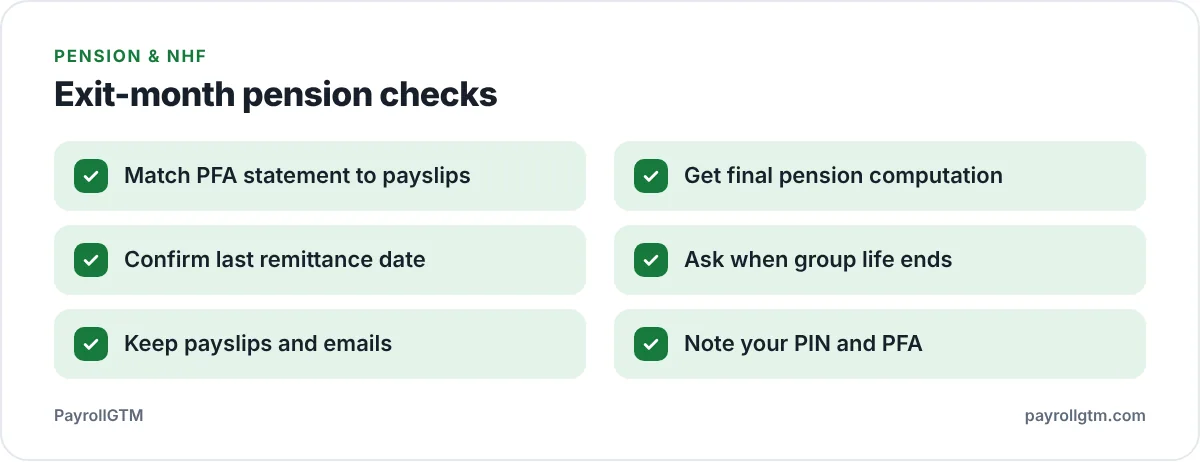
- Get your PFA statement and match it to your payslips.
- Ask HR for the pension computation on the final pay, in writing.
- Confirm the date the last remittance will be made.
- Find out when group life cover ends.
- Keep copies of payslips and any email with HR about pension.
- Write down your PIN and PFA before you lose your work email.
If you are the employer
Remit the final contributions with the same discipline as any other month, and keep the evidence. A PenCom compliance certificate looks at remittance history, and a gap left by a departed employee is still a gap; see the PenCom compliance certificate guide and the broader pension compliance guide for SMEs. Put the pension check on your standard exit list so it does not depend on someone remembering.