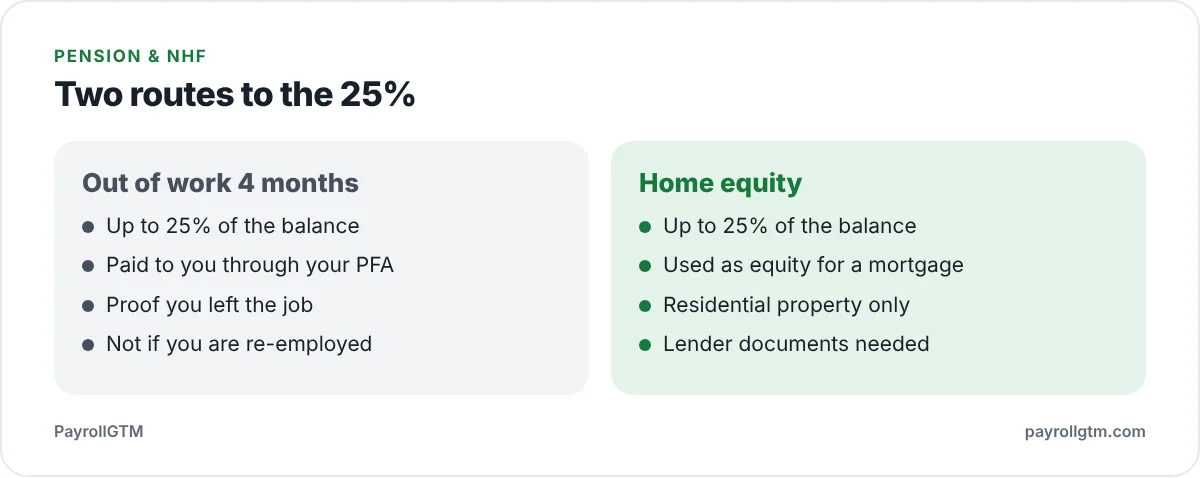
You can take money out of your RSA before retirement in two situations, and in both the limit is 25% of the balance. One is after you have been out of employment for 4 months. The other is using up to 25% as an equity contribution towards a residential mortgage, under a PenCom guideline. Outside those, and retirement from age 50 or on incapacity, the money stays put.
Which route are you on?
The two routes solve different problems, and picking the wrong one wastes weeks. Use the table to see where you fit.
| After job loss | Housing equity | |
|---|---|---|
| What triggers it | Out of employment for 4 months | Buying a residential property with a mortgage |
| How much | Up to 25% of the RSA balance | Up to 25% of the balance as your equity contribution |
| Who can say yes | Your PFA, under PenCom rules | Your PFA, after the mortgage arrangement is in place |
| What it is for | Cash while you look for work | The deposit part of the purchase |
| Typical proof | Evidence you left the job and have not been re-employed | Offer or sale documents and mortgage approval from the lender |
"Typical proof" is our reading of how PFAs behave, not a list from the Act. Your PFA may ask for more, including a signed declaration that you are unemployed. If you have started a business, say so honestly. Being self-employed is not the same as being out of employment in every PFA's reading, and a false declaration puts you in a worse position than waiting.
The 25% after four months without a job
The rule in our reference sources is that a person who has been out of employment for 4 months may request 25% of the balance. The clock runs from your last day of work, so a resignation letter that gives a date and a termination letter both help you prove the start. If you were paid in lieu of notice, ask your old employer to state the last day in writing.
What does not qualify, on the plain reading: taking leave without pay while the job is still there, moving between two employers with a short gap, or changing from one employer to another. If you were re-employed in month three, you are not covered.
Two practical points. First, check the remittance. Your last employer's final contributions should reach the RSA within 7 working days of paying your last salary, so check the balance has caught up before you apply. What happens to your pension when you leave a job sets out what to check on exit. Second, the PFA decides how quickly it pays. Do not plan rent or school fees around a date you have not been given in writing.
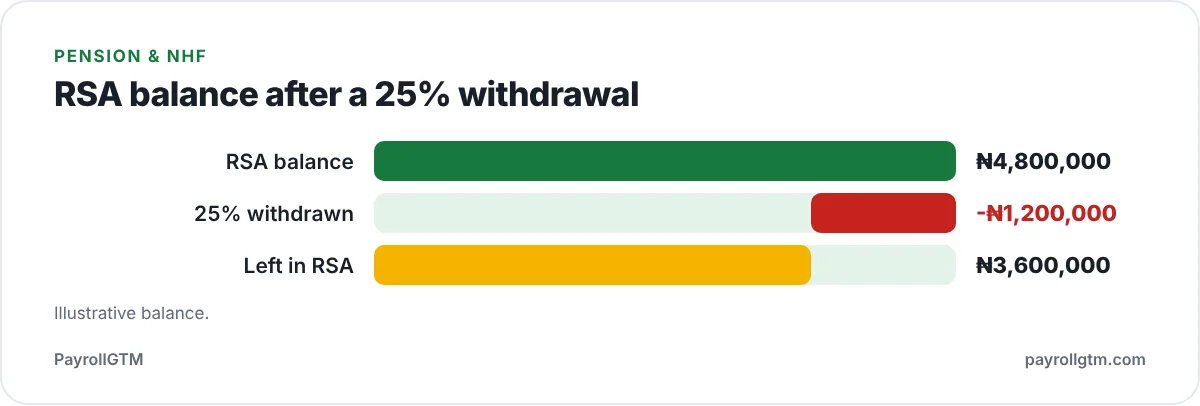
25% of ₦4,800,000 = ₦1,200,000 paid out.
Remaining balance = ₦4,800,000 minus ₦1,200,000 = ₦3,600,000.
The ₦3,600,000 stays invested and, when Chinedu works again, new contributions go on top of it. He cannot go back and ask for more under the same rule on the same balance. The pension benefits themselves, paid under the Pension Reform Act, are not taxed.
Using the RSA as equity for a house
A PenCom guideline lets up to 25% of the RSA balance be used as an equity contribution for a residential mortgage. "Equity" is the part you put in yourself; the lender covers the rest. This is a payment towards the property, not cash you can spend as you like. Expect the PFA to pay it into the transaction, not into your personal account, and expect the lender or developer to be involved.
It is the route for someone who is still employed and has a stable salary. The conditions are tighter in one way: the home must be residential, and the guideline is aimed at a mortgage purchase, not at paying rent or funding a building project from scratch. Whether a land purchase, an off-plan unit or a self-build qualifies depends on the PenCom guideline in force and on your PFA, so ask before you pay a deposit anywhere.
The 10% equity figure here is only an illustration. Lenders set their own, and the FMBN and private mortgage banks differ. Ask the lender for the figure in writing.
What using it does to your retirement benefit
Taking 25% out lowers your balance, and with it the base on which future investment returns accrue. In Chinedu's case, ₦1,200,000 no longer earns anything inside the fund. Nobody can promise what that costs at retirement because returns vary by fund and year, and we will not invent a number here. The direction is certain: a smaller balance earlier means a smaller pot at 50 or 60, unless you replace it with voluntary contributions.
If you later buy a home with the equity, the property may be worth more than the forgone returns, but that is a judgement about the house, not about the pension. When the time comes, retirement benefits as lump sum, annuity or programmed withdrawal explains how the remaining balance pays out. Plan on the smaller figure.
What to do, in order
- Log in to your PFA portal or ask for a statement and read your current balance. Confirm that your employer's last contributions arrived; the pension contribution calculation tells you what should be there.
- Decide which route you are on. Do not apply under unemployment if you are about to start a job, and do not sign a property agreement before the PFA confirms the mortgage route.
- Ask the PFA for the current checklist in writing, including forms, who signs, and how long payment takes.
- Gather the proof: ID, RSA PIN, exit letter or lender documents, bank details in your own name.
- Apply, keep the acknowledgement, and follow up after the stated period.
- Check the balance afterwards and keep the statement with your tax records.
If your PFA is slow or says no
First ask for the refusal in writing with the reason. A rejection is often a missing document, or an employer that has not finished remitting. If the PFA cannot explain, the next step is a written complaint to PenCom, whose contact details are on its website. Switching PFAs may help with service but does not change the rules; see how to change your PFA before you move, and ask whether a transfer would delay a request already in progress.
Employers can be the cause too. If your old company has not remitted, the shortfall is the employer's breach, and the PenCom compliance certificate is one way to see whether the company is in good standing. For the full list of what a worker is entitled to, read employee rights under the Pension Reform Act. If you do not yet have an RSA at all, begin with opening an RSA and getting a PIN, and RSA and PFA explained if the terms are new.