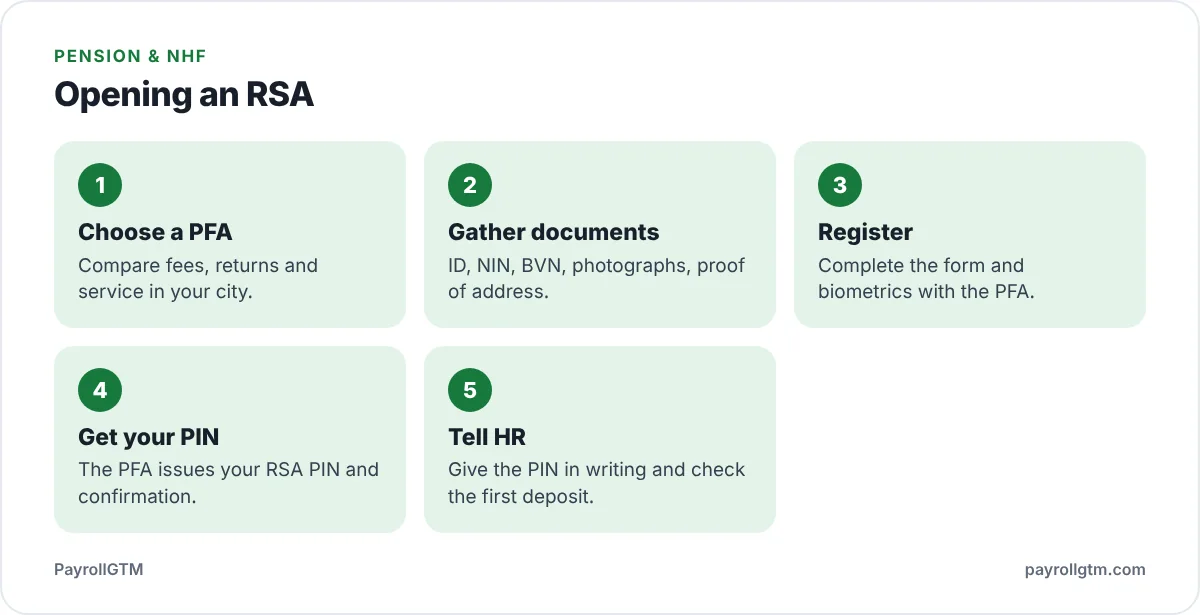
You open a retirement savings account (RSA) by choosing a pension fund administrator (PFA), completing its registration form with your identity documents, and having your details captured by the PFA. The PFA then issues your RSA PIN, which is the number your employer uses to remit your pension. Most people take 2 to 4 steps and a few weeks from first contact to a usable PIN, though the exact documents and timing are set by each PFA, so confirm them before you go.
Who needs an RSA
Every employee in an organisation covered by the Pension Reform Act 2014 needs one. The Act applies to employers with 3 or more employees (not 15, as some websites say). If you work for such an employer, your 8% and the employer's 10% have nowhere to go until your RSA exists. Self-employed people and staff of very small firms can open one too, as a way of saving for retirement; the rights the Pension Reform Act gives employees explain what is yours either way.
If you already have an RSA from a previous job, you do not open another. The account belongs to you, not to the employer, and it moves with you. Skip to the section on giving your PIN to HR.
Step 1: Choose a PFA
You choose the PFA. Your employer may suggest one, and in practice some employers register staff with a PFA if they have not chosen, but you can pick another. Compare these things, which are the ones that affect you:
- Fees. PFAs charge fees that are regulated by PenCom. Ask each one for its current fee schedule in writing rather than relying on a friend's memory.
- Past returns. Ask for the return of the fund you will be placed in (funds differ by age and risk). Past returns do not guarantee future ones, but a PFA that cannot show them is a bad sign.
- Service. Is there a branch or agent in your city? Can you check your balance on an app or by statement? How quickly do they answer a call?
- Your employer's convenience. A payroll team that already remits to one PFA finds it easier to add you, but that is the employer's convenience, not a reason on its own.
The background on how the accounts and funds work is in RSA and PFA explained.
Step 2: Gather your documents
PFAs set their own checklists, and they change. These are the items commonly requested, so treat the list as a guide and ask the PFA for its current one:
- A valid government ID, and your NIN (National Identification Number). The NIMC issues NINs if you do not have one.
- Passport photographs.
- Your BVN (Bank Verification Number).
- Proof of address, such as a utility bill.
- Your employer's details: name, address, and the date you started.
- Details of your next of kin or beneficiaries.
A new-hire pack that includes these saves everyone time; see the new-hire onboarding checklist for where pension registration fits.
Step 3: Complete the registration
You fill in the PFA's registration form, either online or on paper at a branch or agent, and sign it. PFAs generally capture biometric data (a fingerprint and photograph) and verify your NIN or BVN. Some do part of this online and some insist on a visit. Ask which applies before you take time off work.
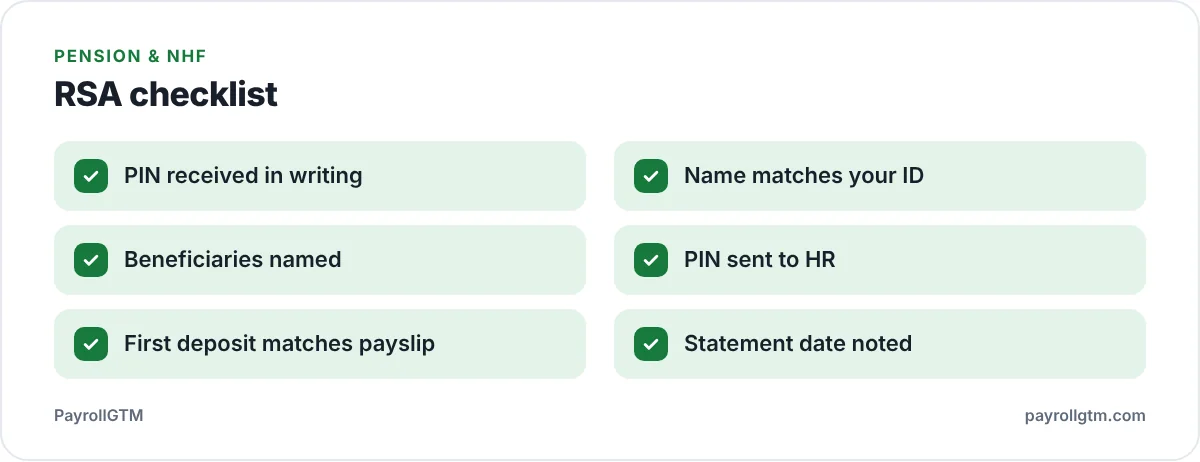
Pay attention to two details. First, the spelling of your name and your date of birth must match your ID. A mismatch is the commonest reason a PIN is delayed or contributions are rejected later. Second, name your beneficiaries accurately, because they decide who receives the balance if you die.
Step 4: Receive your RSA PIN
When registration is complete the PFA gives you your RSA PIN, along with an account confirmation. How you receive it (letter, email, SMS, the PFA's app) depends on the PFA, and how long it takes does too. If more than a few weeks pass, call and ask for the status; do not wait for months. Keep the PIN with your important documents. It is not a secret like a bank PIN, since your employer needs it, but treat it as personal data.
Step 5: Give the PIN to HR and check the first remittance
Take your PIN and PFA name to HR or payroll in writing or by email. They need it to remit your 18%. The employer should remit within 7 working days of paying your salary (see the pension remittance deadline and penalty), so within about a month of giving them the PIN you should be able to see the first deposit.
Log in or request a statement after the first remittance and check that the amount matches your payslip line. If it does not match, ask HR for the remittance schedule before assuming the PFA is at fault. The pension contribution calculation shows how the right amount is worked out.
Why a PIN gets delayed
Three causes account for most of the waiting, and all three are in your control. The first is a name or date of birth that differs between your ID, your BVN and your form, so write them exactly as the documents show. The second is an unreadable fingerprint or photo, which some PFAs ask you to repeat at a branch. The third is an incomplete employer section: if HR has not stamped or supplied the start date and company details the PFA wants, the form sits in a queue. Ask HR for the employer details before you submit, not after the PFA calls you.
If you are a business owner registering staff who have no RSA yet, give each person a week to choose a PFA and collect documents, then book payroll time for the first remittance. Do not pick a PFA for everyone by default, because the right to choose belongs to the employee.
What if you started work without one?
Start now. An employer who has been deducting your 8% but has not been able to remit it for lack of a PIN has a problem, because PenCom checks remittance when it issues compliance certificates (see the PenCom compliance certificate guide). Ask HR in writing what has been deducted since your start date, and where it is now. Contributions made in the meantime should be remitted once the PIN exists. If you have worries about missing amounts, the PFA and PenCom are the right bodies to ask, and PenCom is the regulator.
Opening a second RSA by mistake
If you left a job years ago and cannot remember whether you had one, ask the previous PFA or employer before registering a new one. A second RSA splits your savings and creates paperwork when you retire or withdraw. If it has already happened, ask a PFA about the process for consolidating, because they will need your details from both. To move between PFAs deliberately, use the process in how to change your PFA and transfer your RSA. And when you eventually change jobs, what happens to your pension when you leave a job explains why the same account carries on.
If you later want to use part of the balance for a house, the 25% withdrawal for housing is set out separately, and PenCom or your PFA confirms the current rules.