An RSA (retirement savings account) is your own pension account. It stays with you for life, whichever employer you work for. A PFA (pension fund administrator) is the PenCom-licensed company that opens it and invests the money. You choose your PFA, your employer does not, and the PIN on the account is what lets any employer pay into it. Everything else in the system is detail around those three facts.
The terms, in plain words
- RSA. Your personal retirement savings account. Contributions from you and your employer are paid in, and the balance is yours.
- RSA PIN. The number that identifies the account. Your employer needs it to remit correctly.
- PFA. The licensed company that opens your RSA and invests the contributions.
- PFC (pension fund custodian). A separate licensed institution that holds the assets. The administrator decides how to invest, the custodian keeps the assets safe.
- PenCom. The National Pension Commission, which licenses the PFAs and supervises the scheme.
The split between administrator and custodian is deliberate. If the administrator makes a bad decision, the assets are not in its hands.
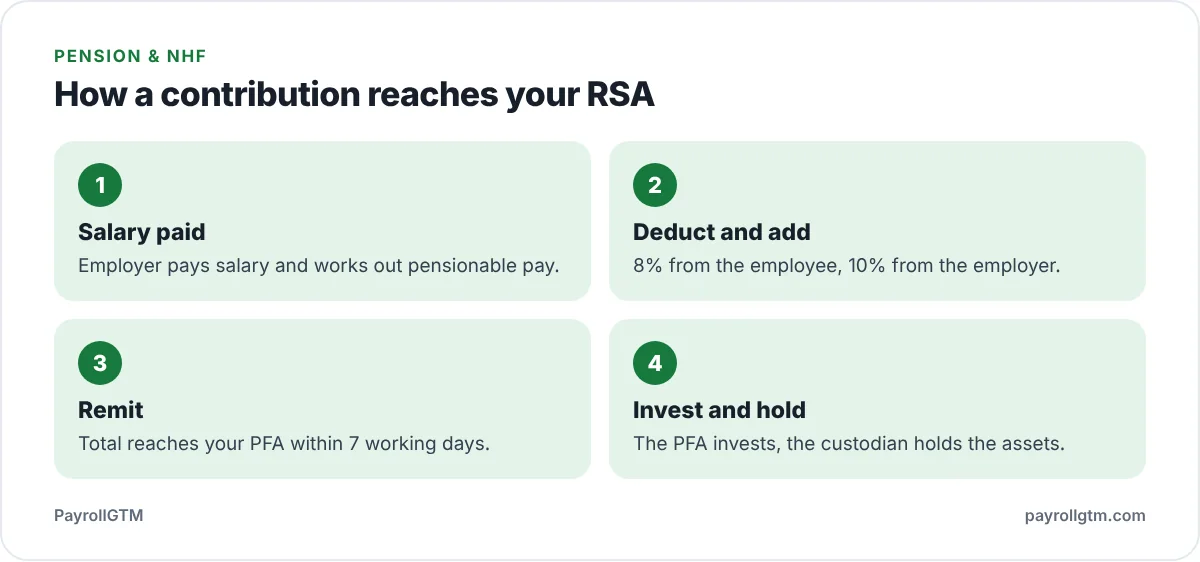
How a contribution reaches your account
The Pension Reform Act 2014 applies to employers with 3 or more employees. The minimum is 18% of monthly emoluments, with 8% from you and 10% from the employer, calculated on at least basic salary, housing and transport. Your 8% is deducted from salary, the employer adds its 10%, and the total must reach your PFA within 7 working days of the salary being paid. Our guide to calculating pension contributions has the full method.
Kemi earns ₦150,000 a month: basic ₦90,000, housing ₦30,000, transport ₦20,000, and ₦10,000 in other allowances. Pensionable pay is ₦140,000. Her 8% is ₦11,200 and her employer's 10% is ₦14,000, so ₦25,200 goes to her RSA each month. Her monthly PAYE, after the pension deduction, is ₦10,820 and her take-home is ₦127,980.
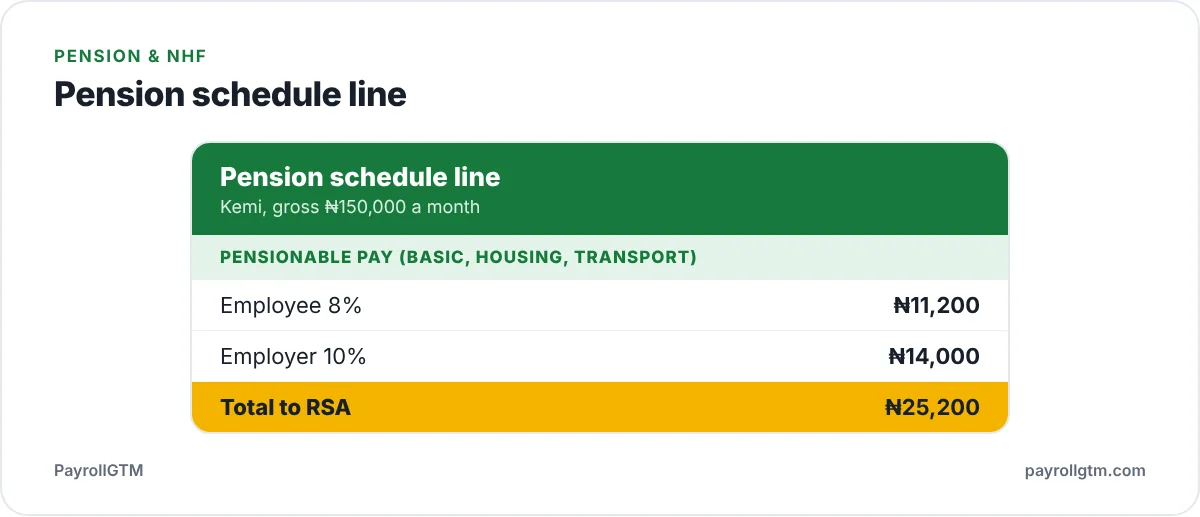
Who chooses the PFA
You do. An employer may invite a few PFAs to explain their services, but it should not pick one for you or refuse to pay into the one you chose. If you start a job and have no RSA, you open one with the PFA you prefer and give the new employer the PIN. If you already have an RSA, do not open a second one. Hand over the existing PIN. How to open an RSA and get a PIN walks through the paperwork.
How to choose a PFA
All licensed PFAs work under the same law, so the differences are in service and results. Ask these questions before you sign:
- Is it licensed? Check with PenCom (pencom.gov.ng) and not with a sales agent.
- What are the returns over several years? Compare the same fund type across years, not one good quarter.
- Can you reach someone? Look for a working portal for balances and statements, and an office or agent you can visit.
- Are the statements clear and on time? You will rely on them to catch missing months.
- Is it easy for your employer? A clear remittance schedule format saves your payroll team time.
Contributions go into funds with different risk levels. PenCom sets the fund types and which age groups they suit, with younger contributors generally in funds with more growth assets and older ones in more cautious funds. Ask your PFA which fund you are in and whether you can move, within PenCom's rules.
Changing your PFA
You can transfer your RSA to another PFA, but PenCom limits how often. The request is made through the new PFA, and then you must give your employer the new details so remittances go to the right place. Until your employer has them, money keeps flowing to the old account. The steps and the current limit are in how to change your PFA. Check PenCom's current guideline before you apply.
Voluntary contributions
You may pay in more than the minimum. Voluntary contributions can reduce your taxable income when properly claimed, but withdrawal terms differ from the compulsory part, so ask your PFA in writing before you commit money. The tax side is covered in voluntary pension contributions.
What goes wrong, and what it costs
A name or PIN mismatch is the usual cause. Late remittance is the other: the penalty is 2% of the unremitted amount for each month of delay (PRA s.11). To avoid both:
- Check every PIN and name against the PFA record when someone joins and again each January.
- Update payroll in the same month an employee changes name, with a copy of the supporting document, and ask the employee to tell the PFA in writing.
- Submit one schedule per PFA each month, listing PIN, pensionable pay and contributions.
- Check your own statement every quarter and confirm that every month shows a credit.
If a month is missing, tell your employer in writing first, then the PFA, and then PenCom if it is not fixed. Employers can show they are up to date with a PenCom compliance certificate, and the pension compliance guide for SMEs sets out the employer side.
Common questions
Can my employer keep my contributions instead of paying the PFA?
No. Deducted contributions must be remitted to your RSA within the statutory time. Keeping them is a breach.
What happens to my RSA if I change jobs?
Nothing. Give the new employer your PIN. See what happens to your pension when you leave a job.
What if I lose my PIN?
Your PFA can confirm it after verifying your identity.
Can I withdraw when I leave a job?
Not freely. Retirement access starts from age 50. After 4 months out of work you can ask for up to 25% of the balance, and up to 25% may go towards a residential mortgage equity contribution under PenCom's guideline. Confirm the current procedure with your PFA. See retirement benefits and the 25% housing rule.