A PenCom compliance certificate is the paper (or portal record) that tells a third party your business is meeting its pension obligations under the Pension Reform Act 2014. Employers usually need one when a client, a tender, a bank or a government agency asks for proof of pension compliance before awarding or renewing a contract. It is not something the law makes every employer hold for its own sake, but if your work depends on contracts with larger organisations, you will meet the request sooner or later. The application route, forms, fees and validity period are set by PenCom and can change, so check pencom.gov.ng or ask your PFAs for the current procedure before you start.
What the certificate is really checking
We have not seen PenCom's current application form, so we will not describe its fields. What we can say with confidence is what the underlying law expects, because that is what any compliance review comes down to.
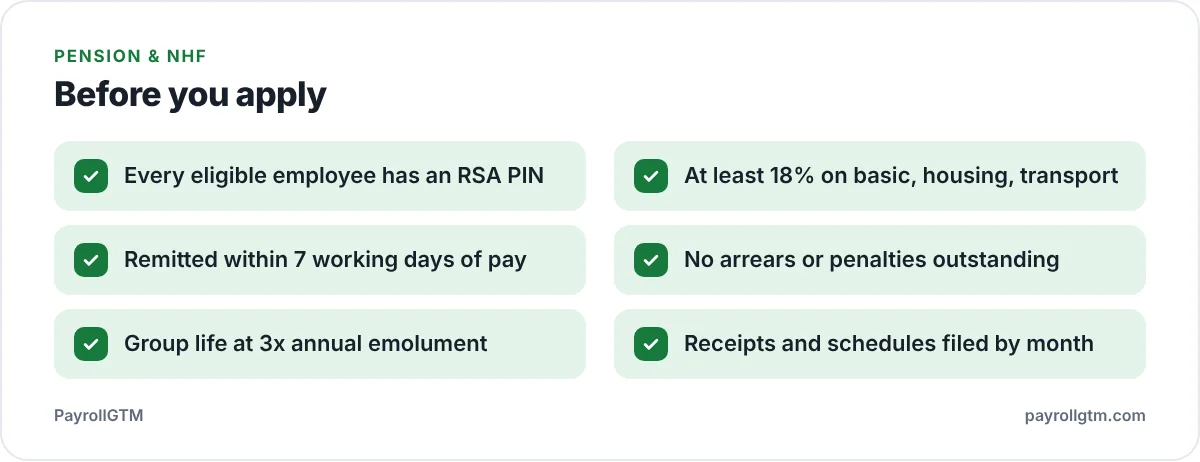
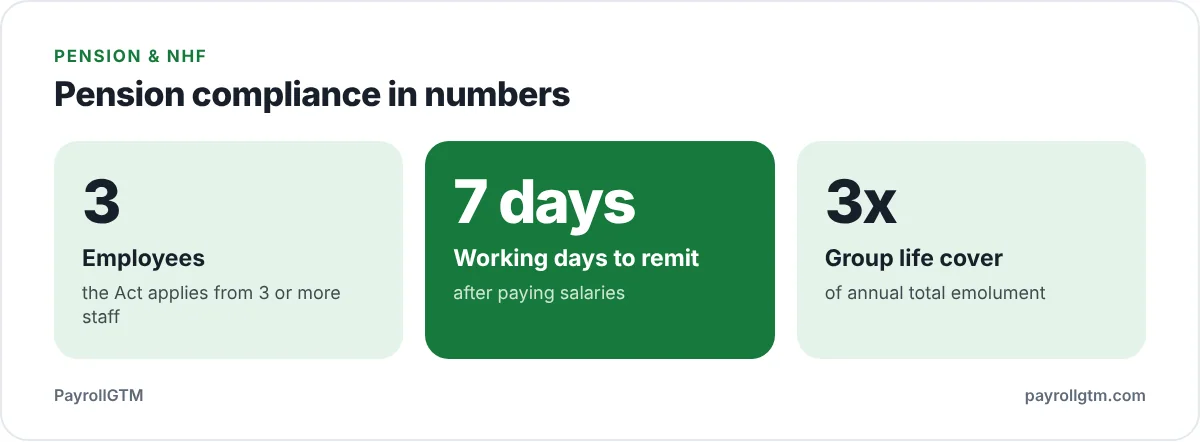
- Every eligible employee is enrolled. The Act applies to employers with three or more employees. Each person on your payroll should have an RSA with a PFA of their choice and an RSA PIN. Staff without a PIN are the commonest gap, which is why opening an RSA and getting a PIN belongs in your onboarding.
- Contributions are at the legal minimum. At least 18% of monthly emoluments (employee 8%, employer 10%), or 20% from the employer if it bears the whole cost, on a base of at least basic, housing and transport.
- Contributions are remitted on time. Within 7 working days of paying salaries, into each RSA. Late remittance attracts 2% of the unremitted amount for each month of delay (PRA s.11).
- Group life insurance is in place. Cover of at least three times annual total emolument, with the employer paying the premium (PRA s.4(5)).
If one of these four is shaky, fix it before applying. An application that exposes arrears gives PenCom a reason to look closely at you.
When you actually need one, and when you do not
Do not apply just because a competitor mentioned it. Ask the party requesting proof exactly what they will accept. Some will take a PenCom certificate, some will accept recent PFA remittance schedules, and a few will want both, so a short email asking "what evidence of pension compliance do you need, and for which period?" saves a wasted application. Public procurement and large corporate vendor lists are the usual places where the request appears. A business with two employees falls below the three-person threshold and may have no pension duty at all, in which case there is nothing for a certificate to certify; but check the headcount honestly, because part-time and fixed-term staff on your payroll may still count. See pension for contract and casual staff for how those staff are treated.
It also helps to give one person ownership. In a small firm that is usually whoever runs payroll, with the owner signing off the schedule. Put the remittance date, the PFA statements and the insurer's renewal date in the same calendar, so that nothing depends on memory.
Step 1: Reconcile your pension records
Start with a table of every person you have paid in the last 12 months or so, including people who have left. For each, you want the PFA, the RSA PIN, the monthly pensionable pay, the amount deducted, the employer's share and the date each contribution reached the PFA. Match it to the PFA contribution statements and your bank debits. The pension contribution calculation shows the formula to recheck each row.
Zainab runs an events company in Port Harcourt with six staff, each on ₦250,000 a month with the whole gross treated as pensionable (we use that simplification here). Per person the 8% employee share is ₦20,000 and the 10% employer share is ₦25,000, so ₦45,000. For six that is ₦270,000 a month to the PFAs.
Her bank shows she remitted for only five people in March, because a new hire's PIN was missing, and sent that sixth person's ₦45,000 in June. The unremitted amount stayed out for three months. At 2% per month of delay the penalty reads ₦45,000 × 2% × 3 = ₦2,700. It is small. Left across a whole team for a year, the same habit would not be.
The money was owed either way. The real cost of this gap is a failed review, which hurts more when a tender is closing.
Step 2: Close the gaps
- Missing PINs. Ask the employee for their existing PIN first; many already have one from a former job and should keep it. Do not open a second RSA for someone who has one. If they have none, they register with a PFA.
- Arrears. Pay everything outstanding with the penalty the PFA calculates and get a receipt. The details of timing are in the pension remittance deadline and penalty guide.
- Wrong base. If you have been paying pension on basic salary alone, recompute on basic plus housing plus transport and pay the shortfall. Paying on basic alone is a frequent underpayment in small payrolls where the salary is split into many allowances.
- Staff who changed PFA. Make sure new contributions go to the new PFA. See how to change your PFA so you know what the employee's side looks like.
Step 3: Confirm group life cover
Ask your insurer for the current policy schedule and check three things: the cover is at least three times annual total emolument for each person, every current employee is on the list, and the policy has not lapsed. For Zainab's team, ₦250,000 a month is ₦3,000,000 a year, so the minimum cover is ₦9,000,000 per person. If staff have had raises since the policy began, the sum assured may now be short. The full requirement is in group life insurance for employers.
Step 4: Assemble the file
PenCom or the party asking will say exactly what they need. Typically this kind of review asks for items from the list below, and having them ready saves days.
- Your CAC documents and the business's Tax ID details (CAC annual returns should also be up to date if you are a company).
- A staff list with PFA names and RSA PINs.
- Evidence of remittance for each month in the period asked: PFA schedules, bank advice or payment receipts.
- The group life policy and the latest premium receipt.
- Any letters from the PFA about arrears or queries.
Step 5: Apply, keep the record, and renew
Submit through whichever channel PenCom directs (we have not confirmed whether that is a portal, a physical office or both), pay any fee against an official receipt, and keep a copy of the full pack. Ask when the certificate expires and what renewal needs. Many compliance documents of this kind are reviewed again after a period, so diarise the expiry date and start the renewal reconciliation about a month before it. Rather than treating it as a one-off event, build the monthly habit: remit within days of payday, reconcile quarterly, and the certificate becomes a formality. The pension compliance guide for small employers sets out that routine, and the employer registration checklist shows where PenCom registration sits among your other obligations.
If PenCom's current requirements differ from this outline, follow PenCom.