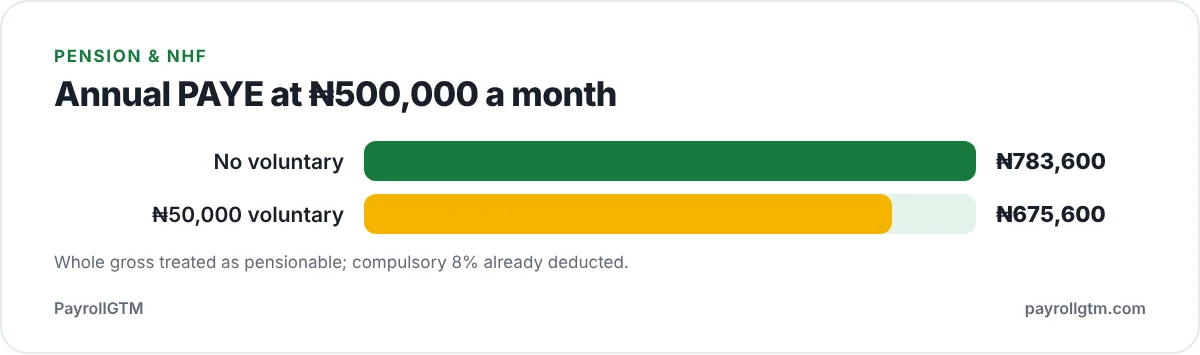
A voluntary pension contribution lowers your taxable income by the amount you pay in, so the tax you save is that amount multiplied by the top rate you pay. On a ₦500,000 monthly salary, adding ₦50,000 a month to your retirement savings account (RSA) cuts annual PAYE from ₦783,600 to ₦675,600, a saving of ₦108,000 a year, while ₦600,000 goes into your own pot. Pension contributions are deductible only when properly claimed, and we have no confirmed cap, so check the current limit with your PFA or state IRS before you commit a large sum.
How voluntary contributions work
The Pension Reform Act 2014 requires a minimum of 18% of monthly emoluments (8% from you, 10% from your employer) on at least basic salary, housing and transport. That is compulsory and already reduces your taxable pay. A voluntary contribution is extra money you choose to pay into the same RSA through your pension fund administrator (PFA), on top of the compulsory part. Some employers also allow payroll deduction for it, which is the simplest route because the payslip then records it.
The tax effect rests on two points in our fact sheet: your employee pension contribution (8% statutory plus approved voluntary contributions) reduces taxable income, and pension benefits under the Act are tax-exempt. You get relief going in and, when benefits are paid under the rules, no tax coming out. The weak point is evidence. If the contribution goes in outside payroll, the employer's PAYE does not know about it, so you must give HR or the state IRS your PFA statement.
Example 1: ₦500,000 a month, ₦50,000 voluntary
We used the site's PAYE calculator logic with the whole gross treated as pensionable, which is the simple default in our examples.
Without voluntary contribution: chargeable income is (₦500,000 minus ₦40,000) x 12 = ₦5,520,000. Tax: ₦330,000 on the 15% band plus 18% of ₦2,520,000 (₦453,600) = ₦783,600 a year, or ₦65,300 a month.
With ₦50,000 a month voluntary (₦600,000 a year): chargeable income is ₦4,920,000. Tax: ₦330,000 plus 18% of ₦1,920,000 (₦345,600) = ₦675,600 a year, or ₦56,300 a month.
Saving: ₦108,000 a year, which is ₦9,000 a month.
Her take-home does not fall by the full ₦50,000. Without the voluntary contribution her net is ₦394,700. With it, she pays ₦56,300 PAYE instead of ₦65,300, so net after the contribution is ₦353,700. The contribution costs her ₦41,000 of take-home to put ₦50,000 into her pension.
Example 2: how the saving changes with salary
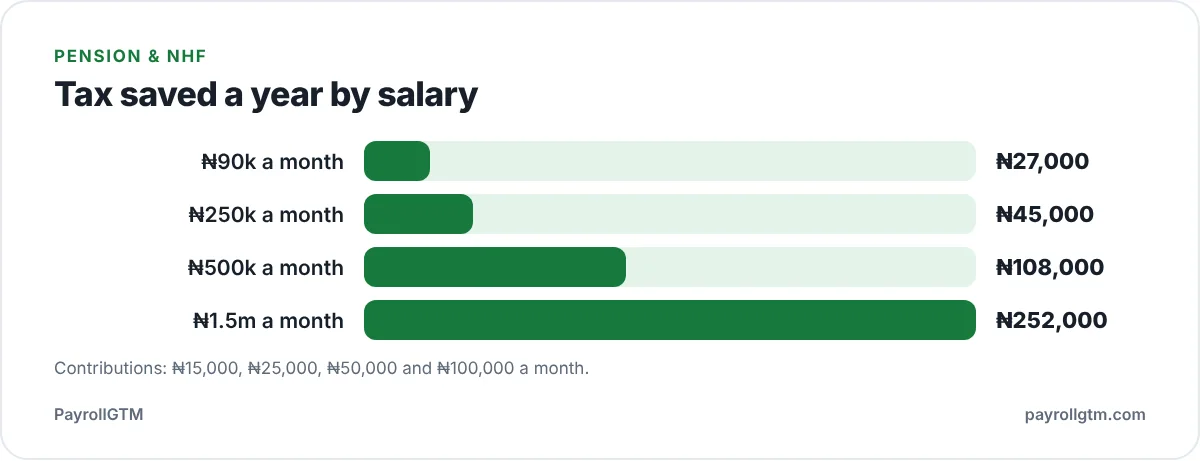
The saving is not a fixed percentage. It follows the highest band your income reaches, because the last naira of income taxed is the first one relieved. The table repeats the calculation for other salaries, all with the same method.
| Gross a month | Voluntary a month | PAYE a year before | PAYE a year after | Tax saved a year |
|---|---|---|---|---|
| ₦90,000 | ₦15,000 | ₦29,040 | ₦2,040 | ₦27,000 |
| ₦250,000 | ₦25,000 | ₦294,000 | ₦249,000 | ₦45,000 |
| ₦500,000 | ₦50,000 | ₦783,600 | ₦675,600 | ₦108,000 |
| ₦1,500,000 | ₦100,000 | ₦2,907,600 | ₦2,655,600 | ₦252,000 |
Look at the first line. At ₦90,000 a month, chargeable income is only ₦993,600 a year, so just ₦193,600 is taxed at all. A ₦180,000 annual voluntary contribution takes it to ₦813,600, nearly into the 0% band, and saves ₦27,000, which is 15% of the contribution. At ₦1,500,000 a month the same method gives 21% relief on the ₦1,200,000 contributed, because the top of that income sits in the 21% band.
The lesson: tax relief is a bonus, not a reason by itself. Someone in the 15% band saves 15 kobo on each naira put aside, and the other 85 kobo has to come from your own pocket.
What you give up: access
Money in an RSA is retirement money. Under PenCom rules you can take benefits from age 50 or on incapacity, a person out of work for four months may request 25% of the balance, and up to 25% can go towards equity in a residential mortgage (see the 25% housing withdrawal). Whether those rules apply differently to the voluntary part, and what charges or lock-in periods your PFA applies, we cannot confirm here; ask your PFA in writing before you start. If you may need the cash within three years, a normal savings account or a cooperative is a better home for it.
Who should consider it, and who should wait
It suits you if you:
- earn enough to pay tax in the 15% band or higher, which on our method starts at roughly ₦90,000 a month;
- already have an emergency fund of a few months' pay;
- have no high-interest debt, since loans often cost more than the tax saving returns;
- expect to stay in the system until 50 or later.
It suits you less if rent, school fees or a loan already take most of your pay, or if you are close to the 0% band, where the saving is small. You do not have to choose a round amount. Even ₦10,000 a month is tracked on the payslip and builds a record.
The mistake that wastes the relief
The usual failure is paying into the RSA yourself and telling nobody. Take Tunde, who earns ₦250,000 a month and pays ₦25,000 into his RSA each month by standing order from his bank. HR knows nothing about it, so payroll keeps deducting PAYE as if nothing had changed, ₦294,000 a year. He has paid ₦300,000 into his own retirement account and received no tax benefit at all unless he claims it afterwards. If his state IRS accepts the claim with his PFA statement, ₦45,000 comes off his bill. If he never files it, he forfeits it. We cannot promise that every state IRS processes such claims by refund; some may only allow a credit against later tax, so ask.
A second trap is the employer's side. A voluntary contribution is yours. Your employer has no duty to match it, and any extra the employer pays beyond the statutory 10% is an employment benefit to be written into the contract or policy, not something to assume. If the employer pays the whole contribution on your behalf, a different minimum applies, covered in when the employer pays the full 20%.
How to start without upsetting payroll
- Ask your PFA how to pay voluntary contributions into your existing RSA, and whether it supplies a statement for tax purposes.
- Tell HR in writing the monthly amount and whether you want payroll to deduct it. Payroll then shows it as a line before PAYE, so the tax drops each month.
- If you pay yourself, keep each receipt and the annual statement and give them to HR or to the state IRS when you file; employees file their own return, which is where the claim goes.
- Set a review date, say each January, to raise, pause or stop.
If HR changes your deduction mid-year you may see a catch-up in one month; how back pay and corrections are handled explains how that gets adjusted. Check your result against the payslip layout to be sure the line appears where you expect.
For the compulsory part and how the base is built, see how pension contributions are calculated and how to structure basic, housing and transport pay.