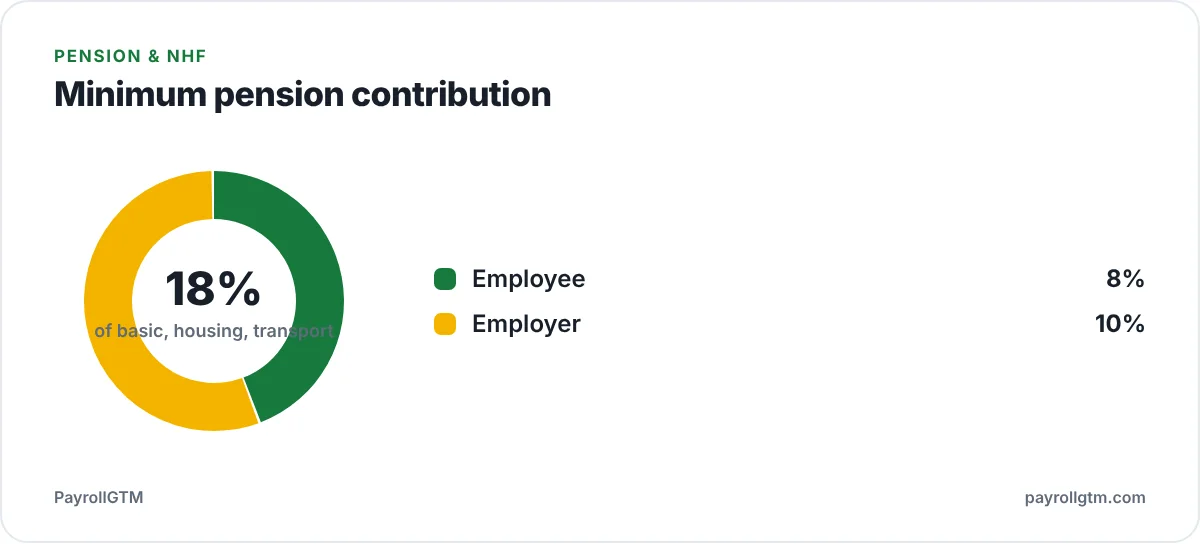
If your employer has 3 or more employees, the Pension Reform Act 2014 (PRA) gives you a retirement savings account (RSA) and requires at least 18% of your basic, housing and transport pay to go into it every month: 8% from you and 10% from the employer. The money must reach your PFA within 7 working days of salary being paid. This guide is for employees; employers should read the pension compliance guide for SMEs.
The questions below are the ones employees actually ask HR, usually after seeing a blank RSA statement.
Does my employer have to pay pension for me?
Yes, once the employer has 3 or more employees. Some websites say 15, which is wrong; that figure is out of date. You do not need your employer's permission to have an RSA, and you do not lose it when you change job. It is your account, with your PIN, and it follows you for life. If you have no RSA yet, how to open an RSA and get a PIN walks through it.
Employers with fewer than 3 staff are outside the compulsory scheme, but can still contribute, and an employee can start a voluntary contribution into their RSA at any time.
How much should be paid, and on which pay?
The legal minimum is 18% of monthly emoluments, where emoluments must include at least basic salary, housing allowance and transport allowance. If your employer pays the whole cost and deducts nothing from you, their minimum is 20%.
Your contract can set a higher base, such as full gross, and an employer is free to do that.
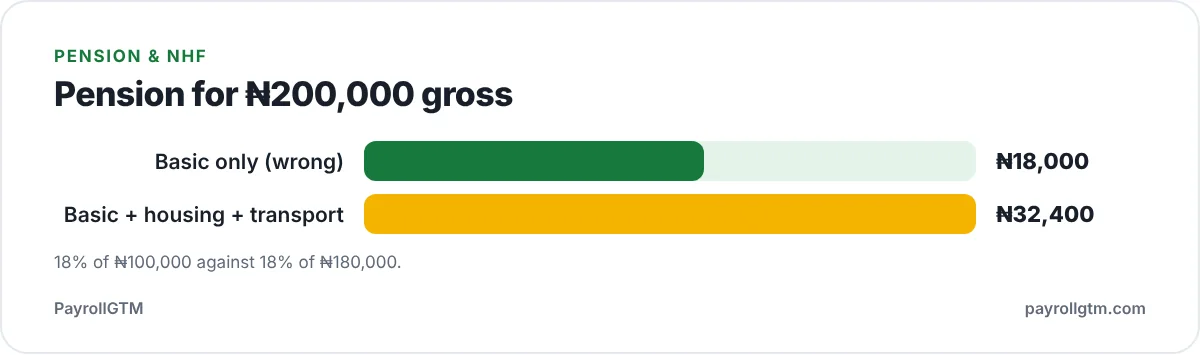
The most common underpayment is a quiet one: the employer calculates on basic only.
- Pay split: basic ₦100,000, housing ₦50,000, transport ₦30,000, other allowances ₦20,000.
- Correct pensionable pay: ₦100,000 + ₦50,000 + ₦30,000 = ₦180,000.
- Her 8%: ₦14,400. Employer 10%: ₦18,000. Total into her RSA: ₦32,400 a month.
- If the employer uses basic only: 18% of ₦100,000 = ₦18,000. Shortfall: ₦14,400 a month, ₦172,800 a year.
The tell is on the payslip. Aisha's deduction should be ₦14,400. If it reads ₦8,000, her employer is using basic only. The method for calculating pension contributions shows the base line by line.
How do I check my employer is actually remitting?
Do not wait for the annual meeting with HR to find out. A deduction on your payslip is not proof of payment. The proof is a credit on your RSA statement, which your PFA produces. Do this once every quarter.
- Log in to your PFA's online portal or app, or visit a branch, and request a statement of account. Statements are normally sent periodically, but you can ask for one at any time.
- Compare each month's credit with your payslip: you should see both your 8% and the employer's 10%, not just one.
- Check the date. Credits should arrive close to payday, within the 7-working-day window.
- Check the employer name on the credit, since contributions credited under the wrong name or PIN cause delays.
- Keep a copy of every statement and your payslips; they are your evidence. If your employer ever changes your pay structure, compare the pension line again the following month.
Your PFA is the place to start if you do not know which one you have. If you want to change it, see how to change your PFA, and for a plain account of how RSAs and PFAs fit together read RSA and PFA explained.
My employer deducts pension but it is not on my statement. What now?
First, make sure the gap is real. Ask your PFA whether there are contributions awaiting matching, for example because of a wrong PIN. If not, write to HR or the payroll officer. Keep it short, attach the statement, name the months, and ask for a payment date.
Dear [HR/Payroll Manager], my RSA statement from [PFA] dated [date] shows no pension credits for [months]. My payslips for those months show a pension deduction of ₦[amount]. Please confirm when these contributions and the employer's share were remitted, with the schedule or payment evidence, or arrange payment. Thank you.
If you get nothing within a reasonable time, tell your PFA in writing, then complain to PenCom. PenCom is the regulator and employers who delay are liable for a penalty of 2% of the unpaid contribution for each month of delay under section 11. The employer's side of that clock is explained in the 7-working-day rule and the 2% penalty.
Do not resign over it before getting the paperwork together, because the evidence is easier to collect while you are still on the payroll. Also be realistic: an employer in real financial trouble may pay slowly even once pressed. Your PFA statement and your letter are what let you claim later.
I am a contract or casual worker. Does any of this apply?
The law looks at the real working relationship, not at the label on your contract. A person who is on the payroll, takes instructions and works fixed hours is usually an employee even if the letter says "contract staff" or "casual". Genuine independent contractors who invoice are different. If your employer says you are outside the pension scheme, ask for the reason in writing and read pension for contract and casual staff. For disputes about status, the National Industrial Court is where employment cases go, so get advice before the relationship breaks down.
Can I choose my own PFA?
Yes. The PRA lets you pick the PFA that will manage your RSA. If you did not choose, the employer may have registered you with one. You can also move later, using the transfer process explained in the PFA guide linked above. When comparing, look at fund performance, statement quality and how easily you can reach their office. Do not take a gift or a sales call as a reason to switch.
Am I entitled to group life cover?
The employer must hold a group life insurance policy for employees, with cover of at least 3 times the annual total emolument, and the employer pays the premium, not you. For Aisha's ₦200,000 gross that works out to at least ₦7,200,000 if total emolument is her full pay (₦200,000 x 12 x 3). Whether "total emolument" means your full gross or a narrower figure is a point to confirm with the insurer or PenCom. You can ask HR to show you the policy or certificate. If an employee dies in service, the payout goes to the nominated beneficiaries. More on the employer's duty is in the group life insurance guide.
When can I take my money out?
Not on request. The usual routes are retirement from age 50, or incapacity. Two partial routes exist under PenCom guidelines: if you have been out of work for 4 months you may request 25% of your RSA balance, and up to 25% can go towards the equity contribution on a residential mortgage. Both have conditions, so confirm the current rules with your PFA before you plan around them. Details are in the guide to withdrawing 25% for housing. At retirement the balance is paid out as a lump sum and a regular income; the split and options depend on your age, balance and PFA, so ask for a benefit illustration before you retire.
Contributions are tax-deductible for you, and pension benefits under the PRA are tax-exempt. Changing jobs does not touch your balance; see what happens to your pension when you leave a job.