Register for PAYE with the state Internal Revenue Service before you pay the first salary, or at the latest before the first remittance falls due on the 10th of the following month. In practice you give the state IRS your business details and a staff list, it opens a PAYE (employer) record for you and tells you how to file and pay. The exact portal, forms and any fees differ by state, and we do not know them all, so treat the steps below as the common sequence and confirm each with your own state office.
Why registering comes before the first payslip
An employer is the collection agent for the state. From the first naira of salary you are expected to deduct PAYE and pay it over, whether or not you have told anyone. Nothing in the law waits for your registration. If you skip it and the state IRS later finds staff on your books, it can raise an assessment from the records it can get (the Administrative Assessment under the Nigeria Tax Administration Act 2025), and the penalties reported for PAYE defaults apply: 10% of tax not remitted plus interest, and 40% on tax that should have been deducted but was not. Confirm current rates with your state IRS. The full list of consequences is in penalties for late PAYE and payroll defaults.
There is also a plain commercial reason. Banks, clients and tenders ask for evidence that your business pays staff tax, and your employees will need a proper tax record to show for loans and visas.
Step 1: Get your business identity in order
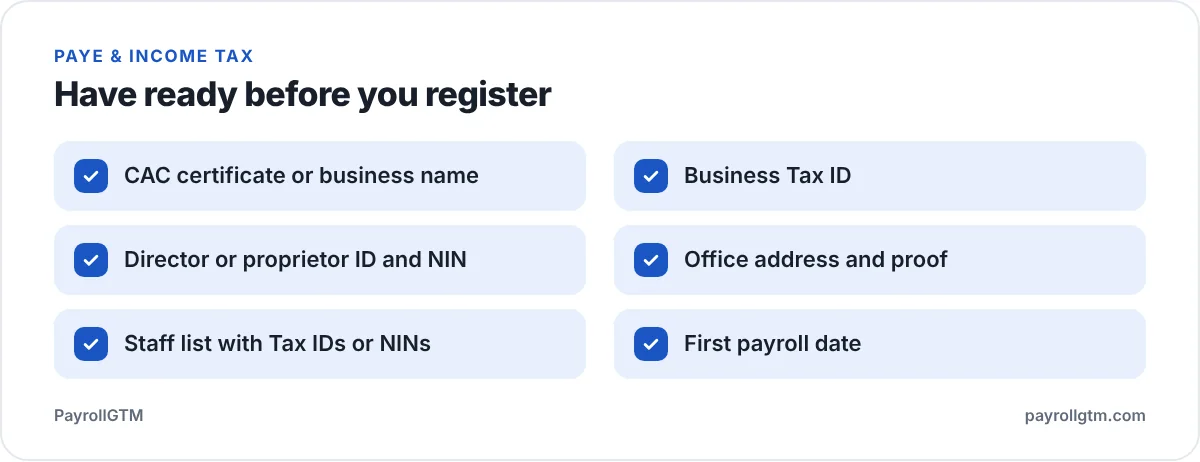
The state IRS will want to see that the business exists and who runs it. Have these ready, in scanned form if the portal needs uploads.
- CAC certificate of incorporation or business name registration, and the status report if you have one.
- The business's Tax ID. For companies, the CAC RC number is reported to become the Tax ID under the unified system announced by the NRS in 2026. Check the current NRS and Joint Revenue Board notice for how this works, because registration steps have been changing. See Tax ID and NIN for the individual side.
- Directors' or proprietor's details, including NIN or ID, phone and email.
- Your office address in the state, with a utility bill or tenancy agreement if asked.
If you are still deciding what else a new business owes, the employer registration checklist covers pension, NSITF and ITF alongside this.
Step 2: Decide which state IRS
PAYE is collected by the state IRS of the employee's state of residence, not necessarily where your office is. A company in Lagos with two staff who live in Ogun State has a different position from one whose whole team lives in Lagos. How states handle this in practice, for example whether the employer registers in several states or the office state accepts a combined remittance and passes it on, is set by the states, and we cannot tell you a single answer. Ask your state IRS in writing and keep the reply. For the categories of staff who fall under the NRS instead, read which tax authority gets PAYE.
Step 3: Complete the employer registration
Most state IRSs run an online portal (LIRS in Lagos, FCT-IRS in Abuja and similar systems elsewhere), and some still accept paper at a tax office. Whichever route, expect to supply the information from step 1, say that you are registering as an employer for PAYE, and give the date of your first payroll. We cannot give form numbers or fees because we have not seen them confirmed for every state, and an invented number does more harm than none. Do not pay anybody who claims to be a "fast-track agent" until you have confirmed with the office that the fee is real and receipted.
What you should receive is some form of employer or PAYE reference, together with instructions on filing and paying. Record it, and use it on every remittance and return.
Step 4: Prepare the first staff schedule
The state IRS typically asks for a schedule of employees with their tax details, and it may require it with the registration or with the first remittance. Build it once and reuse it every month. Typical columns: full name, Tax ID or NIN, state of residence, gross pay, pension, other deductions and PAYE. Whether staff are properly employees at all matters here, since people you treat as contractors do not appear in this schedule. If any of yours are borderline, see employee or contractor before you build it.
A design studio in Abuja hires Hauwa (₦300,000 a month), Segun (₦250,000) and Obinna (₦400,000). We treat the whole gross as pensionable to keep the arithmetic simple; in real payroll pension is on basic, housing and transport. PAYE for the month is computed with the 2026 bands after the 8% employee pension.
| Employee | Gross | Pension 8% | PAYE | Net pay |
|---|---|---|---|---|
| Hauwa | ₦300,000 | ₦24,000 | ₦32,180 | ₦243,820 |
| Segun | ₦250,000 | ₦20,000 | ₦24,500 | ₦205,500 |
| Obinna | ₦400,000 | ₦32,000 | ₦48,740 | ₦319,260 |
| Total | ₦950,000 | ₦76,000 | ₦105,420 | ₦768,580 |
PAYE to remit to FCT-IRS: ₦105,420. The employer pension of 10% adds ₦95,000 on top of the employees' ₦76,000, so ₦171,000 goes to the PFAs. Pension is a separate payment from the tax.
The method behind the figures is in how to calculate PAYE in Nigeria. If staff will claim rent relief or other reductions, ask them for evidence early, as deductions that reduce PAYE explains, because the monthly figure should reflect what they have properly claimed.
Step 5: Remit, then file the year-end return
PAYE deducted from salaries paid in a month is remitted by the 10th of the next month (state practice, so check your own state). A March payroll paid on 28 March is due by 10 April. PAYE remittance deadlines and how to pay covers the payment channels.
After year-end you file the annual return of emoluments, Form H1, due 31 January for the year just ended (NTAA s.14). Late filing carries a penalty of ₦100,000 for the first month and ₦50,000 for each month after (NTAA s.96). Employees also have their own filing duty, so tell them early, as set out in whether employees file annual returns.

If you have already been paying staff without registering
Many small businesses find themselves here, usually because the first hire was a relative or a friend and nobody thought of it as payroll. Register now rather than wait. Work out what PAYE should have been deducted for each month since the first salary (the monthly method in the example above works for past months too), gather the payslips or bank transfers that prove what was paid, and take that file to the state IRS when you register. Ask how they want back periods handled: some offices will agree a payment plan or a voluntary disclosure route, and others will raise an assessment, so the answer depends on the office and we cannot promise a particular outcome. Volunteering the position early is almost always cheaper than being found, because the reported penalties and interest grow every month the tax is unpaid.
Also keep a copy of everything you send. Payroll records are what you will lean on if the state IRS ever reviews your year, and a month-by-month folder of schedules, receipts and payslips is enough.
Mistakes that show up in the first month
- Treating registration as optional until someone asks. The first payroll is the trigger, not an audit letter.
- Using the owner's personal account for remittances. The payment cannot then be matched to the employer reference, and the state IRS may show nothing paid. Pay from the business account with the right reference and keep the receipt.
- Missing Tax IDs or NINs on the schedule. Collect them in the onboarding pack so that the schedule is complete on day one.
- Deducting PAYE but spending it. The money is held in trust for the state. Move it to a separate account on pay day.
- Different numbers in different places. The payslip, the schedule and the payment must agree to the naira. A mismatch is the first thing a reviewer finds.
If anything on your state's process differs from what is written here, trust the state IRS over this page and tell us at our contact page so that we can update it.