No. An employee earning the ₦70,000 national minimum wage or less does not pay PAYE in 2026. The same is true for anyone whose pay is only a little above it: the first ₦800,000 of chargeable income a year is taxed at 0%, and a salary has to reach about ₦72,464 a month (when the whole of it counts for pension) before the first naira of tax appears.
Is someone on ₦70,000 a month taxed at all?
Not on PAYE. There are two separate reasons and they point the same way. The tax law exempts earners at or below the minimum wage, and the tax bands start with a 0% slice of ₦800,000 a year. Twelve months of ₦70,000 is ₦840,000, which looks like it overshoots the slice. It does not, because the 8% pension contribution comes off first.
Her payslip should still show a PAYE line. It reads ₦0.00, not a blank, so that anyone checking it later can see the tax was considered and found to be nil.
At what salary does tax actually start?
The arithmetic is simple. Tax starts when twelve times (gross minus pension) goes past ₦800,000. If the whole gross counts for pension, pension is 8% of it, so the point is ₦800,000 divided by 12, divided by 0.92. That is ₦72,464 a month. At ₦72,500 the monthly PAYE is ₦5, so nobody should lose sleep over the first few naira.
The figure moves if only part of the pay is pensionable. Pension is charged on basic, housing and transport, not on every allowance. If none of the pay were pensionable the point would be ₦66,667. If 70% is pensionable it is about ₦70,621. That is why you cannot read a single threshold off a news headline; it depends on how the salary is split.
What does PAYE look like just above the minimum wage?
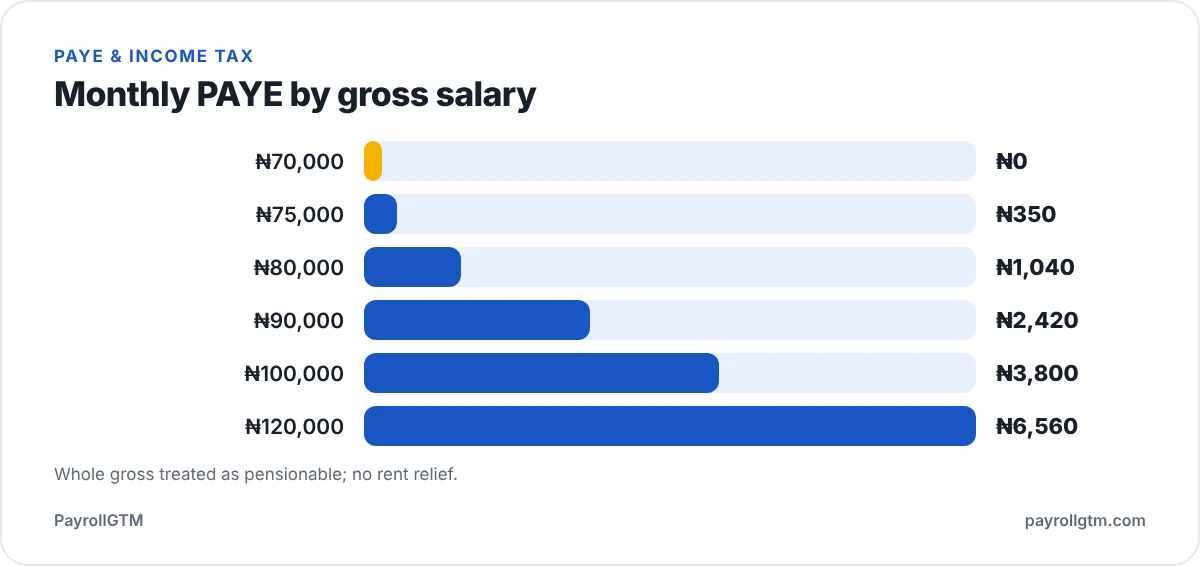
It climbs slowly, because only the part above ₦800,000 of chargeable income is taxed, and that part is taxed at 15%. These figures treat the whole gross as pensionable and claim no rent relief.
| Monthly gross | Employee pension (8%) | Monthly PAYE | Take-home |
|---|---|---|---|
| ₦70,000 | ₦5,600 | ₦0 | ₦64,400 |
| ₦75,000 | ₦6,000 | ₦350 | ₦68,650 |
| ₦80,000 | ₦6,400 | ₦1,040 | ₦72,560 |
| ₦90,000 | ₦7,200 | ₦2,420 | ₦80,380 |
| ₦100,000 | ₦8,000 | ₦3,800 | ₦88,200 |
| ₦120,000 | ₦9,600 | ₦6,560 | ₦103,840 |
A rise from ₦70,000 to ₦100,000 is ₦30,000 more gross but only ₦23,800 more take-home. The gap is ₦2,400 of extra pension and ₦3,800 of PAYE. Staff who ask why a raise "did not show" are usually looking at this.
What if my allowances are not pensionable?
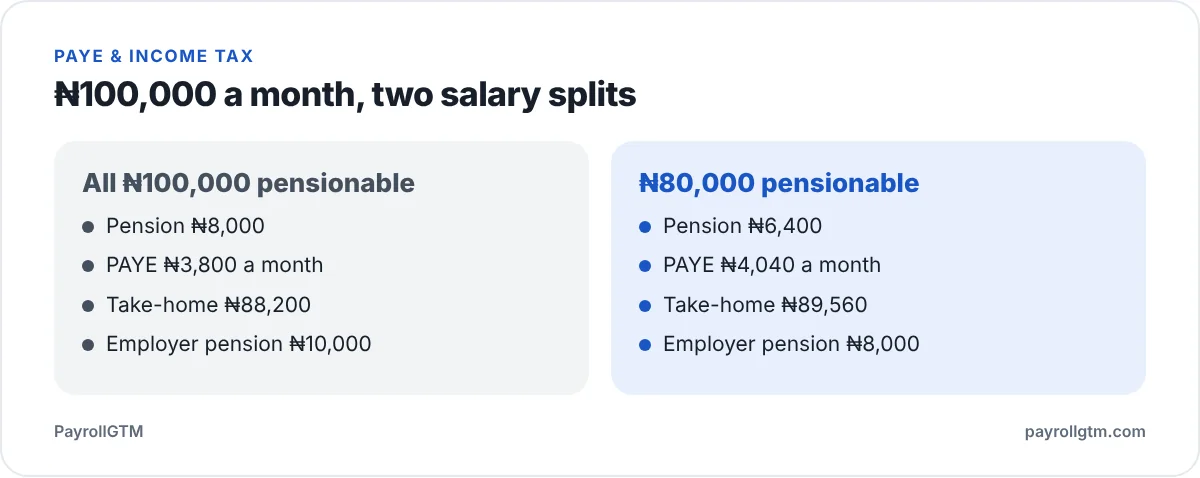
Then your pension is lower and your tax is higher than the table shows. Take Segun on ₦100,000 a month, split as ₦50,000 basic, ₦20,000 housing, ₦10,000 transport and ₦20,000 other allowances. Pensionable pay is ₦80,000, so pension is ₦6,400, chargeable income is ₦1,123,200 a year, and PAYE is ₦4,040 a month. His take-home is ₦89,560, which is ₦1,360 more than the table's ₦88,200, because less went to pension and, in his case, that outweighs the extra ₦240 of tax.
The employer's 10% pension is lower too, ₦8,000 instead of ₦10,000. The minimum base for pension is basic plus housing plus transport, but an employer can choose to count more. How you split a salary is a real decision; the guide to designing a salary structure covers it.
Does the minimum wage law oblige every employer to pay ₦70,000?
Not every one. The National Minimum Wage (Amendment) Act 2024 sets ₦70,000 a month and applies to employers with 25 or more employees. A business with 10 staff is outside it, though it may still choose to pay at that level, and many do because it is hard to hire for less. Whether allowances can be counted towards the ₦70,000 is a point to confirm for your own case. Our minimum wage compliance article walks through who is covered.
The tax exemption and the wage law are different things. A worker at a six-person firm who earns ₦65,000 is not protected by the wage Act but still pays no PAYE.
What should an employer do about staff who pay no PAYE?
- Run them through payroll like everyone else, with the PAYE line at ₦0. Do not leave them off the schedule.
- Keep their pension going. Pension is separate from tax, and an employer with 3 or more employees must pay 8% and 10% for them too. See how pension contributions are calculated.
- Include them in your annual employee return where your state IRS asks for all staff. Some offices want nil-tax employees listed; check with yours.
- Re-run the numbers whenever pay changes. A ₦5,000 raise, a new allowance or a once-off bonus can move someone over the line. A bonus is added to the year's income, as the guide on tax on bonuses and 13th-month pay shows.
What happens when a minimum wage worker gets a bonus or a raise?
The exemption follows the person's income for the year, not a label on the payslip. Ibrahim earns ₦70,000 a month and receives a ₦40,000 December bonus that is not pensionable. His annual pay is ₦880,000. Pension on the ₦840,000 of regular pay is ₦67,200, which leaves ₦812,800 of chargeable income. Only ₦12,800 sits above the 0% slice, so the tax for the year is ₦1,920 (15% of ₦12,800). One small bonus has created a bill that a monthly "exempt" flag would have missed.
Whether the exemption for earners at the minimum wage still applies to someone who has just crossed it through a bonus is not something we can settle from the sources we use. The bands alone produce the ₦1,920 figure. If the amounts are small, ask your state IRS how it wants year-end true-ups handled, and record the answer in your payroll file.
How should the payslip look for staff who pay no tax?
Show every line, even the zero ones. A payslip for Kemi's grade might read: Gross ₦70,000.00; Employee pension (8%) ₦5,600.00; PAYE ₦0.00; Net pay ₦64,400.00. Staff on low pay often assume that "no tax" means the pension line is also optional, and some employers quietly drop it. Dropping it does not remove the employer's duty to remit. The guide to reading a Nigerian payslip is worth handing to new staff, because a payslip they understand prevents most of the questions that land on the payroll officer's desk.
What about a second job or side income?
This is where low earners get caught. The ₦800,000 slice is used once. If Hauwa earns ₦70,000 at one employer and ₦70,000 from another, each employer taking her alone sees ₦0. Together she earns ₦140,000 a month, and the correct PAYE is ₦9,320 a month. Neither payslip shows it, so she has to declare the second income herself. Read how PAYE works with two employers before the year ends. Freelance income is treated differently again; see tax for freelancers and the self-employed.
If rent is a real cost for you, rent relief can lower chargeable income further, and the list of deductions that reduce PAYE shows what else counts. To check your own figure, use the payroll calculator.