Segun works weekdays for a logistics firm in Ikeja on ₦200,000 a month. On Saturdays and in the evenings he is on the books of a school as an accounts clerk at ₦150,000 a month. Each payslip shows PAYE, each looks fair, and in March of next year he is told he owes the state IRS more than ₦100,000. Nobody made an arithmetic error. Each employer simply did the sum as though it were his only job.
That is the short answer to the question: yes, if you have two employers, you can end up owing more tax at year end than your payslips showed. Every employer applies the first ₦800,000 at 0% and the 15% band to the pay it sees, and neither knows what the other pays. This article shows how big the gap is, why it arises and what to do about it.
Why two employers under-deduct
PAYE is a progressive tax. The first ₦800,000 of chargeable income a year is taxed at 0%, the next ₦2,200,000 at 15%, the next ₦9,000,000 at 18%, and so on. A payroll officer working out your tax uses the whole ladder, starting at the bottom, on the salary they pay you. Two payrolls therefore climb the ladder twice from the bottom. You get two tax-free ₦800,000 slices instead of one, and more of your income is taxed at 15% when part of it should have been at 18%.
Employers are not at fault. They calculate on the pay they control, and they usually cannot see what another employer pays an individual. The adjustment belongs to the employee and, in the end, the state IRS.
Segun's numbers, side by side
We worked every figure below with the same method as the standard PAYE calculation: annual pay, minus 8% pension on the full salary, then the bands. Both employers are assumed to deduct pension on all of the salary they pay, and neither staff member has claimed any other relief.
| Item | Employer A | Employer B |
|---|---|---|
| Monthly gross | ₦200,000 | ₦150,000 |
| Annual gross | ₦2,400,000 | ₦1,800,000 |
| Pension at 8% (yearly) | ₦192,000 | ₦144,000 |
| Chargeable income | ₦2,208,000 | ₦1,656,000 |
| PAYE per year | ₦211,200 | ₦128,400 |
| PAYE per month | ₦17,600 | ₦10,700 |
Together the two payslips withhold ₦28,300 a month, which is ₦339,600 for the year. Now treat the same income as one job paying ₦350,000 a month.
Annual gross is ₦4,200,000. Pension at 8% is ₦336,000, so chargeable income is ₦3,864,000. The first ₦800,000 is at 0%. The next ₦2,200,000 at 15% is ₦330,000. The remaining ₦864,000 falls in the 18% band and gives ₦155,520. Total PAYE is ₦485,520 a year, or ₦40,460 a month.
Difference: ₦485,520 minus ₦339,600 is ₦145,920 a year, about ₦12,160 a month, that was never deducted.
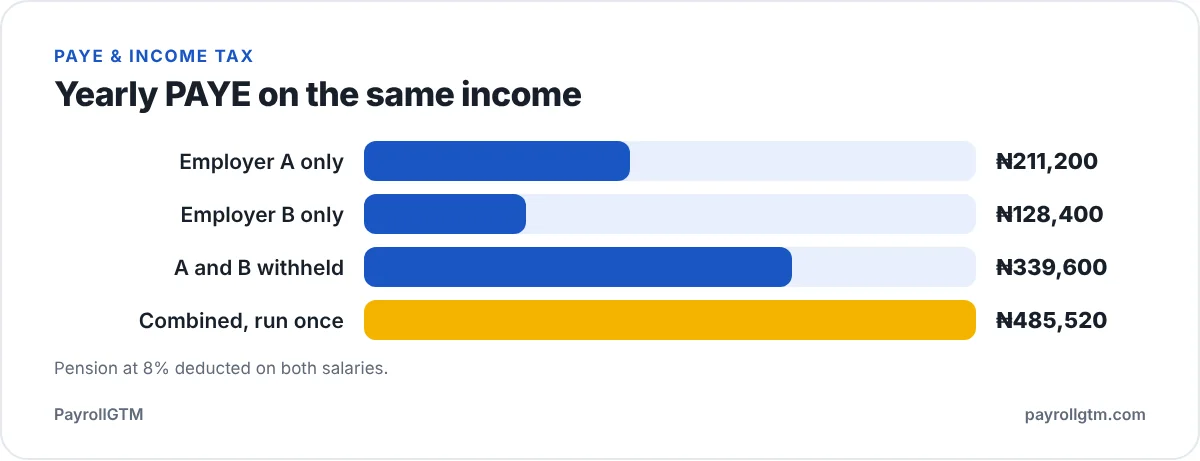
The gap is the value of the second ₦800,000 0% slice (₦120,000 of tax at 15%) plus the tax on the difference between 15% and 18% for the income that sits above ₦3 million when combined. It is largest for people whose combined pay moves them into a higher band.
What Segun should do
Whoever pays two employers should assume the combined tax is the real tax, and plan for it. In practice, three routes are open, and they can be combined.
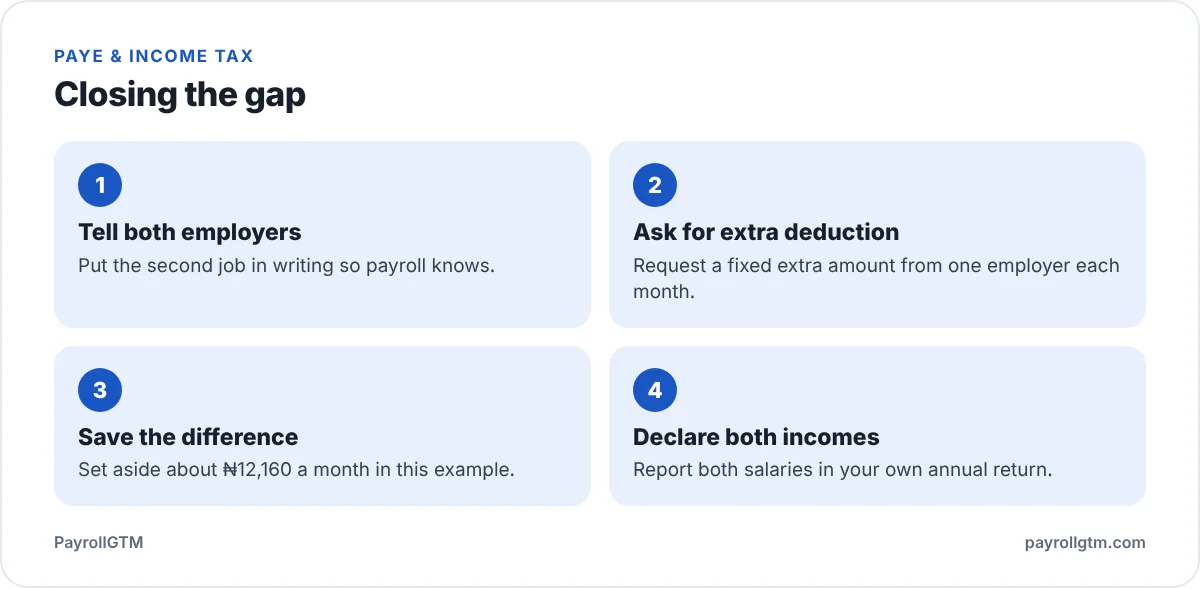
- Tell both employers, in writing, that you have another job. Some payroll teams will not change anything, since they cannot see your other income. Others will accept a request to deduct extra. Ask politely and keep a copy.
- Ask one employer to deduct at a higher rate or an extra fixed amount each month. In Segun's case, asking Employer A to deduct another ₦12,160 a month would close the gap by December. Whether payroll can do this depends on the software and the employer's policy; there is no automatic mechanism, so it is a request, not a right.
- Put the money aside yourself. If neither will adjust, set ₦12,160 aside monthly in a separate account. When the return is due, you will have the shortfall in hand.
Whichever route you take, declare both incomes in your own annual return. The Nigeria Tax Administration Act expects employees to file their own returns even where an employer files for them, as discussed in whether employees file annual returns in 2026. This is where the combined income is reported, and where the state IRS can reconcile what the two employers deducted against what is actually due.
Which reliefs go where
Reliefs are the second place people double count. Each employer's payroll may apply the same claim, and the law does not let you take it twice.
- Rent relief is 20% of rent paid, capped at ₦500,000 a year, for you as one person. Give the evidence to only one employer. The walk-through is in how to claim rent relief.
- Pension is deducted on each salary separately, because each employer pays into your RSA. This one does not double count. Both deductions reduce chargeable income.
- Other claims such as health insurance or life insurance premiums should be evidenced once and applied once. The list is in deductions that reduce PAYE.
The practical rule is to nominate one employer as your main payroll for reliefs, and to tell the other employer you have done so.
Is the second income always a second salary?
Not always, and the tax treatment changes with the label.
- Two employed jobs, each with a contract and payslip. Treated as in this article. Both are employment income.
- One job and a freelance side business. The side income is not on any payslip, so no PAYE is deducted from it at all. You report and pay tax on it yourself. See tax for freelancers and the self-employed.
- A second job that is really a contract engagement. Employee or contractor status depends on how the relationship works, not on what the invoice says. The classification guide sets out the tests.
- A year-end bonus from one employer. It is added to employment income for the year, which can push the combined total up a band. See PAYE on bonuses and 13th-month pay.
Low earners and minimum wage
If both jobs are small, the extra tax may be zero or tiny. Someone with a ₦70,000 job and a ₦50,000 job has ₦1,440,000 a year in combined pay. After 8% pension (if both employers deduct it) chargeable income is ₦1,324,800, so tax of about ₦78,720 is due on the combined figure at 15% on ₦524,800, even though neither job alone would pay a naira, because each is under the 0% threshold on its own. A person on exactly the national minimum wage is outside PAYE as explained in whether minimum wage is taxable, but that exemption is about one job, not two. We do not have a published rule on how the exemption applies when a second wage is added, so ask your state IRS.
What employers can do
If you run payroll and a new hire tells you they have another job, there is no standard form that makes you act. A sensible approach is to record in the personnel file that the employee has disclosed a second job, and to say in the offer letter or handbook that you will deduct PAYE on the pay you control only. If the employee asks you to take an extra monthly amount, document the request in a short signed note and show it on the payslip as a separate line, so that your own filings still reconcile. Do not remit extra tax under the employee's name without the written request, because your Form H1 should show what was actually deducted.
Use salary after tax in Nigeria in 2026 to check any single payslip, and the payroll calculator to try the combined total.