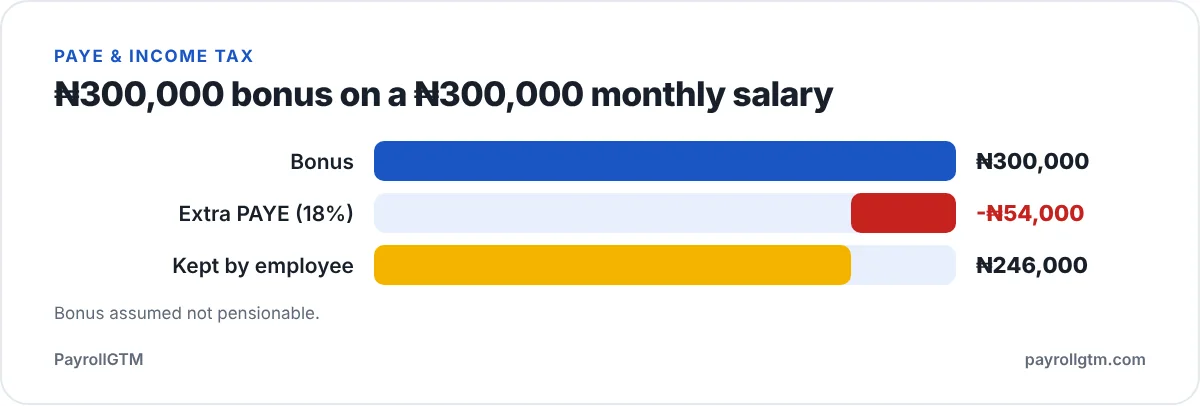
A bonus, a 13th-month payment and a leave allowance are all taxed as ordinary employment income in 2026. They are added to the rest of the year's pay, and the extra tax is charged at whatever band the top of your income falls in, so a ₦300,000 bonus on a ₦300,000 monthly salary costs ₦54,000 in PAYE and leaves ₦246,000. There is no separate "bonus rate" and no lower rate for a payment labelled as a gift.
How a bonus is added to your annual income
PAYE under the Nigeria Tax Act is worked out on a full year of income, then shared across the months. A bonus simply raises the year's total. The tax on that total is higher than the tax on the salary alone, and the difference is the tax on the bonus.
One assumption runs through every example here: the bonus is not part of basic, housing or transport, so it does not attract pension. The 8% employee contribution and 10% employer contribution are charged on those three items, so a plain cash bonus normally sits outside them. If your contract folds the bonus into basic salary, pension applies and the numbers below change. Check how your contract words it.
Without the bonus: pension is ₦24,000 a month (₦288,000 a year), so chargeable income is ₦3,600,000 minus ₦288,000 = ₦3,312,000. Tax is 0% on the first ₦800,000, 15% on the next ₦2,200,000 (₦330,000) and 18% on the remaining ₦312,000 (₦56,160). Annual PAYE is ₦386,160, or ₦32,180 a month.
With the bonus: chargeable income becomes ₦3,612,000. Tax is ₦330,000 plus 18% of ₦612,000 (₦110,160), so ₦440,160 for the year.
The bonus therefore adds ₦54,000 of PAYE, exactly 18% of ₦300,000. Aisha keeps ₦246,000.
Why the tax rate on a bonus differs from person to person
The rate on the bonus is the rate of the band the bonus lands in, not the employee's average rate. Aisha's salary already reaches the 18% band, so every extra naira is taxed at 18%. Someone lower down pays less on the same bonus, and someone higher up pays more.
| Monthly salary | Bonus (one month's pay) | Annual PAYE before | Annual PAYE after | Tax on bonus |
|---|---|---|---|---|
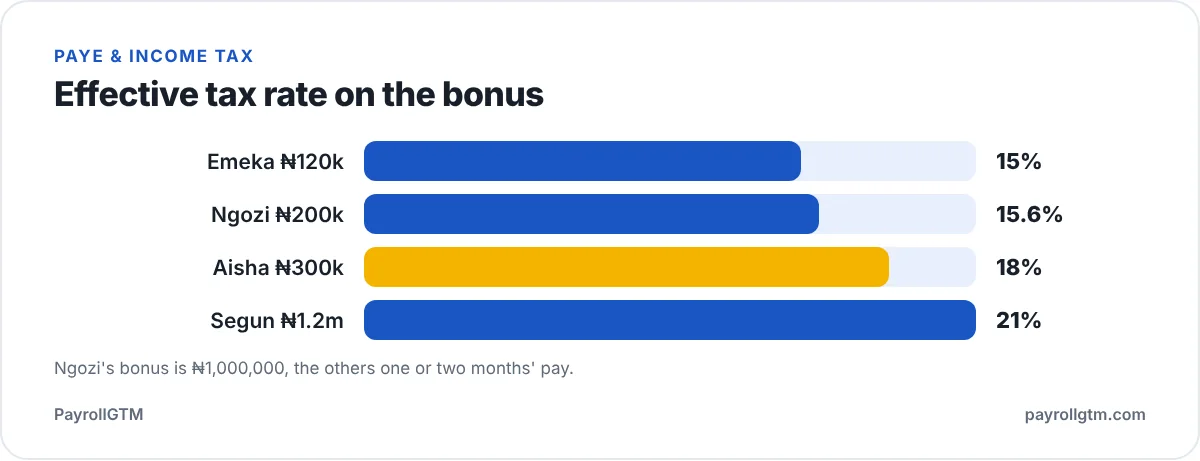
| ₦120,000 (Emeka) | ₦120,000 | ₦78,720 | ₦96,720 | ₦18,000 (15%) |
| ₦300,000 (Aisha) | ₦300,000 | ₦386,160 | ₦440,160 | ₦54,000 (18%) |
| ₦1,200,000 (Segun) | ₦2,400,000 (two months) | ₦2,212,080 | ₦2,716,080 | ₦504,000 (21%) |
A bonus can also straddle two bands. If part of it fills the top of one band and the rest spills into the next, the tax is a blend. Ngozi earns ₦200,000 a month and gets a ₦1,000,000 bonus. Her annual PAYE rises from ₦211,200 to ₦367,440, so the bonus costs ₦156,240, an effective 15.6%, because ₦792,000 of it is taxed at 15% and ₦208,000 at 18%.
Why the December payslip can look like a big tax jump
Aisha's PAYE goes from ₦32,180 in November to ₦86,180 in December. That is not an error. Her year's tax went up by ₦54,000 and December is the month that carries it: ₦440,160 for the year, less eleven months at ₦32,180 (₦353,980), leaves ₦86,180.
Where it can go wrong is the method. Some payroll sheets take the month's pay, multiply by 12 and tax that, as if the bonus will repeat every month. For Aisha the two methods land on the same figure because her whole year sits in one band. For Ngozi they do not.
Correct December figure: ₦367,440 (the year's tax) minus ₦193,600 = ₦173,840.
Sheet that multiplies December by 12: chargeable pay of (₦1,200,000 minus ₦16,000 pension) × 12 = ₦14,208,000, which reaches the 21% band. Monthly PAYE comes out at ₦201,140.
That deducts ₦27,300 too much in December. It is recoverable through a year-end true-up, but Ngozi is out of pocket until then, and she will blame payroll.
How a given employer's system spreads tax across months is a payroll setting, not something the Act spells out in this level of detail. What matters to the state IRS is that the year's total is right. If your December deduction looks odd, ask payroll for the year-to-date working before you query the amount. The step-by-step PAYE method shows how to rebuild it yourself.
13th-month pay and leave allowance
A 13th-month payment is not a legal requirement for private employers. It exists because the contract, handbook or custom of the company says so, and once it is paid it is taxed like any other pay. The same applies to a leave allowance: nothing in the Labour Act sets one, so its amount and timing come from your contract. Many Lagos and Abuja employers pay it as a fixed sum or a percentage of annual basic, but that is practice.
The tax treatment follows the rule above. Add Aisha's ₦300,000 13th-month pay and a ₦120,000 leave allowance to her ₦3,312,000 and her chargeable income reaches ₦3,732,000. The two payments cost ₦75,600 in tax, which is 18% of ₦420,000, and her take-home from them is ₦344,400.
Spreading a leave allowance across twelve months changes nothing about the annual tax. It only changes when the cash arrives and how smooth the payslips look. The annual total is what counts.
What to do if you promised a net amount
"We will give you ₦300,000 after tax" means the company must pay more than ₦300,000. Divide the net figure by one minus the marginal rate. For an employee in the 18% band: ₦300,000 ÷ 0.82 = ₦365,854 gross. The tax on that is ₦65,854 and the employee keeps ₦300,000.
Check the band first. If the gross-up pushes some of the bonus into the next band, a straight division under-pays and you need to split the calculation at the band edge. The net-to-gross method covers that, and the payroll calculator lets you test the result. Put the promise in writing as either gross or net. Vague wording is how a ₦54,000 argument starts.
What payroll should check before a bonus run
Most bonus problems are set up weeks before payday, when nobody has looked at the year-to-date figures. A short routine saves the argument later.
- Pull each employee's year-to-date gross, pension and PAYE up to the month before the bonus. The December figure only makes sense against that.
- Decide in writing whether the bonus is pensionable. If it is not, say so in the bonus letter, so the employee is not surprised that no pension line appears.
- Collect any rent evidence or other claims early. A tenancy agreement and receipts handed over in January cannot lower December's tax.
- Run the year-end figure first, then work backwards to the month's deduction, rather than multiplying the month by 12.
- Show the bonus on its own line of the payslip, with the extra PAYE it caused. Employees accept a ₦54,000 deduction far more easily when they can see where it came from.
Keep the working with the payroll records. If the state IRS later asks why December PAYE was ₦86,180 and not ₦32,180, the year-to-date sheet answers it in one page.
Mistakes that cost money
- Paying the bonus in cash outside payroll. The tax is still due. Under NTAA s.34 an Administrative Assessment lets the tax authority work from the records it has, and a reported 40% administrative penalty applies to tax that should have been deducted but was not. Confirm current penalties with your state IRS.
- Treating a bonus as pensionable by default. This raises both contributions and lowers take-home without any rule requiring it, unless your contract defines it that way.
- Forgetting the second job. A bonus from one employer adds to income taxed elsewhere. See how PAYE works with more than one employer.
- Ignoring reliefs. Rent relief, pension and other evidenced deductions lower the chargeable base before the bonus is added. Deductions that reduce PAYE and how to claim rent relief explain what to hand to payroll before December.
For other take-home figures at different salaries, see salary after tax in Nigeria.