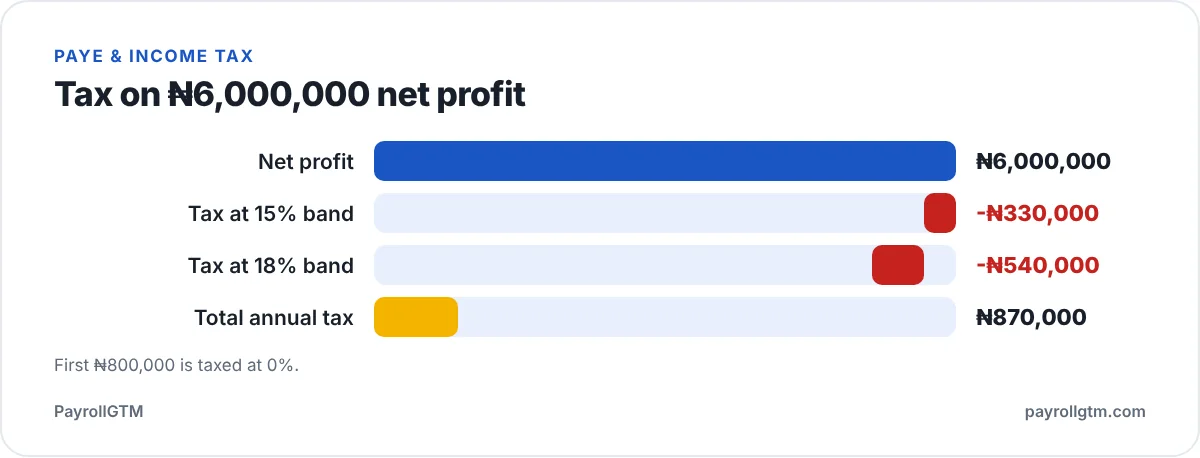
A freelancer or self-employed person in Nigeria pays tax on net profit at the same progressive rates as an employee: nothing on the first ₦800,000 of chargeable income in a year, then 15%, 18%, 21%, 23% and 25% in higher bands. The difference is that nobody deducts it for you. You register, keep records, file a return and pay the state Internal Revenue Service of the state where you live. On ₦6,000,000 of annual net profit with no reliefs, the tax is ₦870,000, or ₦72,500 a month set aside.
First decision: are you really self-employed?
The label you use does not decide it. If one client controls your hours, supplies your tools, pays you a fixed monthly sum and you work for nobody else, a tax office or a court may treat you as an employee, and that client should be deducting PAYE and paying pension. The full test is in employee or contractor: how payroll classification works.
You are more clearly on your own account if you:
- invoice several clients and can turn work down;
- decide how, where and when the work is done;
- carry your own costs (data, laptop, transport, a sub-contractor);
- bear the loss if a job goes badly.
If most of those are false, raise it with the client before the tax year ends. Quietly drifting into a disguised employment arrangement leaves both sides exposed.
Second decision: register and get a Tax ID
Every taxable person needs a Tax ID under the Nigeria Tax Administration Act (NTAA ss.6 to 8). The Nigeria Revenue Service (NRS) announced a unified Tax ID system in May 2026; individuals can reportedly use their NIN, and a registered business uses its CAC registration number. Because this is new, check the current notice from the NRS or your state IRS before you register, and do not pay any "agent" who quotes a fee you cannot verify on an official channel.
If you trade under a business name or a company, registration with the Corporate Affairs Commission is a separate step. A company is taxed as a company, not under the personal bands on this page; compliance basics for a registered business covers that side.
Third decision: what counts as your taxable profit
Profit is income received for the work minus the costs you incurred wholly for earning it: tools, a share of internet and phone, co-working fees, sub-contractor payments, professional subscriptions. Keep an invoice or receipt for each. Money you spent on yourself (rent for your home, food, a personal phone) is not a business cost, though the personal rent relief may apply separately.
Which cost items a tax office accepts, and how it treats equipment you buy, are matters of detail where we have no confirmed rule to quote. Ask your state IRS or an accountant. What is certain is that unsupported deductions are the first thing an assessor removes.
Fourth decision: how much to set aside
Use the same bands as salaried staff. The first ₦800,000 is taxed at 0%, the next ₦2,200,000 at 15%, and the next ₦9,000,000 at 18%.
First ₦800,000 at 0% = ₦0
Next ₦2,200,000 at 15% = ₦330,000
Remaining ₦3,000,000 at 18% = ₦540,000
Total = ₦870,000 a year, which is ₦72,500 a month and 14.5% of profit.
Now see what legitimate reliefs do to that bill. Rent relief is 20% of rent you actually paid, capped at ₦500,000, and you need the tenancy agreement and receipts. Contributions you make to your own pension are deductible when properly claimed. The table shows the effect on Segun.
| Situation | Chargeable income | Annual tax | Monthly set-aside |
|---|---|---|---|
| No reliefs | ₦6,000,000 | ₦870,000 | ₦72,500 |
| Rent ₦1,500,000 paid (relief ₦300,000) | ₦5,700,000 | ₦816,000 | ₦68,000 |
| Voluntary pension ₦600,000 a year | ₦5,400,000 | ₦762,000 | ₦63,500 |
| Both of the above | ₦5,100,000 | ₦708,000 | ₦59,000 |
Putting ₦600,000 into a voluntary RSA contribution saves ₦108,000 of tax at his top rate of 18%, but the money is locked in the retirement account, so decide if you can afford that. Voluntary pension contributions explains the trade-off.
Fifth decision: how to handle withholding tax on your invoices
Some clients, especially companies and government bodies, deduct withholding tax (WHT) from your fee before paying you, and issue a credit note or certificate. That tax is generally a credit against your final bill, not an extra cost. So if Segun's clients withheld a total of ₦300,000 during the year, the ₦870,000 would be reduced by that credit, leaving ₦570,000 to pay, provided he holds the certificates.
We have not confirmed current WHT rates or the exact credit procedure under the 2025 laws, so check both with your state IRS or the NRS before relying on the number. Always ask clients for the WHT certificate; without it, you cannot prove the credit.
Sixth decision: records, filing and payment
Keep a simple ledger: date, client, invoice number, amount received, cost incurred, receipt. The monthly habit takes ten minutes and saves days in January. Open a separate account for tax money so you do not spend it.
The annual return date in the NTAA is 31 January for the preceding year, and late filing carries a penalty of ₦100,000 for the first month and ₦50,000 for each month after (s.96). Whether your state asks for part-payments during the year, and on what dates, differs by state, so ask. If you do not file, the tax authority can assess you from the information it holds (NTAA s.34). That assessment will rarely favour you.
What if you also have a job?
Then you have two kinds of income. The employer deducts PAYE on salary as if it were your only income, and your freelance profit stacks on top, falling into the higher bands. Set aside a larger share of the side profit than the 14.5% in the example; paye for second jobs and how to calculate PAYE show the stacking. Use salary after tax to see what your payroll deducts today.
Mistakes that cost freelancers money
The commonest one is spending the tax. A designer in Abuja who banks ₦500,000 a month for twelve months, spends it all, and then learns in January that she owes about ₦870,000 on ₦6,000,000 of profit has a debt larger than a month's income plus a late filing clock already running. Setting aside a fixed share on the day money arrives is dull and works.
The second is relying on memory for costs. If you cannot show a receipt or invoice for an expense, expect it to be disallowed. The third is mixing personal and business transactions in one bank account. An assessor reading a statement full of mixed spending will not guess in your favour, and under the administrative assessment power they can work from whatever records exist.
The fourth is treating a retainer from one client as freelance income when it looks like a salary. If the client has not set you up on payroll and you invoice ₦400,000 every month for a full-time role, ask the question in the first section again, and read whether low pay is taxable if your monthly figure is small.
A quick plan for the first three months
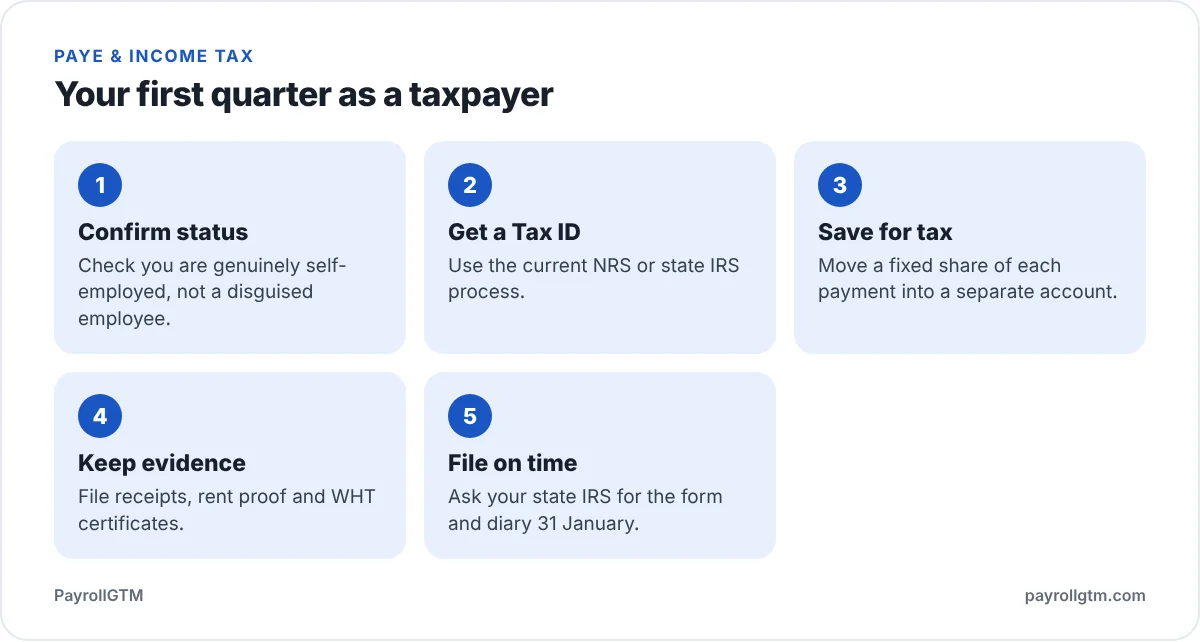
- Confirm your status and register or confirm your Tax ID.
- Open a tax savings account and move 15% of every payment into it.
- Collect evidence for rent and any pension contribution.
- Ask each client for WHT certificates when they deduct.
- Diary 31 January and ask your state IRS what form you file.