A salary paid in dollars is taxed in naira. If you live and work in Nigeria, the amount is converted at the CBN official rate on the date you are paid (this is the reported rule, so confirm it with your state IRS), and the result goes through the same 2026 bands as any other salary. The currency of the payslip changes nothing about whether PAYE applies. What it changes is who has to do the paperwork.
Take Chinedu, a front-end developer in Enugu. A software company abroad pays him $1,000 a month into a domiciliary account, and he signs a contract directly with that company. No Nigerian entity exists on their side, so nobody deducts PAYE and his payslip shows the full dollar amount. He has assumed, like many people in his position, that income paid abroad is not Nigeria's business. That assumption is where the trouble starts, and the rest of this guide follows his year from the first payment to the return.
Is the salary taxable in Nigeria at all?
For a person who is resident in Nigeria and does the work from Nigeria, employment income is taxable here, whoever the payer is and wherever the money lands. Remote work for a foreign company is ordinary employment income to the Nigerian tax authority if you are an employee, or business income if you are really a contractor. Tax residence has its own tests under the Nigeria Tax Act 2025, and we have not set them out here because the sources we rely on do not give a safe summary. If you split your year between countries, or work from Nigeria only part of the time, ask your state IRS or a tax adviser how your days and your ties are counted before you decide where the salary is taxable.
The state IRS of the state where you live collects personal income tax from most employees (LIRS in Lagos, FCT-IRS in Abuja). There are exceptions that go to the NRS, and which tax authority gets PAYE explains them. A dollar salary does not move you to a different authority.
How the dollars become naira
The reported rule is conversion at the CBN official rate on the payment date. Three practical points follow from that.
- Use the rate for the day the money was paid or credited, not the day the contract was signed, not the rate your bureau de change quoted, and not the rate in the offer letter if that was a negotiated figure.
- Keep evidence. A bank credit advice or statement showing the date and the dollar amount, plus a screenshot or printout of the official rate for that date, is what an assessor will ask for.
- Every payment gets its own conversion. If the rate moves during the year, the naira figure moves with it, and the annual total is the sum of twelve conversions, not twelve times January's figure.
Worked example: $1,000 a month with no Nigerian payroll
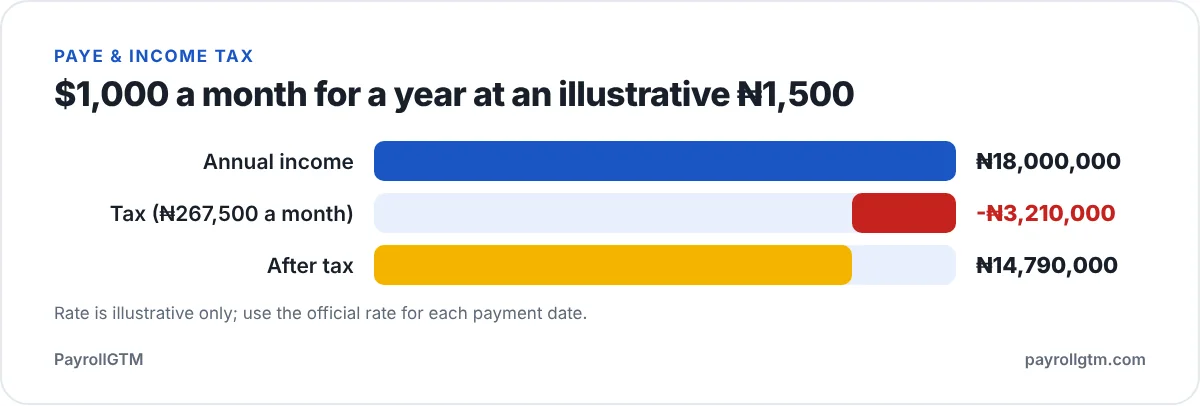
At the illustrative rate, Chinedu's $1,000 is ₦1,500,000 a month, or ₦18,000,000 a year. No employer pension is being paid and he has no pension deduction to claim, so the whole amount is chargeable. We computed the tax with the site's PAYE calculation.
Annual income ₦18,000,000, no deductions.
- First ₦800,000 at 0%: ₦0
- Next ₦2,200,000 at 15%: ₦330,000
- Next ₦9,000,000 at 18%: ₦1,620,000
- Next ₦6,000,000 at 21% (up to ₦18,000,000): ₦1,260,000
Annual tax ₦3,210,000, which is ₦267,500 a month, about 17.8% of the ₦1,500,000.
Because nobody withholds this, Chinedu has to put ₦267,500 aside every month and pay it himself. The cash is the real problem. A ₦3.2 million bill arriving at once, with no deductions through the year, is the typical way this arrangement goes wrong.
What the exchange rate does to the bill
The same dollars produce different tax when the official rate changes, because the bands apply to the naira total. Here is the same $1,000 a month at three illustrative rates (annual income at a steady rate, no deductions).
| Illustrative rate | Monthly naira | Annual naira | Annual tax | Tax per month |
|---|---|---|---|---|
| ₦1,400 | ₦1,400,000 | ₦16,800,000 | ₦2,958,000 | ₦246,500 |
| ₦1,500 | ₦1,500,000 | ₦18,000,000 | ₦3,210,000 | ₦267,500 |
| ₦1,600 | ₦1,600,000 | ₦19,200,000 | ₦3,462,000 | ₦288,500 |
A ₦100 move in the rate shifts his yearly tax by ₦252,000 in either direction. Anyone paid in dollars should treat the monthly tax figure as an estimate and settle the real number when the year's payments are all converted.
Who deducts and who pays
It depends on who the payer is.
- A Nigerian company that pays in dollars. This is a normal payroll with a currency twist. The employer converts each payment, deducts PAYE and pension on the naira figure, remits to the state IRS and includes the employee in its annual return (Form H1). Our worked example for ₦1,500,000 a month with pension on the whole amount gives employee pension ₦120,000, PAYE ₦242,300 and net pay of ₦1,137,700, with the employer adding ₦150,000 pension.
- A foreign company with a Nigerian subsidiary or an employer-of-record that runs Nigerian payroll. Same as above, deducted by that local entity.
- A foreign company with no Nigerian presence that pays you directly. There is no one to run PAYE. As far as we can tell, the tax is then yours to declare and pay to your state IRS. Whether it is handled as a monthly self-payment, an annual assessment or something else is set by each state IRS, so ask them how they want it, and register first.
Before assuming the third case applies, check that you are really an employee. Someone invoicing a foreign client as an independent consultant is taxed as self-employed instead, with different rules, covered in tax for freelancers and the self-employed. The test is control, hours and exclusivity, not the label on the contract. Employee or contractor explains how to tell.
Pension, NHF and what you can deduct
If a Nigerian employer pays you, the usual pension rules apply: employee 8% and employer 10% of monthly emoluments, with the contribution computed on the naira amount. Employers with three or more staff are covered. If a foreign company with no Nigerian operations pays you directly, it is not clear that it is bound by the Pension Reform Act, so do not assume it is. You can still pay voluntary contributions into your own RSA, and those are deductible when properly claimed, as described in voluntary pension contributions and their tax benefit. NHF is voluntary for private-sector workers.
The other deductions work for you whoever the payer is, if you have the evidence. Rent relief is 20% of the rent you actually paid, capped at ₦500,000. If Chinedu pays ₦1,800,000 rent a year, relief is ₦360,000 and his chargeable income falls from ₦18,000,000 to ₦17,640,000, which cuts the annual tax from ₦3,210,000 to ₦3,134,400. That is ₦75,600 a year (₦6,300 a month). See how to claim rent relief for what the state IRS wants to see, and deductions that reduce PAYE for the rest of the list.
A practical routine for the year
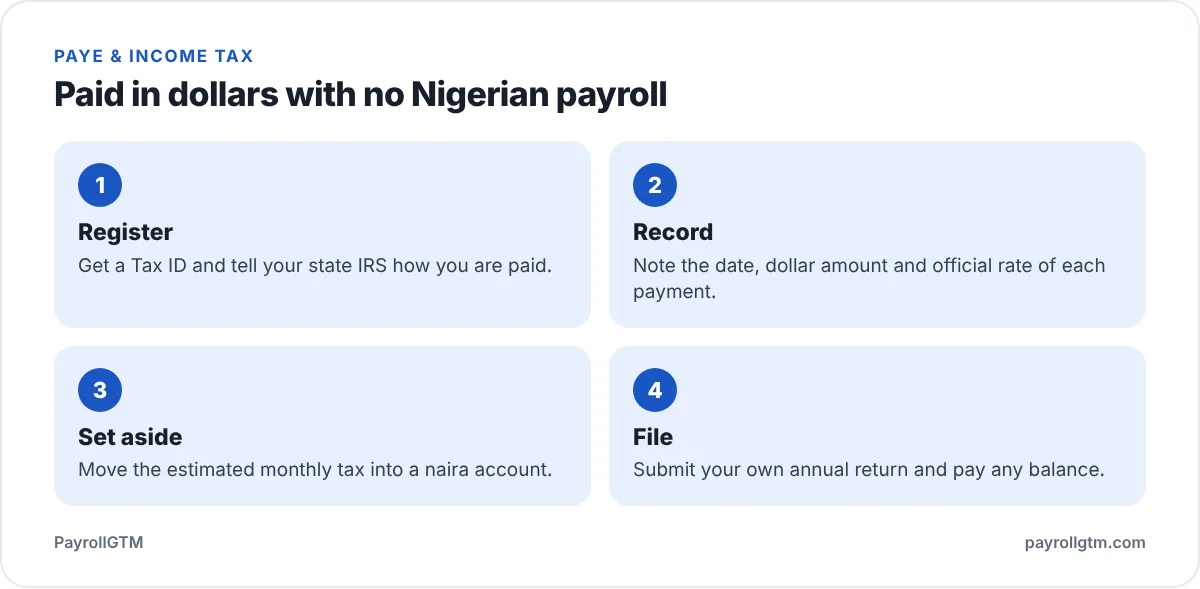
- Get a Tax ID. Individuals can reportedly use their NIN, but check the current NRS and Joint Revenue Board notice, and see Tax ID and NIN for employees.
- Tell your state IRS in writing that you are paid by a foreign payer with no Nigerian PAYE, and ask how they want the tax paid and the return filed.
- Each time you are paid, record the date, the dollar amount and the official rate for that day. A simple sheet with those three columns is enough.
- Move the estimated tax into a separate naira account the same week.
- File your own annual return. The employer's return does not replace it, and here there is no employer return. Do employees file annual tax returns sets out the duty and deadline.
One more point for people paid partly in dollars and partly in naira: the two add together into a single income for the year, so work out the combined figure rather than taxing each half separately.