Six things can lower the PAYE on a Nigerian salary in 2026: the 8% employee pension, rent relief of 20% of rent paid (capped at ₦500,000 a year), NHIS/NHIA contributions, NHF contributions, interest on a loan for your own home, and life insurance or annuity premiums. Only pension comes off automatically through payroll. Every other item reduces tax only if you claim it and can prove it.
The old Consolidated Relief Allowance (the ₦200,000 plus 20% of gross) no longer exists, so a pay slip that still shows it is out of date. The deductions below are what replaced it, and the table sets out how each one works.
The deductions at a glance
This table shows what each deduction is, whether a cap is confirmed, and who normally deals with it.
| Deduction | What it is | Cap we can confirm | Who handles it |
|---|---|---|---|
| Employee pension | 8% of basic, housing and transport, paid into your RSA | 8% is the statutory minimum; voluntary top-ups are separate | Employer deducts through payroll |
| Rent relief | 20% of the annual rent you actually pay | ₦500,000 a year (reached at ₦2.5 million rent) | You claim, with evidence; some employers apply it in payroll |
| NHIS/NHIA contributions | Health insurance contributions you pay | None confirmed | Employer if deducted from pay; otherwise you claim |
| NHF contribution | 2.5% of basic salary to the Federal Mortgage Bank | None confirmed | Employer if you opted in |
| Home loan interest | Interest on a loan for a residential house you live in | None confirmed | You claim, with lender statements |
| Life insurance or annuity premium | Premiums you pay on your own policy | None confirmed | You claim, with policy and receipts |
"None confirmed" does not mean unlimited. It means the sources we rely on do not state a cap, so ask your state IRS before you claim a large figure.
Pension: the one deduction that happens by default
Your 8% is taken before PAYE is worked out, so it lowers your chargeable income without any paperwork. It is calculated on at least basic, housing and transport. If you also pay a voluntary contribution into your RSA, that can reduce tax further when properly claimed; the article on voluntary pension contributions and their tax benefits covers how. The part payroll teams get wrong is the base. If housing and transport are left out of the pensionable pay, the pension line is too small and the PAYE is too high. See how pension contributions are calculated for the right base.
Rent relief: 20% of rent, up to ₦500,000
If you pay ₦1,500,000 a year in rent, the relief is ₦300,000. If you pay ₦3,000,000, 20% would be ₦600,000, so the cap holds it at ₦500,000. It applies only to rent you pay yourself. A housing allowance from your employer is not rent you paid, and rent paid by your company on your behalf does not qualify. Evidence means a tenancy agreement and rent receipts or bank transfers in your name. The step-by-step guide on claiming rent relief shows what to hand to payroll, and why rent relief replaced the old allowance explains the change.
Health insurance, NHF, home loan interest and life policies
These four share a pattern: they reduce taxable income only when you declare them with proof.
- Health insurance. Contributions under the national scheme count. If your employer runs a group plan and deducts your share, ask payroll whether it is treated as a deduction. See health insurance for employees for how these plans work.
- NHF. The 2.5% of basic is a deduction for those who pay it. For private-sector staff it is voluntary, so there is no deduction unless you opted in. See NHF for private-sector staff.
- Home loan interest. Only interest, not the capital repaid, and only on a residential house you live in. Keep the lender's annual statement showing the interest charged.
- Life insurance or annuity premiums. Your own policy and receipts. This is separate from the group life cover your employer must buy for you, which the employer pays.
The same salary with and without claims
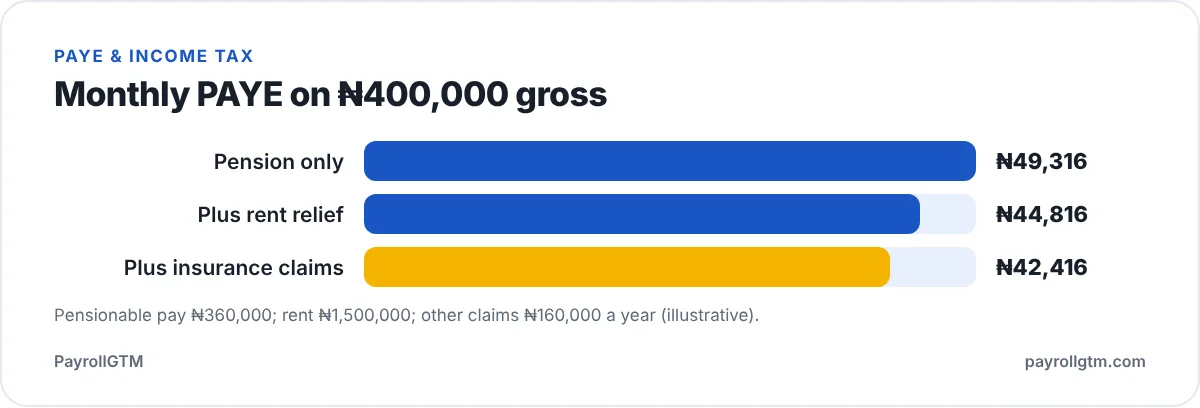
Her chargeable income sits in the 18% band, which is why each extra ₦100,000 deducted saves ₦18,000 of tax over the year. The full set of claims is worth ₦6,900 a month, or ₦82,800 a year, to her. Someone in the 15% band saves 15 kobo per naira deducted, so the value of a claim rises with income.
What evidence to keep
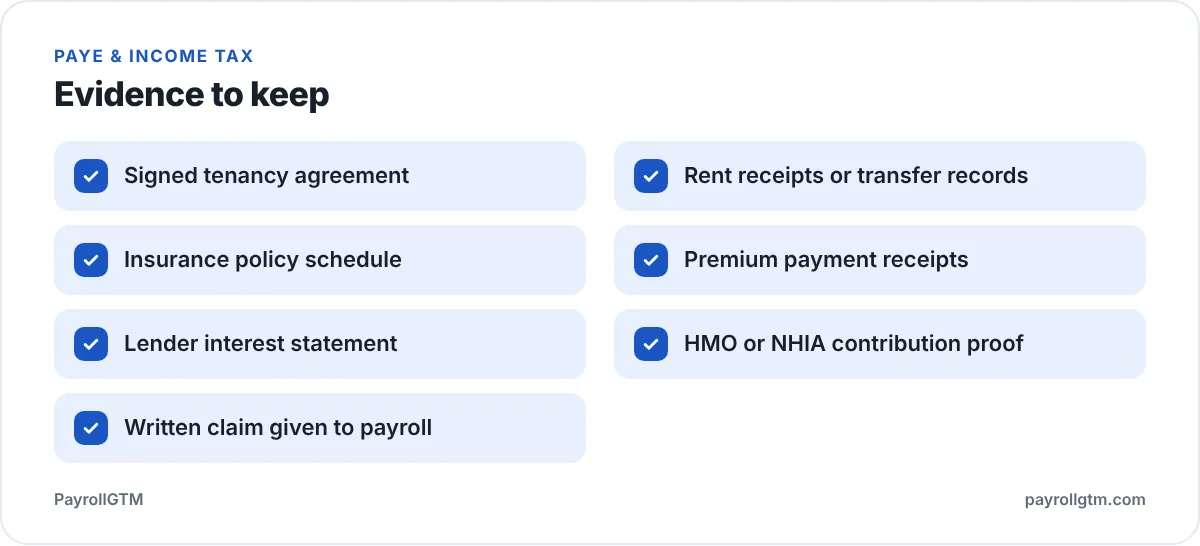
Keep paper or scans for several years, since a state IRS can query past years; the guide to payroll record keeping covers retention. A claim you cannot support is an under-deduction waiting to be corrected, and the penalty reported for tax that should have been deducted is 40% of the tax, so confirm the figure with your state IRS before you gamble on an unsupported claim.
Claiming part-way through the year
Relief is worked out on the whole year, so a claim made in July still belongs to the full year's tax. How the catch-up is handled is a state IRS matter. Some payroll teams spread the benefit over the remaining months, others hold it for the year-end return. Ask yours, and write the method into your payroll procedure so two staff with the same claim are treated the same way.
A smaller saving than Aisha's, but a real one, and it costs the employer nothing except a few minutes of filing.
What employers should put in writing
A one-page claim form removes most of the arguments. It should ask the employee to state which relief they are claiming, the annual amount, the document attached, and the date, and to sign. Payroll then files the form with the supporting document in the employee's file, applies the relief from a stated month, and notes it on the payslip as a separate line or in the tax workings. When an auditor asks why one employee's PAYE is lower than a colleague's on the same pay, the form answers the question in seconds. The same form works for every relief on the list, and the rent relief article shows what a completed one needs.
When claims do not help
If you earn around the minimum wage, your chargeable income may already be inside the 0% band, so a claim saves nothing; see whether minimum wage is taxable. If you have two employers, claim each relief once only, not against both payrolls; the guide to PAYE with two employers explains how to avoid doubling up. And relief reduces taxable income, never your pension base or your gross pay.
To see your own numbers with and without claims, try the payroll calculator, then compare it with the take-home on your payslip using salary after tax in 2026.