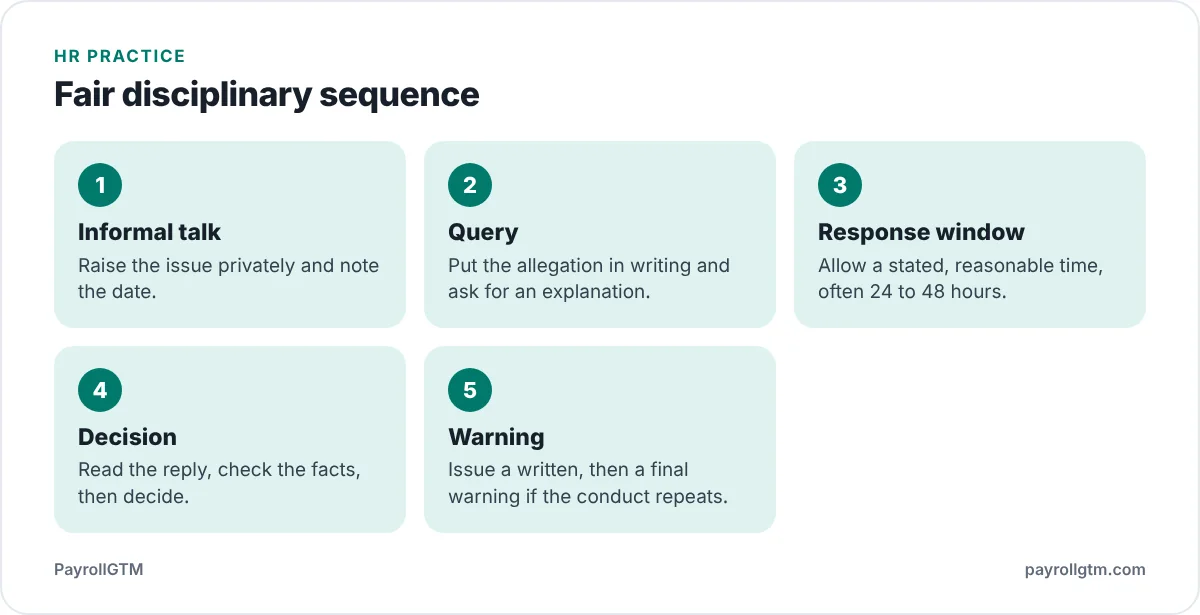
A fair disciplinary sequence in a Nigerian small business runs from an informal word, to a written query, to a written warning, to a final warning, and only then to anything more serious. Each step should be in writing, give the employee a chance to respond, and be kept on file. Below are copy-ready texts for a query and a written warning, with notes on what to change. They are templates, not legal advice. For a dismissal or suspension, read the full disciplinary procedure and fair hearing guide first.
The sequence, and why order matters
- Informal conversation. For a first, minor problem, talk privately and note the date and what was agreed. No letter yet.
- Query. A written letter that states the alleged problem and asks for a written explanation. A query is not a punishment. It is a request to hear the employee's side.
- Response window. Practice among many employers is 24 to 48 hours for a simple matter, longer for a complex one. The law does not fix this, so state the deadline in the letter and be reasonable, particularly if the employee is on leave or the facts need documents.
- Decision. The manager reads the response, checks the facts, and decides: no action, advice and guidance, or a written warning.
- Written warning, then final warning. Each stays on file for a period set in your policy (for example 6 to 12 months). Repeating the same offence after a final warning is what justifies stronger action.
Serious misconduct such as theft or violence can justify skipping steps, usually with a suspension while you investigate. Even then, give the employee a chance to answer. A company that skips the hearing risks losing at the National Industrial Court of Nigeria, however guilty the employee seems; see wrongful dismissal and the National Industrial Court.
Before you write: three checks
- Is there a rule? You can only query a breach of a rule the employee knew about. Point to the contract clause, handbook section or code of conduct. If you have none, start with a workplace code of conduct and, for lateness, an attendance policy.
- Do you have the facts? Dates, times, figures, who saw what. Attach evidence (an attendance record, a stock sheet) or say where it can be seen.
- Is the writer the right person? The direct manager or HR issues the query. A letter signed by a person with no authority will be challenged.
Sample query letter
Replace the bracketed text. Keep the facts plain and the tone calm.
[Company letterhead]
[Date]
PRIVATE AND CONFIDENTIAL
[Employee's full name]
[Position / Department]QUERY: [short description, e.g. Absence from duty on 12 and 13 March]
Dear [First name],
It has been reported that you were absent from your duty post on [date(s)] without approval from your supervisor. Our attendance records show that you did not sign in on those days, and no leave request was received. This appears to be a breach of [clause / section] of [the staff handbook / your employment contract].
Please state in writing, within [48 hours] of receiving this letter, your explanation for the absence and attach any supporting document. If you need more time or documents to respond, tell [name] before the deadline and say why.
This letter is a request for your explanation. No decision has been made. Your reply will be considered before any action is taken.
Yours sincerely,
[Name, title]Received by: ____________ Date: ________ (acknowledgement of receipt, not of guilt)
The last line matters. Many employees refuse to sign a query out of fear. If so, note the date and time you handed it over, who witnessed it, and also email it.
Sample written warning
Issue this after you have read the response and decided that the breach is proved. Say what you considered, not only what you decided.
[Company letterhead]
[Date]
PRIVATE AND CONFIDENTIAL
[Employee's full name]
[Position / Department]WRITTEN WARNING
Dear [First name],
We refer to our query of [date] and your reply of [date]. We have considered your explanation that [summary of what the employee said]. We found that [what the facts show, e.g. no approval was obtained and the reason given was not supported by any record].
This is therefore a written warning for [conduct] in breach of [clause]. You are expected to [the standard, e.g. obtain written approval from your supervisor before any absence]. This warning will remain on your file for [12 months]. A repeat of this conduct, or any other misconduct, in that period may lead to further disciplinary action up to and including dismissal in line with your contract.
If you disagree with this decision, you may write to [HR / managing director] within [5 working days] giving your reasons.
Yours sincerely,
[Name, title]Received by: ____________ Date: ________
A final written warning follows the same layout, with a clearer sentence on the consequence: "Further misconduct in the next [12 months] may result in your dismissal." Do not copy a warning word for word from a past case. Each one must describe the actual facts.
If the employee does not reply, or replies angrily
Silence is not an admission. If the deadline passes with no reply, send a short reminder with a new date, and say that you will decide on the facts available if there is still no response. Then decide on the evidence you have and record that no explanation was given. An angry reply is common and does not change the process. Read it for facts, ignore the tone, and do not answer insult with insult. If the reply raises a new point (the supervisor never approved the shift swap, the sign-in book was missing), check it before you issue a warning. A warning that ignores a good explanation is the one that fails later.
Where the allegation is serious and you need time, a short suspension on full pay while you investigate is a common step, but the terms depend on the contract and the handbook, so check your own documents and take legal advice before you rely on it.
Language to avoid
- No insults or judgments of character ("lazy", "dishonest", "useless"). Describe conduct, dates and effect.
- No threats you cannot carry out, such as "you will be sacked", in a query. That prejudges the hearing.
- No copying the whole office. Send it to the employee, HR and the line manager only. The same discipline applies to personal data in the letter, as covered in employee data protection under the NDPA.
- No deduction from pay as a punishment unless the contract and the law clearly allow it; see wage payment and lawful deductions.
What to keep on file
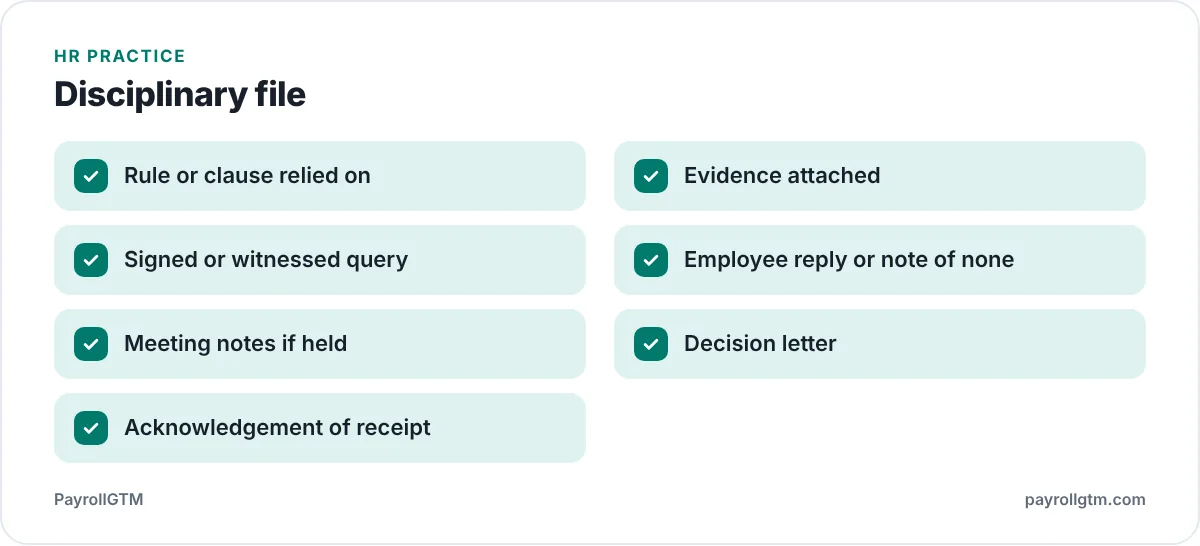
For each case, keep the rule relied on, the evidence, the query, the response (or a note that none came), any meeting notes, the decision letter and the acknowledgement. Store them in the personnel file, with limited access. If the employee later resigns, the resignation acceptance and exit templates help you close the matter cleanly, and your offer letter and contract (see the job offer letter template) should already refer to the disciplinary policy.