A person is an employee or a contractor according to how the work really operates, not what the contract or invoice calls it. If you control their hours and methods, they work only for you, use your equipment and cannot send a substitute, treat them as an employee: deduct PAYE, pay pension and register them for NSITF. If they run their own business for several clients and carry their own risk, they are a contractor.
The label "consultant" does not protect you. Misclassifying an employee as a contractor can look cheaper for a year or two and then produce a bill for tax and pension contributions, plus penalties, that is far larger than the saving.
What changes with each status
For an employee, you deduct PAYE monthly and remit it to the state IRS of the employee's residence by the 10th of the following month. You also pay pension at a combined minimum of 18% of monthly emoluments (8% from the employee, 10% from you) if you have 3 or more employees, hold group life cover, and pay 1% of total payroll to the NSITF. The Labour Act protections for notice, leave and lawful deductions apply as well, subject to the "worker" definition that excludes some administrative, executive, technical and professional staff in some respects.
For a genuine contractor, you pay under a service agreement. The contractor is responsible for their own income tax, pension and insurance. Withholding tax may apply to the payment, and the rate depends on the type of service and the payee, so ask your accountant or the NRS for the current rate instead of using a rule of thumb. Ask for the contractor's Tax ID before the first payment. If they are registered for VAT, their invoice may carry it. Our guide to tax for freelancers and the self-employed shows the contractor's side.
The five tests that matter
No single factor decides it. Officers and courts look at the substance of the arrangement.
| Test | Points to employee | Points to contractor |
|---|---|---|
| Control | You set hours, methods and priorities | They decide how to deliver the result |
| Integration | Company email, on the organisation chart, supervises staff | Visibly separate from the team |
| Financial risk | Paid the same whatever the month brings | Own tools, quotes for jobs, can make a loss |
| Exclusivity and length | Only you, full time, for years | Several clients, project by project |
| Substitution | Must do the work personally | May send someone else |
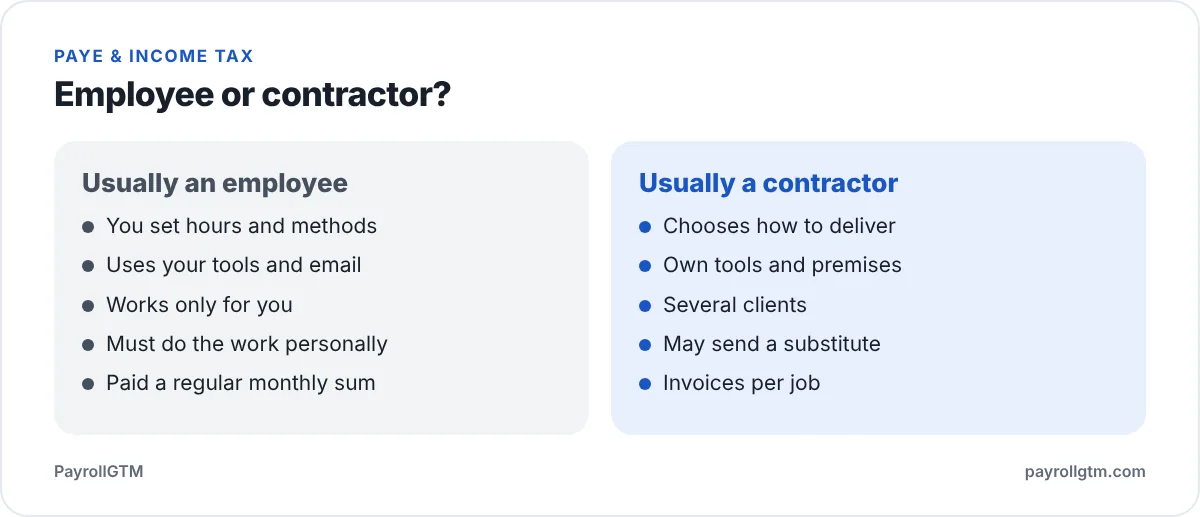
The typical payment pattern differs too: a regular monthly salary for an employee against an invoice per job or milestone for a contractor, but the pattern alone proves nothing.
Two cases
The designer. A bakery pays a freelance designer ₦80,000 per project for packaging artwork. She works from home with her own software, has other clients and sets her own deadlines within the project timetable. That is a classic contractor. The bakery collects her Tax ID, applies withholding tax if it applies to that type of service, and keeps the invoice and a short service agreement.
The driver. A trading company pays Obinna ₦120,000 every month. He reports at 7:30 each morning, drives only the company vehicle, follows the manager's route instructions and works for nobody else. The company calls him a contractor to avoid pension and insurance costs. Nearly every test points to employment. Notice what separates the two: not the amount of money or the word in the contract, but who controls the work, who carries the risk and how deeply the person sits inside the business.
What misclassifying the driver costs
We ran Obinna's pay through the calculator on this site as an employee on ₦120,000 gross, with all of it pensionable.
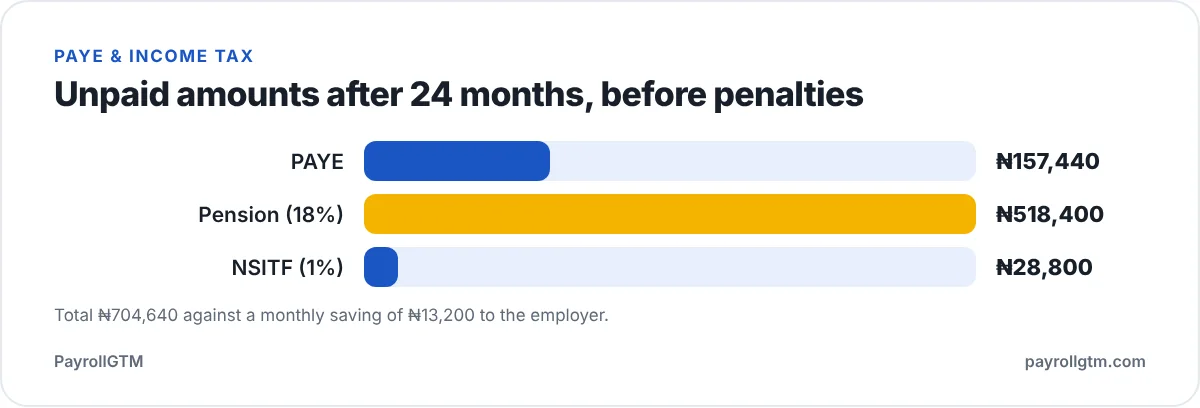
The company "saves" ₦13,200 a month, or ₦158,400 a year. Now suppose a tax officer or the pension regulator reclassifies him after two years. The amounts that were never deducted or paid add up like this.
| Item (24 months) | Monthly | Total |
|---|---|---|
| PAYE not deducted | ₦6,560 | ₦157,440 |
| Pension, 18% combined (₦9,600 + ₦12,000) | ₦21,600 | ₦518,400 |
| NSITF 1% of pay | ₦1,200 | ₦28,800 |
| Total before penalties and interest | ₦29,360 | ₦704,640 |
Penalties come on top. Late pension attracts 2% of the unremitted contribution for each month of delay under the Pension Reform Act, and tax that should have been deducted is reported to carry a 40% administrative penalty plus interest. Confirm the current position with your state IRS. See penalties for late PAYE and payroll defaults. Obinna may also claim leave and notice. A two-year saving of ₦316,800 against a bill above ₦700,000 is a poor trade.
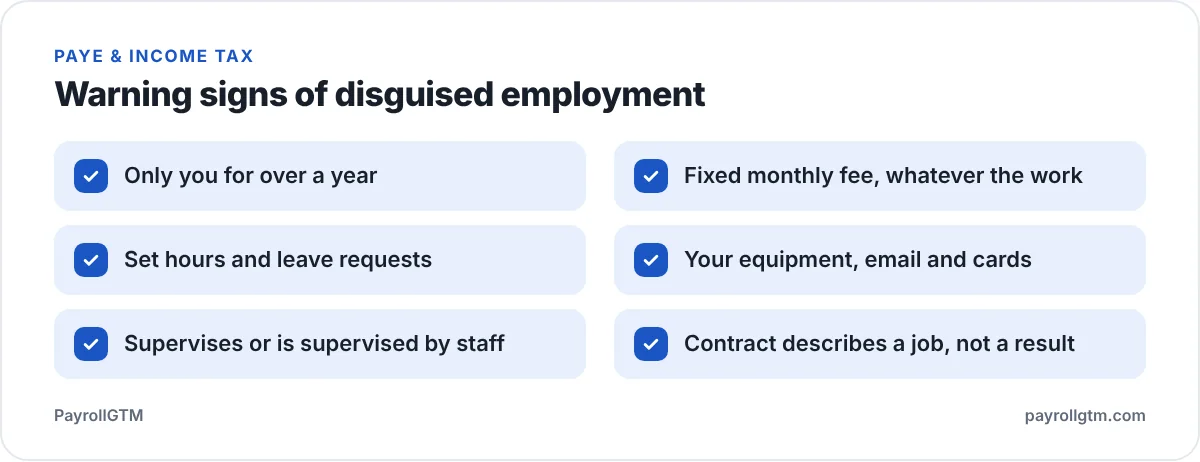
Warning signs of disguised employment
Several together make reclassification likely.
A simple classification routine
- Describe the work. One paragraph on what the person does and what result you expect.
- Score the five tests. Note whether each fact points to employment or contracting.
- Record the decision and reasons in the person's file.
- Use the right paper. An employment contract for staff, or a service agreement with deliverables, fees, tax responsibilities and termination for contractors.
- Review yearly. A project contractor who becomes a daily presence may belong on payroll.
Part-time, casual and fixed-term workers can still be employees. The pension position is covered in pension for contract and casual staff, and the contract types in casual, fixed-term and permanent employees.
If you find a misclassification
Act early. Agree the correct status with the person, move them onto payroll from now on, and ask a tax adviser or your state IRS how to treat past periods. Voluntary correction usually lands better than a finding in an audit. Never backdate documents, because that creates a bigger problem than the original mistake. To start payroll properly, see how employers register for PAYE with the state IRS, and collect the worker's Tax ID as explained in Tax ID and NIN for employees. For the monthly calculation, see how to calculate PAYE in 2026.
Common questions
Can I avoid payroll costs by calling someone a consultant?
No. The real working relationship decides the outcome.
Is a written contract enough protection?
It helps only if reality matches the paper.
What if a contractor will not give me a Tax ID?
Withholding tax may apply at a higher rate to payees who cannot be identified, and your own records are incomplete. Make a Tax ID a condition of engagement.
Classification is a judgement. For borderline cases take advice from a tax adviser or lawyer.