At about 4 p.m. on a Thursday, a machine operator at a small bottling plant in Ogun State catches his hand in a conveyor guard that was left off for cleaning. He is taken to a clinic, the supervisor says "we will sort it out", and nobody writes anything down. Three weeks later he cannot grip, his salary is still being paid, and no one can say whether the company's NSITF contribution covers him, who should report the injury, or what he is entitled to. This is the situation the Employees Compensation Act 2010 (ECA) is meant to settle, and the steps taken in the first hours decide how smoothly it goes.
What the Act is for, in plain terms
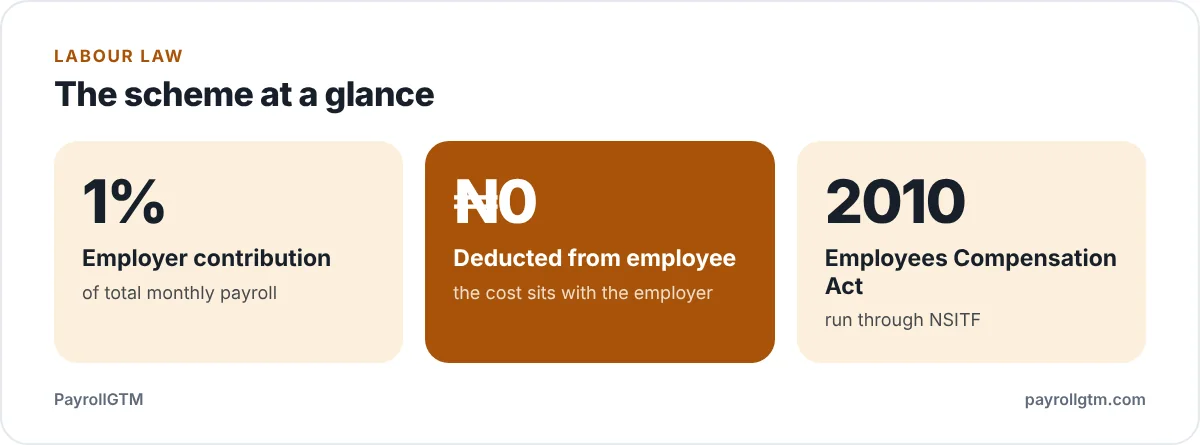
The ECA sets up a compensation scheme for employees who are injured, become ill or die because of their work. The scheme is run by the Nigeria Social Insurance Trust Fund (NSITF) and funded by employers. The employer pays 1% of its total monthly payroll (total emoluments) to NSITF. Nothing is deducted from the employee's pay for it. If you see an "NSITF" line deducted from a worker's payslip, something is wrong; the contribution sits on the employer side of the books.
The idea is that a worker hurt on the job should be compensated through the fund without having to sue the employer first. Registration, the exact filing steps and the claim forms are set by NSITF and may change, so we describe the process in principle here and tell you where to confirm details. NSITF registration and contributions covers the monthly side.
What the contribution costs
For a plant paying ₦6,500,000 in total monthly emoluments, the NSITF contribution is 1%, or ₦65,000 a month, ₦780,000 a year. That is a cost to the business, not to staff, and it is separate from the 10% employer pension and any group life premium. An employer of 12 people on an average ₦150,000 pays ₦18,000 a month. Compared with the cost of one unreported serious injury, the contribution is small, and the employer registration checklist shows where NSITF sits among your other first-year duties.
What an employer should do after an incident
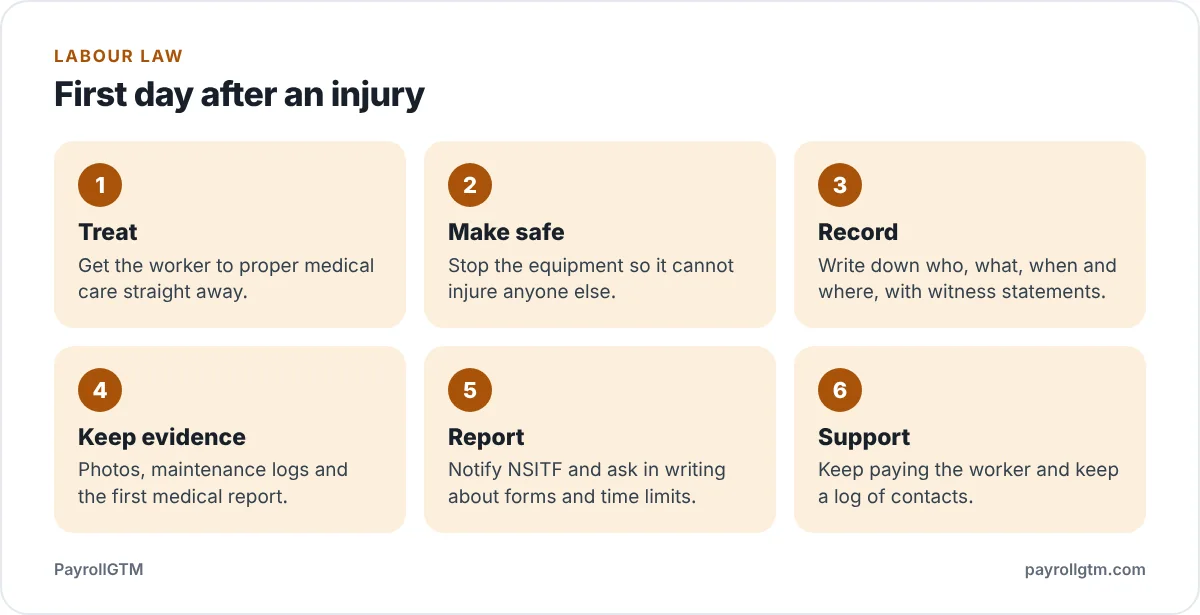
Going back to the plant, here is the order that would have protected both sides.
- Get medical care first. Call for transport, give first aid, and take the person to the nearest competent facility. Do not wait for a supervisor's approval or argue about cost.
- Make the area safe. Stop the machine, lock it out, and keep other staff away so the same accident cannot repeat.
- Write down what happened the same day. Date, time, place, who was present, what the worker was doing, what equipment was involved, and what was done afterwards. Ask any witness to sign a short statement.
- Keep evidence. Photographs of the scene, the guard or equipment, maintenance logs, the worker's job description and training records, and the first medical report.
- Tell the worker's family or next of kin and be honest about what is known.
- Report to NSITF through its current notification channel, and tell your insurer if you hold any additional cover. Ask NSITF in writing what forms and time limits apply; we have not confirmed a deadline and you should not guess one.
- Keep paying and keep talking. Continue salary while the worker is treated unless the contract or NSITF guidance says otherwise, and keep a file of every contact.
The common mistake is silence. An employer who hides an accident, pressures the worker to sign a waiver or pays a small sum "to close the matter" can create more liability than the incident itself, and it destroys trust with everyone else on the shop floor.
What an employee can expect, in principle
An injured worker can generally expect three things from the system: treatment, compensation set by the scheme, and protection from being punished for claiming. Which medical costs are covered, how disability is assessed and what amounts are paid depend on NSITF's rules and on medical assessment. We do not state any amounts or formulas here because we have not verified them. Ask NSITF for the current schedule, or ask a labour lawyer.
If you are the worker, do these things:
- Report the incident to your supervisor and HR the same day, in writing if possible (a message counts as a record).
- Keep every medical document, receipt and discharge note.
- Note names of colleagues who saw it.
- Do not sign a release or "settlement" form you do not understand.
- If your employer will not report to NSITF, you may be able to approach NSITF yourself; ask the nearest NSITF office how.
An employer cannot lawfully treat a claim as misconduct. Dismissing someone because they were hurt and reported it invites a case at the National Industrial Court; see wrongful dismissal and the NICN. A worker who needs extended treatment may also use sick leave, and the statutory floor is up to 12 working days a year on a doctor's certificate; the leave guide explains it.
Does it cover casual and contract workers?
Treat them as covered until a lawyer or NSITF tells you otherwise. Calling someone a casual does not change the facts of who controls the work and bears the risk, a point developed in casual, fixed-term and permanent employees. Include every worker on site in your payroll record, because contributions are based on total payroll and an off-book worker who is injured is the hardest case to defend.
Managers and professionals sit in a grey area under older labour law, as discussed in the Labour Act coverage guide, so do not assume your senior staff are outside the scheme.
Illness and long-term conditions count too
The scheme is not only for sudden accidents. Work-related disease, such as hearing loss in a noisy workshop or a back problem from years of heavy lifting, can fall within it, and so can a death arising from work. These cases are harder because the link to the job has to be shown. Keep health and safety records, medical check-ups where you do them, and job histories, so that the connection can be assessed fairly. If a worker raises a long-term condition, treat it as seriously as a visible injury and ask NSITF how to document it.
Prevention that costs little
Most workplace injuries in small businesses come from a few repeat causes. Fix those before you buy any insurance.
- Machine guards that stay on, with a lockout rule for cleaning or repair.
- Protective gear that fits and is replaced when worn (boots, gloves, goggles, ear protection).
- Written instruction and a short induction for each new operator, signed.
- Clear floors, working lighting, a fire extinguisher that has been serviced, and a first-aid box that is stocked.
- A rule on working hours and rest, because tired people get hurt. See working hours, overtime and rest days.
- A named person who writes the incident down, every time.
Put the reporting rule in the contract and handbook so everyone knows it; what a contract should contain and the employer duties summary list the other terms. The incident should also go into your payroll and HR files,, and your own calendar should show the NSITF payment date so contributions are never skipped. Check NSITF for the current due date, since we have not confirmed one.
Back to the plant
Had the supervisor logged the incident, taken photographs and notified NSITF within days, the operator would have had treatment, the employer a clean record, and the other 40 workers a reason to trust the system. What the Act promises is real, but it works only if someone starts the paperwork.