Genuine compensation for loss of employment is exempt from personal income tax up to ₦50 million under the Nigeria Tax Act 2025, up from ₦10 million before 2026. That exemption covers the compensation itself. It does not cover everything in a final pay packet, and the difference between the two is where most employers and employees go wrong.
The rest of this page helps you sort a termination payment into the part that is plausibly exempt and the part that is ordinary taxed pay, then shows what the sorting is worth in naira. Where the law is unclear we say so, because a wrong label on a ₦8 million payment is an expensive mistake.
Start by asking what the payment is for
Work through these questions in order for each line of the settlement.
- Is it pay for work already done? Salary up to the last day, arrears and unpaid allowances are earnings, however the letter describes them. They are taxed through PAYE like any other month.
- Is it pay for time not taken or notice not worked? Unused leave converted to cash and pay in lieu of notice replace pay the employee would have received. The safe working assumption is that both are ordinary employment income.
- Is it a payment because the job itself was lost? A redundancy payment, or a negotiated sum for ending the contract early, is the kind of payment the compensation exemption is aimed at.
- Is it a bonus, commission or incentive that happens to be paid at exit? Bonuses are employment income, and the leaving date does not change that.
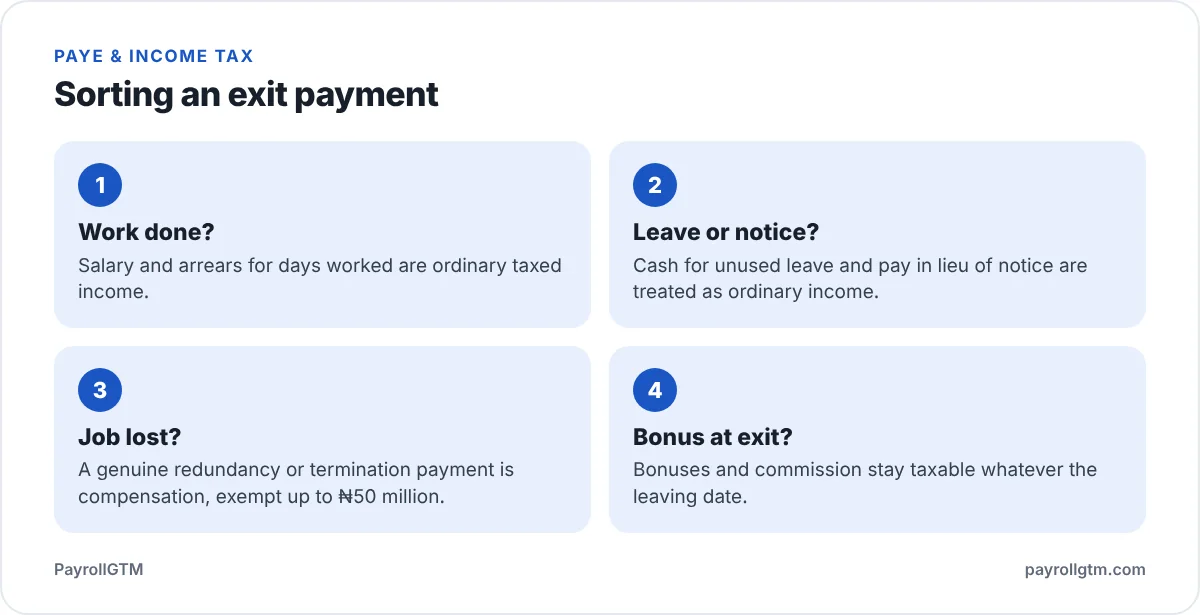
We cannot give you a statutory definition of "compensation for loss of employment" with a section number, because it is not in the sources we rely on. Treat the four questions as a working method and have your state IRS or a tax adviser confirm the classification of any unusual item before you pay it.
Where each item usually lands
This table is our reading of how a typical exit package is likely to be treated. It is a guide to what to ask, not a ruling.
| Item in the settlement | Likely treatment | What to do |
|---|---|---|
| Salary for days worked in the final month | Ordinary income, PAYE applies | Run through the normal final payroll |
| Unused leave paid in cash | Ordinary income | Add to the final payroll and show it on its own line |
| Pay in lieu of notice | Ordinary income | Add to the final payroll |
| Outstanding bonus or commission | Ordinary income | Add to the final payroll |
| Redundancy or severance payment for loss of the job | Compensation for loss of employment, exempt up to ₦50 million | Pay separately and document the reason |
| Ex-gratia "thank you" sum with no link to the termination | Unclear, may be treated as ordinary income | Ask the state IRS before paying |
| Retirement gratuity or pension lump sum | Separate rules, and our sources conflict | See the retirement benefits guide and confirm with PenCom or the state IRS |
What the sorting is worth: an ₦8 million package
Tunde earns ₦400,000 a month, with the whole gross treated as pensionable to keep the example simple. He is made redundant on 30 June. His exit package is six months of salary for the year so far (₦2,400,000), one month's pay in lieu of notice (₦400,000), ₦200,000 for unused leave and an ₦8,000,000 redundancy payment.
- Ordinary income for the year: ₦2,400,000 + ₦400,000 + ₦200,000 = ₦3,000,000.
- Employee pension on the salary only (8% of ₦2,400,000) = ₦192,000. This example does not apply pension to the leave and notice pay, which is a simplification.
- Chargeable income: ₦3,000,000 minus ₦192,000 = ₦2,808,000.
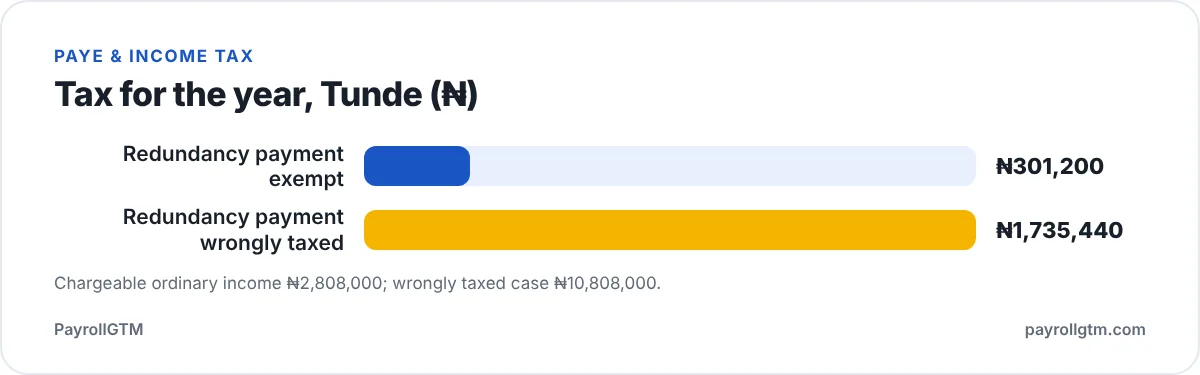
- First ₦800,000 at 0% = ₦0. The remaining ₦2,008,000 at 15% = ₦301,200 of tax for the year.
- The ₦8,000,000 redundancy payment is treated as exempt compensation and stays out of the calculation.
Now the mistake. A payroll officer sees "₦8,000,000" on the settlement and adds it to the year's pay without asking whether it is exempt. Chargeable income becomes ₦10,808,000. The tax is ₦330,000 on the ₦2,200,000 band at 15% plus ₦1,405,440 at 18% on the remaining ₦7,808,000, which makes ₦1,735,440.
That is ₦1,434,240 more than the correct figure. Tunde loses it from a payment that was meant to carry him between jobs, and he has to chase the state IRS for a refund. We worked these figures with the same PAYE method as in our step-by-step PAYE guide.
What if the package is above ₦50 million?
The exemption is described as a threshold of ₦50 million. We have not seen enough in our sources to say whether the amount above ₦50 million is taxed as ordinary income in full, or taxed on the excess only, and the two readings give different answers. For a senior exit near or over the line, get a written view from the state IRS or a tax adviser before the payment is made, not after.
Also remember that any exempt part still has to be reported honestly. An exemption is a treatment of a payment, not a reason to leave it off the records. It belongs in the settlement letter, the final payslip and the year's return of emoluments (see the Form H1 guide).
Labelling does not create the exemption
Redundancy has to be genuine for the label to hold. The Labour Act (s.20) expects the employer to inform the union or workers' representative, apply "last in, first out" subject to skill and family situation, and pay redundancy benefits as agreed or set by a collective agreement. Our guide to how to do a redundancy lawfully covers the process, and notice and severance rules explain what the employee is owed besides the redundancy sum.
If you are the employee receiving the offer
Ask for the package in writing with each component on its own line and a one-line reason. A single lump sum described as "exit benefit" tells you nothing about how it will be taxed, and it leaves you arguing after the money has moved. Check that the leave days and notice period used match your contract and the Labour Act floors (one week for 3 months to under 2 years of service, two weeks for 2 to under 5 years, one month for 5 years or more). Then compare your final payslip with the letter. If the redundancy line shows PAYE, ask HR to explain in writing why it was treated as ordinary pay, and keep the reply, because you will need it if you have to apply for a refund.
A short routine for the finance team
- List every item in the settlement letter on its own line, with the reason for each.
- Mark each as ordinary pay or compensation using the four questions above.
- Run the ordinary pay through the final payroll. A final settlement checklist keeps the leave and notice calculations consistent.
- Pay the compensation separately with a short note of why it is exempt and keep a copy of the board or HR approval.
- Keep the working for the retention period. If any item is doubtful, write to the state IRS first and keep its reply.
Employees can use the same list when a settlement offer arrives. If you are an employee and the compensation line looks too low once PAYE is taken off, ask which items were taxed and why. To see how an ordinary final month looks, try the payroll calculator, and for how bonuses are added to the year, read PAYE on bonuses and leave allowances.