A union can organise your workers, negotiate pay and conditions with you, and represent staff in grievances. It cannot run your business, set your prices or override a lawful instruction on its own say-so. A small employer who gets a letter from a union, or a petition from a staff group, should respond in writing, politely and promptly, keep a record, and take advice before agreeing to anything that changes pay or jobs. The questions below are the ones owners ask us most often.
Do my workers have a right to join a union?
Yes. Nigerian law protects the freedom of workers to form and join associations, and an employer should not dismiss, demote or threaten a worker because they joined or spoke to a union. Do not write "no union membership" into a contract as a condition of employment. A clause like that is unlikely to hold up and it invites exactly the dispute you wanted to avoid.
The reverse also applies. A worker is not normally forced to join. Staff who decline should not be treated differently in pay or promotion.
What is the difference between a union and a staff association?
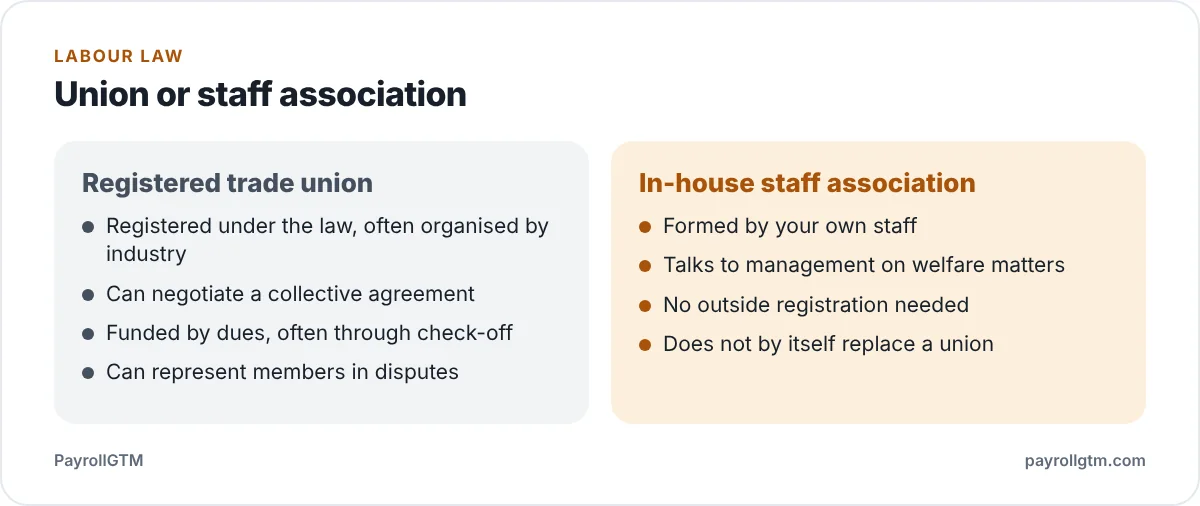
A trade union is registered under the law and, in Nigeria, is usually organised by industry (banking, oil and gas, hospitality, education and so on) rather than by individual company. A staff association or workers' committee is an in-house group with no outside registration, set up to talk to management about welfare, canteen, transport and similar matters.
Staff associations are useful and lawful, but they do not automatically carry the legal weight of a registered union when it comes to collective bargaining. A friendly in-house committee is not a substitute if your sector's union has enrolled your staff. Equally, a union cannot be wished away by forming a committee to compete with it. Treat both seriously.
What happens when a union writes to say it has members in my company?
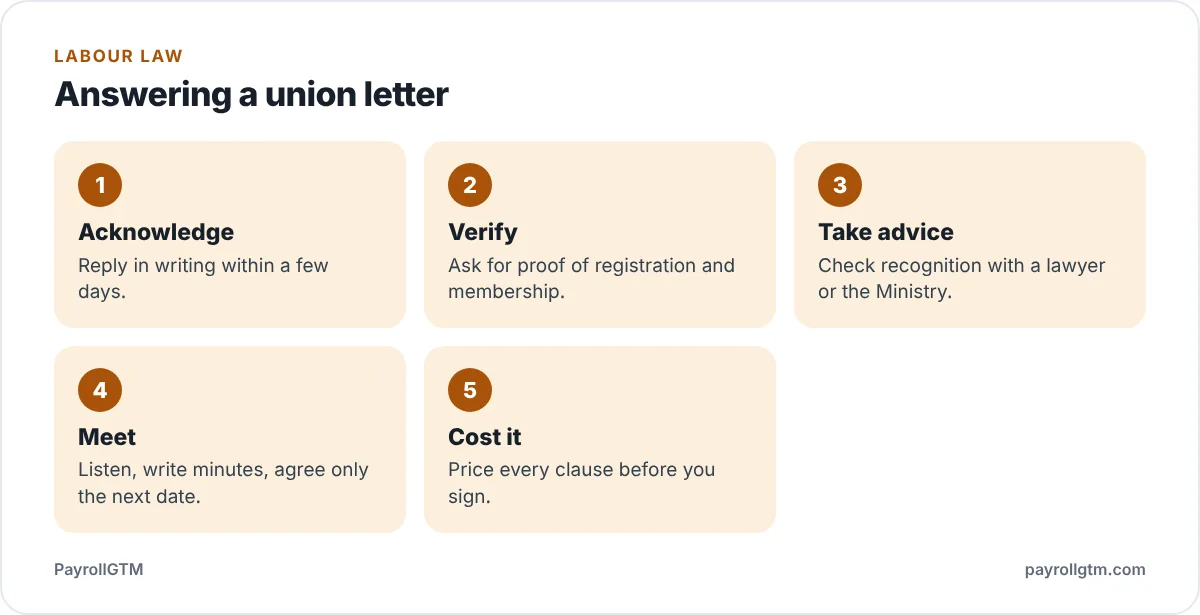
Do not ignore it and do not panic. A typical letter introduces the union, says some of your staff have joined, and asks for a meeting or for check-off arrangements. A sensible sequence:
- Acknowledge the letter in writing within a few days. Silence is the quickest way to turn a request into a dispute.
- Ask the union to confirm its registration and the names of your staff who are members (staff may be reluctant to be named, so a list of numbers is a start).
- Ask a lawyer or the Ministry of Labour whether, in your industry and at your size, the union is entitled to recognition.
- Meet, listen and write minutes. Agree nothing on the day except the date of the next meeting.
For very small employers the practical question is often whether the union will accept a smaller, simpler arrangement. Many will, if management shows good faith.
What is a collective agreement and does it bind me?
A collective agreement is a written agreement between an employer (or an employers' association) and a union covering terms such as pay scales, allowances, working hours, leave and grievance procedure. Once signed, its terms are generally treated as part of workers' conditions of employment, and the National Industrial Court can enforce them. That is why you should never sign one on the day. Take it home, compare it with your contracts and handbook, and cost every clause.
A Lagos printing firm with 22 staff is asked to agree a ₦15,000 monthly transport allowance for all production workers. Fourteen workers qualify. The cost is 14 × ₦15,000 = ₦210,000 a month, or ₦2,520,000 a year. If the allowance counts as transport pay, it is part of pensionable emoluments, so the employer's 10% pension contribution applies on top (₦1,500 per worker a month), and the real cost is higher than the headline. The owner offers ₦10,000 now and a review in 12 months. Putting the numbers on paper like this lets management counter-offer from facts, not feelings.
Remember that the terms you agree also feed through to PAYE, pension and NSITF, because they change gross pay. Use the employer cost calculator before you say yes.
What are check-off dues and can I refuse to deduct them?
Check-off means the employer deducts union dues from the member's salary and pays them over to the union. As we understand the law, an employer deducts only where the worker has authorised it in writing, and the deduction should show on the payslip. Do not deduct "because the union asked". Ask for the signed authorisations, then deduct and remit on a fixed date each month, and keep proof of payment. The wider rules on what you can lawfully deduct are in our guide to wage deductions.
Does the union have to be consulted about redundancy?
Where you are making workers redundant, the Labour Act (s.20) requires the employer to inform the trade union or the workers' representative about the reasons and the extent of the redundancy. It also requires "last in, first out" selection, subject to skill and family responsibility, and payment of redundancy pay as agreed or as the collective agreement provides. If your firm has no union, tell the representatives the workers choose. See how to carry out redundancy lawfully for the process, and the court route if it goes wrong.
Can staff strike, and what can I do?
Strikes are governed by their own conditions in Nigerian law, including dispute procedures that normally come first, and certain essential services are restricted. We will not give you a checklist because it depends on the sector and the stage of the dispute. If a strike notice arrives, call a lawyer the same day, keep paying wages that are due for work done, and keep records of what was said and when. Do not respond by sacking the leaders. Disputes over jobs and pay go to the National Industrial Court of Nigeria, which has exclusive jurisdiction over labour matters.
What should I avoid doing while talks are on?
Owners damage their own position in predictable ways. They transfer a known union activist to a remote branch, they warn staff informally that "those who attend will be remembered", they hold meetings with individual workers to side-step the union, or they promise something verbally and then deny it. Each of these can be framed as victimisation, and a court will look at the timing. If a worker who is also a union officer has a genuine performance or conduct problem, handle it by the book: a written query, a hearing and a proportionate sanction, as set out in the disciplinary procedure guide. Dates and paperwork are your protection.
What records should a small employer keep?
You do not need a union file, only a tidy folder. Keep it simple:
- Letters in and out, with dates of receipt.
- Minutes of every meeting, signed or emailed to both sides.
- Any signed agreement and the costing you did before signing.
- Check-off authorisations, monthly dues schedules and proof of payment.
- Your handbook, contracts and grievance procedure, so you can show staff already had a route to raise issues.
A clear handbook and well-drafted employment contracts do most of the prevention for you. Check the baseline duties in employer obligations under the Labour Act and the rules on leave and sick pay, since leave and hours are where agreements usually start. For official contact points, the Federal Ministry of Labour and Employment is the place to ask about registration and dispute procedure.