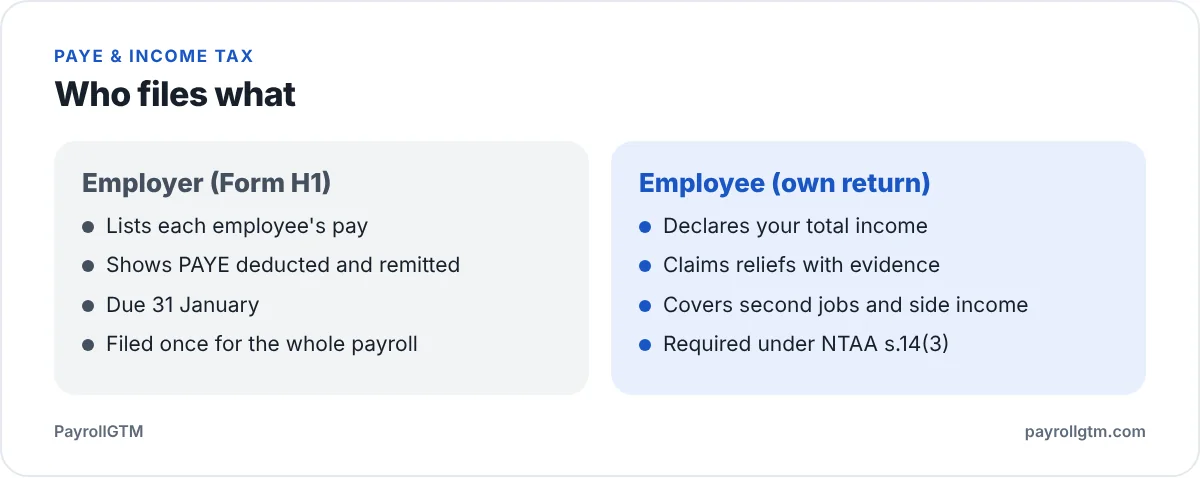
Yes. Under section 14(3) of the Nigeria Tax Administration Act 2025 (NTAA), an employee has to file a personal annual return even when the employer has already filed the Form H1 schedule for the whole workforce. The employer's filing covers what it paid and deducted; yours covers your own tax position. In practice many state tax offices have not yet made this obvious to ordinary salary earners, so treat it as a duty you will be asked about, not one you can ignore.
- Why the employer's return does not replace yours
- The date to work to, and what a late filing can cost
- Documents to collect before you file
- Two employers, side income and rent relief you missed
Does my employer's return mean I have nothing to file?
No. The employer's annual return (Form H1, due 31 January for the year just ended) lists each employee's pay and the PAYE deducted. It is a schedule about the employer's duties. Section 14(3) of the NTAA says the employee must still file their own return.
Think of it as a cross-check. The tax office holds the employer's list on one side and, if you file, your own declaration on the other. When the two agree, nothing happens. When they do not, that is where questions start.
One honest limit. The Act sets the duty, but each state Internal Revenue Service (for example LIRS in Lagos or FCT-IRS in Abuja) runs its own forms, portals and, sometimes, its own filing calendar. We have not seen a single national employee form that every state uses. Before you file, ask your state IRS office or check its current notices for the exact form and the date it expects.
Which tax office do I file with?
Normally the state IRS of the state where you live, because that is the office that collects PAYE on your salary. Some categories sit with the Nigeria Revenue Service (NRS, formerly FIRS), such as members of the armed forces, the police and foreign affairs staff, as well as non-residents. If you are unsure, this guide to which authority collects PAYE sets out the split.
Your employer's payroll records should show which office your PAYE is remitted to. Look at the tax office name on a payslip or ask HR. Filing in the wrong state is a common slip for people who work in Lagos but live in Ogun, or the reverse.
When is the deadline, and what is the penalty?
The annual return date written into the NTAA is 31 January for the previous calendar year. So income from January to December 2026 falls due by 31 January 2027. Check whether your state IRS publishes the same date for individuals.
For late filing, section 96 of the NTAA sets a penalty of ₦100,000 for the first month and ₦50,000 for each month after. Whether a state IRS applies that figure to an individual salary earner, rather than to a company or a self-employed taxpayer, is something to confirm with them. Do not assume it will be waived.
What documents do I need?
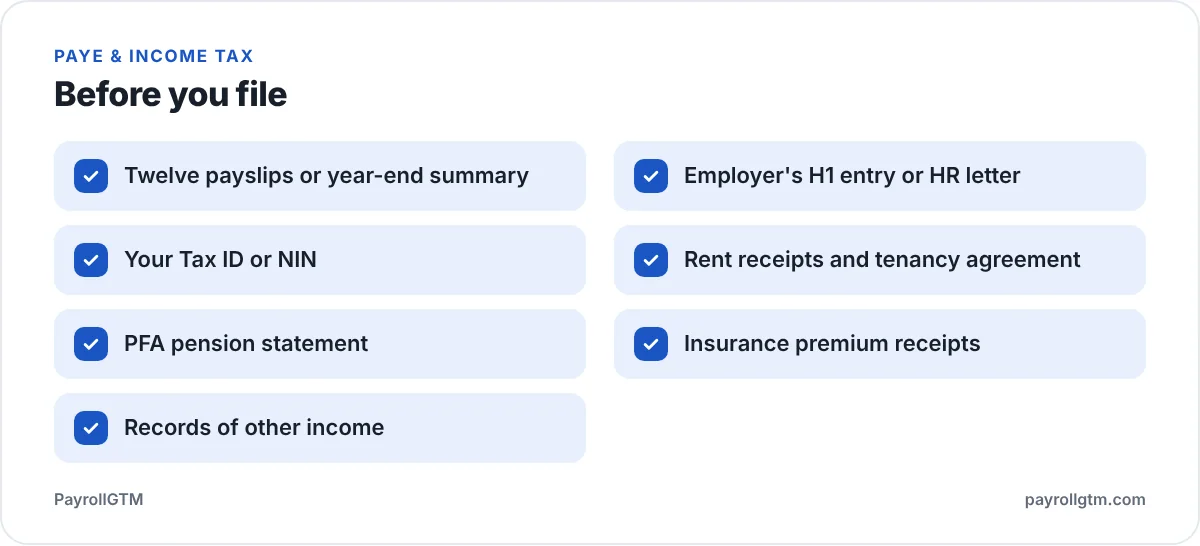
Collect these before you open any portal or visit an office:
- Twelve payslips for the year, or the employer's year-end pay summary.
- A copy of the employer's H1 entry for you, or a letter from HR giving total pay and total PAYE deducted. Ask for it in January; HR is busiest in the first week.
- Your Tax ID. Individuals can reportedly use their NIN as Tax ID; see our note on Tax ID and NIN, and check the current NRS notice for the registration steps.
- Evidence for any relief you want to claim: tenancy agreement and rent receipts, pension contribution statements from your PFA, health insurance and life insurance premium receipts.
- Records of any other income, with dates and amounts.
What if I had two employers during the year?
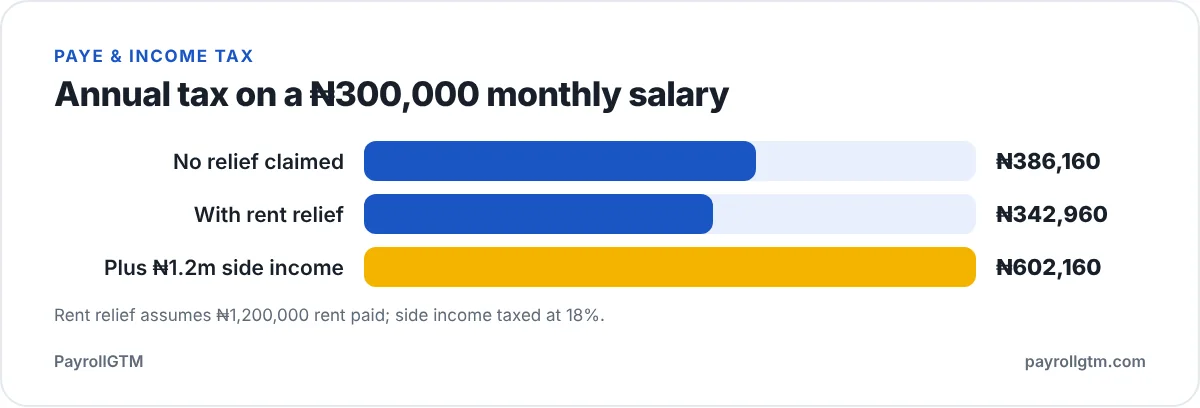
This is the case where the personal return does the most work. Each employer deducts PAYE as if its salary were your only income, so each applies the free first ₦800,000 and the lower bands to its own payroll. Together they can under-deduct.
For the payroll side of this, read how PAYE works for second jobs. For a consultant paid by invoice, see also whether the second engagement is employment or contract work, because that changes who deducts what.
Can I claim relief my employer did not apply?
Often yes, and this is the best reason to file even if you owe nothing. Employers apply rent relief only when you give them evidence in time. Rent relief is 20% of the annual rent you actually paid, capped at ₦500,000.
How a state IRS handles a refund or a credit against next year's tax differs, and we have no confirmed national rule, so ask the office before you assume cash comes back. The better habit is to give your employer the evidence early next year; the step-by-step is in how to claim rent relief. Other claims, such as pension and health insurance, are listed in deductions that reduce PAYE.
What if my employer deducted PAYE but never paid it over?
The unremitted tax is the employer's liability, but you will want proof that it was deducted. Your payslips are that proof. Keep them and tell the state IRS in writing. Employers who default face the penalties described in the PAYE remittance guide. Do not wait for an audit letter to find out.
What if I joined or left part way through the year?
File anyway, and file for the part of the year you worked. If you left in June and started elsewhere in August, you have two employers for the year even though they never overlapped, so you need two year-end summaries. The first employer's final payslip and any exit letter should show pay and PAYE to your last day. Ask for it before you leave, because chasing a former HR team in January is slow. Also keep any month-by-month records for the gap, since the annual figure is compared against the whole twelve months, not only the months you were on a payroll.
If your employer is small and has not registered for PAYE at all, you cannot get an H1 entry. Keep your own bank statements showing salary received and tell the state IRS that no tax was deducted. That is the employer's failing, but the personal duty to declare is still yours. How employers register for PAYE explains what they should have done.
A short routine for every January
- Ask HR for your year-end pay and PAYE summary by the first week.
- Check it against your December payslip year-to-date figures.
- Gather rent, pension and insurance evidence.
- List any income outside your salary.
- Confirm the form and portal with your state IRS, file, and keep the acknowledgement and your working papers in one folder.
If the employer later faces an audit, the same paperwork protects you; see how to prepare for a payroll tax audit.