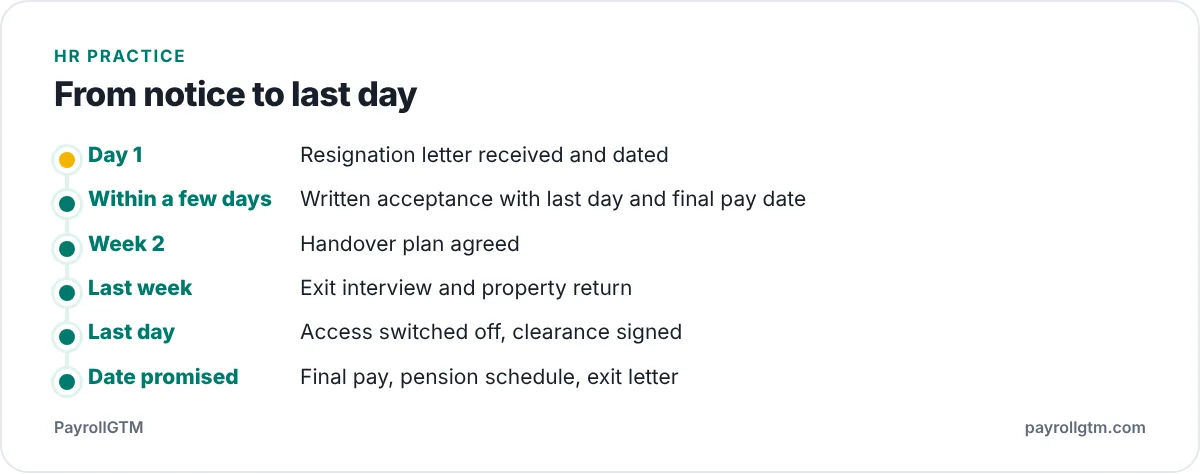
Reply to a resignation in writing within a few working days. The acceptance letter should confirm four things: you received the notice, the agreed last working day, what the employee must hand over, and when final pay and exit papers will be ready. Then hold an exit interview in the last week and use the answers. The copyable letter and the ten questions are below.
Why a written acceptance matters
Verbal "okay, we will miss you" creates arguments later. Was notice served from the 1st or the 15th? Did the employer waive the balance of notice, or expect payment for it? Does the employee still owe a laptop? A one-page reply with dates removes all of these. It also protects the employee, because it confirms the last day on which salary, pension and group cover run.
Before you write, check the contract and the handbook for the notice period, any pay in lieu clause and what the exit process requires. The Labour Act minimums are 1 day, 1 week, 2 weeks or 1 month depending on length of service, but the contract usually sets a longer period for senior staff. The employee's side of the process is in how to resign in Nigeria, and the duties on your side are in the Labour Act employer obligations.
Acceptance letter you can copy
Replace the square brackets. Send it by email and keep a signed copy on the personnel file.
[Company letterhead]
[Date][Employee name]
[Job title and department]Dear [First name],
Acceptance of resignation
We acknowledge your letter of [date] resigning from your position as [job title]. We accept your resignation with regret.
In line with clause [number] of your contract of employment, your last working day will be [date], after which your employment ends. [If notice is shortened or paid in lieu: By agreement, the unserved part of your notice period will be [waived / paid for by you / paid by the company], as set out in the attached note.]
Before your last day, please:
- Complete a handover of your duties and files to [name] by [date].
- Return all company property listed in the attached form, including [laptop, ID card, keys, SIM].
- Meet HR for an exit interview and clearance on [date].
Your final salary for the days worked up to [last day], together with any other sums due under your contract, will be paid by [date], less any amounts you have agreed in writing to repay. HR will give you your pension contribution schedule, your final payslip and an employment confirmation letter once clearance is complete. Your confidentiality obligations in clause [number] continue after you leave.
Thank you for your service. We wish you well.
Yours sincerely,
[Name]
[Title]
Two edits matter most. Put an actual date for final pay, not "after clearance". And only mention deductions that the employee has already agreed to in writing. Deducting unilaterally is a common cause of disputes, see the rules on lawful wage deductions.
Confirm these four points in every acceptance
- Last day. Count it from the day you received the letter. If the employee wants to leave earlier, agree it in writing. If you are releasing them early, say the company is paying in lieu or waiving the balance, and say which.
- Handover. Name the person receiving it. "Handover to the team" tends to mean handover to nobody.
- Property and access. List the items and switch off system access on the last day, not before the handover is done.
- Money. Final salary prorated to the last day (see how part-month pay is worked out), any leave or bonus entitlement under the contract, and the pension that must still be remitted on that last salary.
Should you make a counter-offer?
Do it only if you would have promoted or raised the person anyway. A counter-offer made in a panic usually buys three to six months, and it tells the rest of the team that resigning is how you get a raise. Ask one question first: what exactly would have to change for you to stay? If the answer is pay and you cannot afford it, accept gracefully. If the answer is a manager or workload, that is information you need whether or not the person stays.
If you do counter, put the new terms in writing and treat it as a variation of the contract. A revised offer should look like a proper letter, see the job offer letter template.
Awkward cases
The employee gives less notice than the contract requires. You can accept the shorter period, waive the balance, or hold them to the contract and ask for pay in lieu. Whichever you choose, say it in the acceptance letter. Recovering money from final pay needs the employee's written agreement or a contract clause that allows it.
The employee wants to withdraw the resignation. Once you have accepted it in writing, withdrawal needs your agreement. You can say yes, but confirm it in writing and file it with the original letter.
The employee stops coming to work without notice. Do not treat that as a resignation. Write to the person at their last known address and email, ask them to report or explain by a stated date, and follow your disciplinary process before treating the job as ended.
The employee is on probation or fixed-term. The contract governs. Some shorten notice during probation, and fixed-term contracts may have no early exit right at all, so read the clause before you promise a date.
Ten exit interview questions
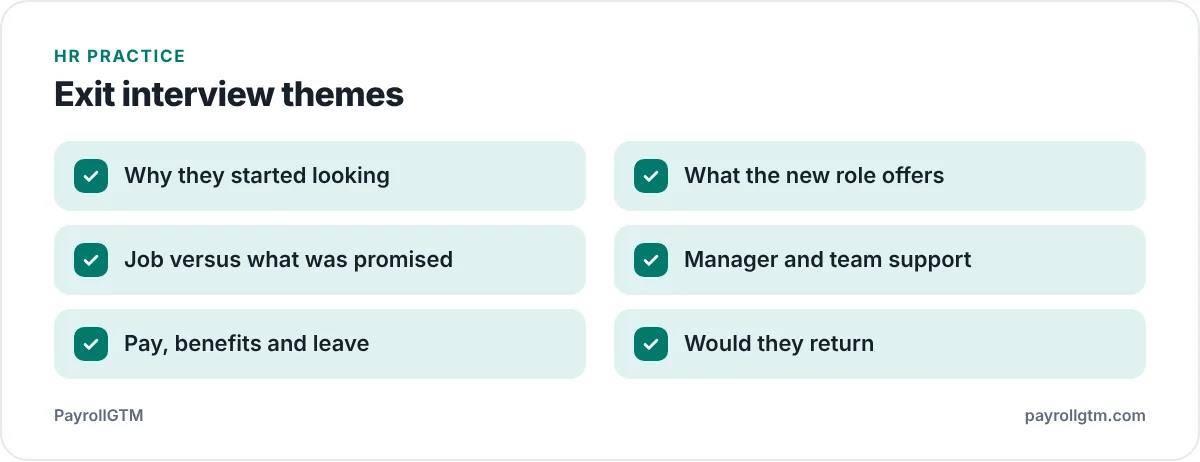
Hold it in the last week, with someone other than the direct manager, in private, for about 30 minutes. Say the notes are for improving the business and will not be quoted to the next employer. Ask these, grouped by topic:
The decision to leave
- What made you start looking for another job?
- What did the new role offer that we did not?
- Was there a point at which you could have been persuaded to stay?
The job and the manager
- Did the job turn out to be what you were told at interview?
- Did you have what you needed to do it: tools, training, clear targets?
- How would you describe the support from your manager?
Pay, benefits and conditions
- How did your pay and benefits compare with what you could get elsewhere?
- Were leave, hours and working arrangements fair? Compare the answers with your own leave policy.
The business
- What should we stop doing, and what should we keep?
- Would you recommend us as an employer, and would you consider returning?
What to do with the answers
Write a two-line summary per exit and file it separately from the employee's personnel record. After 5 or 6 exits, tally the reasons. If three people in a year left over one manager, or over transport costs, or because no appraisal ever happened, that is your actual retention problem. Pair it with a proper appraisal process and a code of conduct that staff recognise.
Exit notes are personal data, so keep them in a restricted folder and delete them on your retention schedule. The data protection rules for employee records are in our NDPA payroll guide. For the money and paperwork on the last day, use the offboarding and final settlement checklist. If a departing employee raises a complaint about pay or treatment in the interview, do not argue it out in the room. Record it, thank them, and follow it up in writing afterwards.